
1. A Human Story
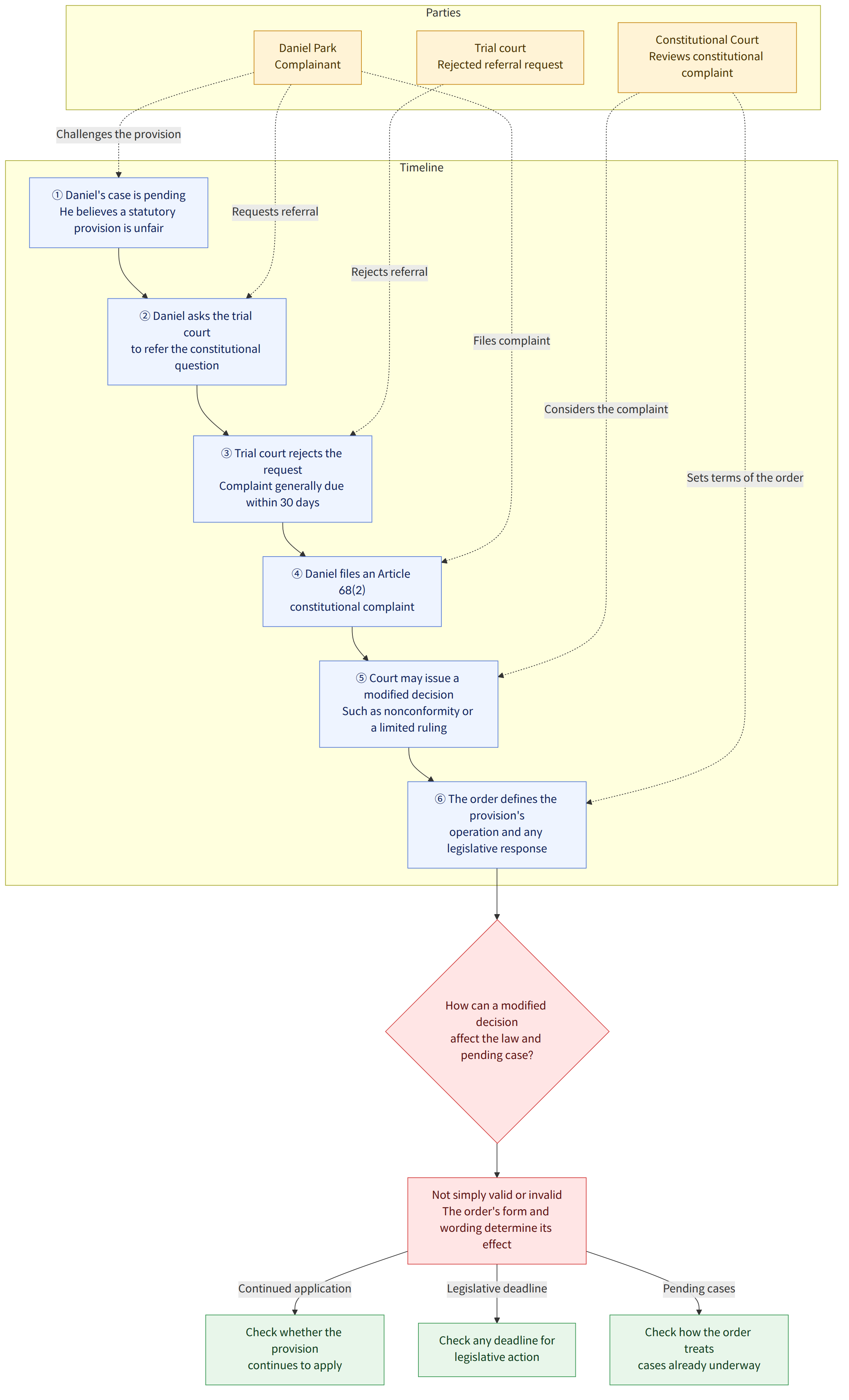
When Daniel Park opened the letter from the trial court, he read the same sentence twice: the court had rejected his request to refer a statutory provision to the Constitutional Court. Daniel believed that provision had treated people in his position unfairly. His case was still pending, but the ordinary judge had decided not to send the constitutional question upstairs.
Daniel did not give up. He filed a constitutional complaint under Article 68(2) of the Constitutional Court Act. At his first meeting with counsel, he asked the question that had been troubling him: “Will the Constitutional Court simply say the law is valid or invalid?” The answer was no. Korean constitutional adjudication has room for decisions between those two poles—and those intermediate rulings can matter greatly to people waiting for the law to change.
2. The Legal Question
What is a modified decision in a constitutional complaint under Article 68(2), and how can it affect the law Daniel is challenging and his pending case?
3. What Korean Law Says
Article 68(2) provides a route to the Constitutional Court for someone involved in a court case where the ordinary court has rejected a request to refer the constitutionality of a statute to the Constitutional Court. The constitutional complaint is not a general appeal about whether a law seems unfair: it arises from a particular constitutional issue in pending litigation. The filing deadline is generally 30 days from the ordinary court’s rejection.
A modified decision is a decision on the merits that is neither a straightforward ruling that a statute is constitutional nor a straightforward ruling that it is unconstitutional. The Constitutional Court has recognized these intermediate forms as useful in protecting the Constitution while avoiding unnecessary disruption to the legal system.
“Modified decision” is a general label for a merits decision that takes a form other than an ordinary constitutionality or unconstitutionality ruling. The precise legal effect depends on the kind of decision and the terms of the Court’s order.
Common examples include:
- Nonconformity decision: The Court finds that a provision conflicts with the Constitution but may allow it to remain temporarily effective, often to give the National Assembly time to revise it and avoid a legal vacuum. The order determines whether and how the provision continues to operate.
- Limited-constitutionality decision: The Court concludes that a provision is constitutional only when understood in a specified, constitutionally acceptable way. The ruling narrows the meaning that may properly be given to the text.
- Limited-unconstitutionality decision: The Court identifies a particular interpretation or scope of application as unconstitutional, rather than invalidating every possible operation of the provision.
- Legislative-exhortation decision: The Court indicates that legislative action is needed. Such an exhortation should not be confused with an automatic repeal: its legal force depends on the accompanying disposition and the wording of the order.
The Court has reasoned that an authority to invalidate an entire provision can include the narrower authority to find only part of it defective. Intermediate orders can preserve constitutionally acceptable operation, respect the legislature’s role, and help maintain a coherent legal system.
The practical question is therefore not just which label appears in the decision. A reader must also ask what the Court’s order says about the provision’s continued application, any deadline for legislative action, and the treatment of cases already underway.
4. How Korean Courts Approach This
The Constitutional Court treats these decisions as a way to address constitutional defects with precision. If every constitutional problem required the immediate, complete removal of a statute, the result could be to erase valid parts of the law, create a gap in essential rules, or displace choices that properly belong to elected lawmakers. A qualified decision can sometimes avoid those consequences while making clear that the existing legal arrangement cannot remain as it is.
The Court’s general approach reflects two principles at once: the Constitution is the supreme law, and legislation is ordinarily made by the National Assembly. A remedy should protect constitutional rights while respecting the legislature’s proper lawmaking role where that can be done consistently with the Constitution.
These outcomes are not interchangeable. A nonconformity ruling may leave a provision operating for a limited period, while a limited ruling defines which interpretation or application is permissible. A legislative exhortation, standing alone, should not be assumed to have the same effect as an order invalidating a statute. The operative language—and any instructions about timing or continued effect—matters.
5. Applying the Law to the Case
For Daniel, the analysis unfolds in several steps:
- The procedural door is open only because his case is pending and the referral request was rejected. Article 68(2) gives him a route to challenge the constitutionality of the relevant statute in that setting. He must also comply with the filing deadline and other procedural requirements.
- The Court must examine the challenged rule, not merely Daniel’s sense that it is unfair. It considers the constitutional objection and the provision’s purpose, wording, and operation. The facts of Daniel’s case help explain how the rule affects him, but they do not by themselves decide the constitutional question.
- The available remedy need not be all or nothing. Suppose, in this fictional account, the Court concludes that a statutory eligibility rule has a legitimate purpose and can operate constitutionally in many situations, but its broad wording also excludes a group in a way the Constitution does not permit. Striking out the entire rule might remove valid protections as well as the defective restriction. A nonconformity decision could identify the defect while giving lawmakers an opportunity to enact a constitutional replacement.
- The order determines what happens next. If the Court allows the provision to remain temporarily effective, Daniel cannot assume that the rule has vanished on the day of judgment. He must check whether the order sets a deadline, limits application of the provision, or specifies what should happen to pending cases. Any later amendment may also affect his underlying claim.
The Constitutional Court’s decision in this illustrative story is a nonconformity decision. It finds a constitutional problem with the rule’s overbroad operation, but does not erase every part of the provision immediately. The legislature is asked to correct the defect within the period and on the terms stated in the order. That outcome answers Daniel’s constitutional challenge, but it does not automatically decide whether he wins the separate case that brought him to court.
6. Conclusion: What Happened, and What Should You Do?
Daniel’s complaint did not end with a simple “valid” or “invalid.” The Court found the rule constitutionally defective in part and issued a nonconformity decision, leaving the provision’s short-term operation to the terms of its order while the legislature addressed the problem. Daniel’s pending case continued; its outcome depended on the order, any legislative amendment, and how the revised or continuing rule applied to his facts.
For readers facing a similar situation:
- Track the deadline and procedure. If a court rejects a request to refer a constitutional question, seek advice promptly; an Article 68(2) complaint is generally subject to a 30-day filing period.
- Read the operative part of the decision carefully. Do not assume that a nonconformity ruling immediately voids a law, or that a limited ruling covers every situation. Check what the Court says about timing and application.
- Keep your underlying case moving. Preserve evidence, meet court deadlines, and ask counsel how the constitutional decision or any new legislation affects your individual claim.