1. A New Life and an Unexpected Hurdle
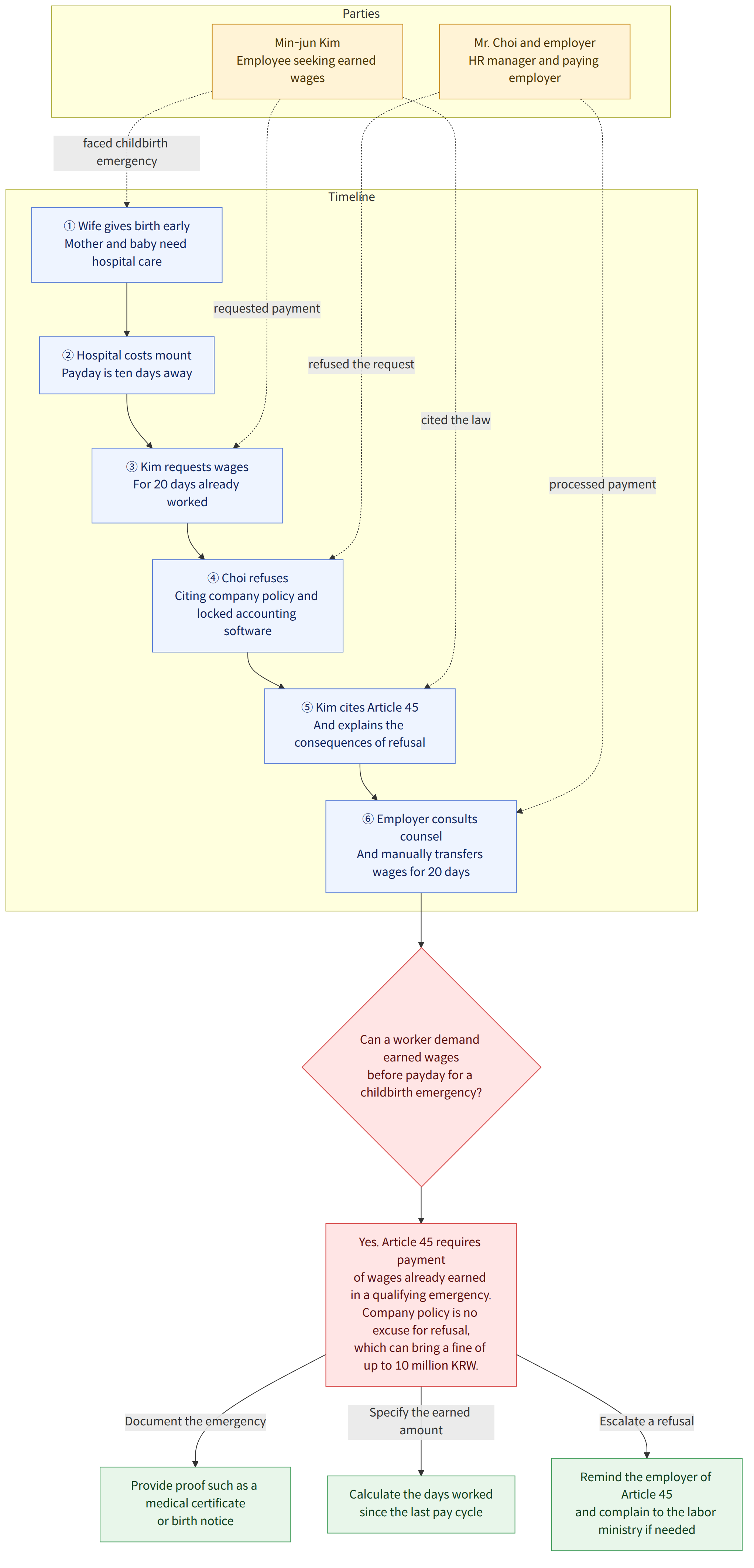
Min-jun Kim, a dedicated employee at a mid-sized IT firm, recently experienced the most frantic week of his life. His wife, Ji-soo, went into labor two weeks earlier than expected. While their beautiful baby was born healthy, complications from the premature birth required both mother and child to stay in the neonatal intensive care unit for several days.
As the hospital bills mounted into thousands of dollars, Min-jun faced a stark reality: his payday was still ten days away. Most of his savings had recently been used for a housing loan deposit. Desperate, he approached his HR manager, Mr. Choi, asking for a favor. "Sir, could the company pay me for the 20 days I've already worked this month? I need to settle the hospital deposit immediately."
Mr. Choi looked sympathetic but shook his head. "Min-jun, I understand, but our policy doesn't allow mid-month payments. The accounting software is locked until the 25th. There is no precedent for this."
Min-jun sat in the hospital lobby, feeling helpless. Is a worker's only option in an emergency to take out a high-interest loan?
2. The Legal Question: Can You Demand Your Salary Early?
The core issue in this scenario is whether a worker has a legally enforceable right to demand wages for work already performed before the scheduled payday when faced with an emergency like childbirth or a medical crisis.
3. What Korean Law Says: Emergency Payments
South Korea's Labor Standards Act (LSA) provides a specific safety net for these exact situations. Article 45 mandates the "Emergency Payment" of wages to protect the livelihood of workers in distress.
Labor Standards Act Article 45 (Emergency Payment)An employer shall pay wages for work already performed even prior to the payday, if a worker requests the employer to pay wages in order to cover expenses for childbirth, diseases, disasters, or other emergencies prescribed by Presidential Decree.
According to the Enforcement Decree (Article 25), "emergencies" include:
- Childbirth, illness, or disaster involving the worker or their dependents.
- Marriage or death of the worker or their dependents.
- Instances where the worker must return home for one week or more due to unavoidable reasons.
It is crucial to note that this is not a request for a "salary advance" (borrowing money against future work). Rather, it is a claim for the payment of wages for labor that has already been provided but not yet paid due to the monthly cycle.
4. How Korean Courts and Authorities Approach This
Korean labor authorities and courts treat this provision as a mandatory obligation of the employer. Internal company policies, lack of precedent, or "accounting system limitations" are not valid excuses for non-compliance.
If an employer refuses a legitimate request for emergency payment, they are in violation of the LSA and can be punished by a fine of up to 10 million KRW. The law prioritizes the worker's immediate survival and family welfare over corporate administrative convenience.
5. Applying the Law to Min-jun's Case
Applying these principles to Min-jun's situation, it is clear that his request is legally protected.
First, his wife’s childbirth is explicitly listed as a valid emergency under the law. Second, he is only asking for the 20 days of work he has already completed.
When Mr. Choi claimed that company policy prohibits such payments, he was essentially admitting to a policy that violates the Labor Standards Act. Min-jun has the right to inform the company that under Article 45, they are legally obligated to calculate his pro-rated salary for the 20 days and pay it immediately to cover the hospital costs.
6. Conclusion: What Happened, and What Should You Do?
Equipped with the knowledge of Article 45, Min-jun returned to the HR office the next morning. He politely cited the law and explained that the company could face a fine for refusal. Realizing the legal implications, Mr. Choi consulted the company's legal counsel and quickly processed a manual transfer for the 20 days of work. Min-jun was able to pay the hospital and bring his healthy family home.
If you find yourself in a similar crisis, here are three practical tips:
- Provide Documentation: When making the request, bring proof of the emergency, such as a medical certificate, birth notice, or funeral notice, to leave no room for dispute regarding the "emergency" status.
- Be Specific About the Amount: Calculate exactly how many days you have worked since the last pay cycle. The company is only obligated to pay for those specific days.
- Escalate if Necessary: If your employer flatly refuses, remind them of Article 45. If they still persist, you can file a complaint with the Ministry of Employment and Labor.
In Korea, your earned wages are your most basic right, especially when life throws an unexpected curveball. Don't be afraid to exercise that right.
This column is provided for informational purposes only and does not constitute legal advice. For specific legal issues, please consult with a qualified professional.