
1. A Human Story
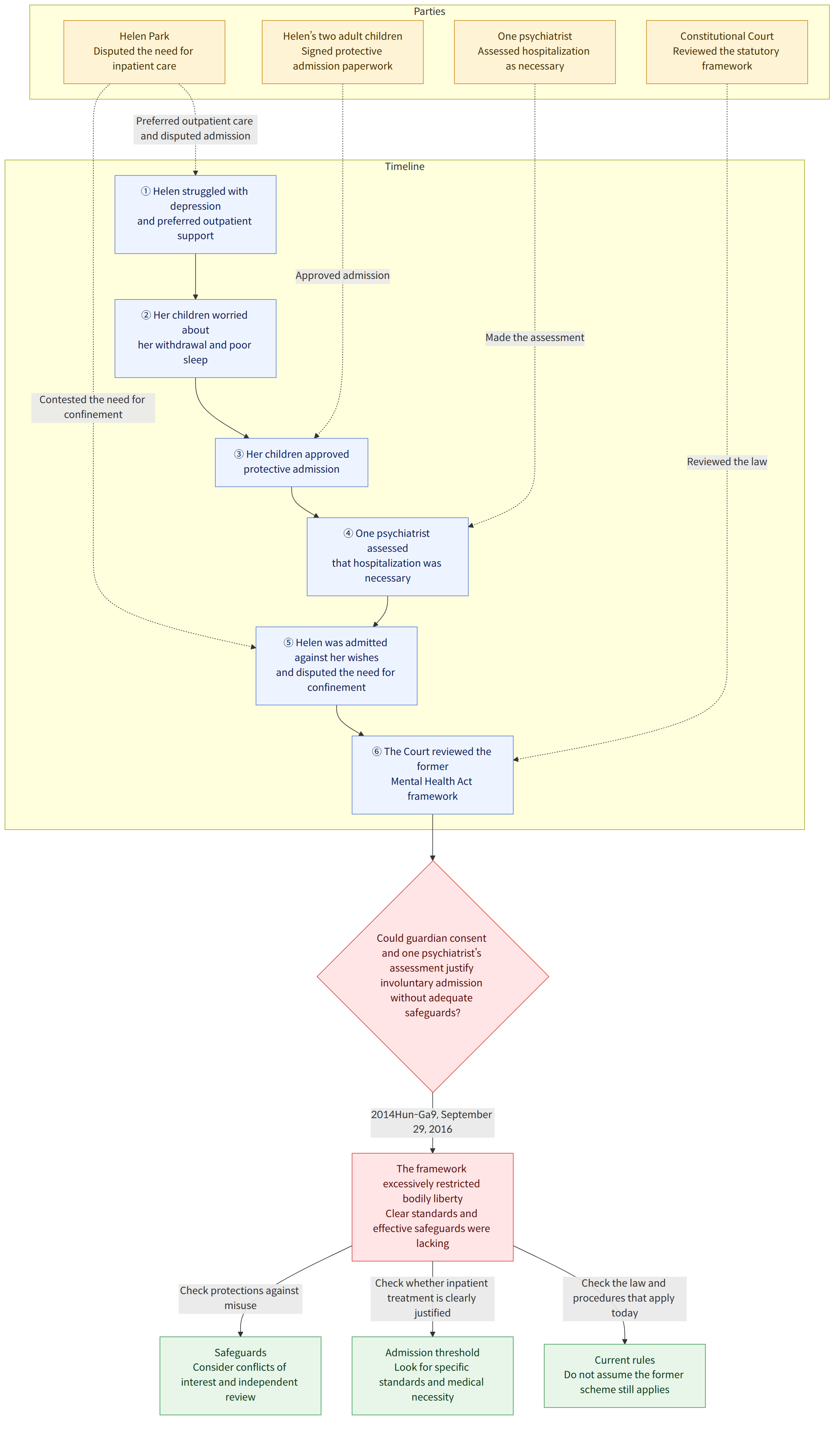
When Helen Park began struggling with depression during menopause, her two adult children worried. They saw her withdrawing from family dinners and sleeping poorly. Helen, however, believed she needed outpatient support, not a psychiatric hospital. She did not think she was a danger to herself or anyone else, and no one had shown her that inpatient treatment was medically necessary.
Then her children signed the paperwork for protective admission, and one psychiatrist assessed her as needing to be hospitalized. Helen was taken to a psychiatric institution against her wishes. The prospect of being held there for months felt less like treatment than a loss of control over her own life. Her question was not whether her family meant well. It was whether their agreement, combined with one doctor’s decision, could constitutionally take away her freedom.
2. The Legal Question
Could Korean law permit a person to be involuntarily admitted to a psychiatric institution on the consent of two guardians and the assessment of one psychiatrist, even when the person disputed the need for hospitalization and the statutory safeguards did not adequately prevent mistaken or abusive confinement?
3. What Korean Law Says
The issue arose under provisions of Korea’s former Mental Health Act governing protective admission: a form of involuntary hospitalization initiated through guardians and a psychiatric assessment. The Constitutional Court examined that system in its decision of September 29, 2016, case 2014Hun-Ga9.
The starting point is that admission to a hospital against a person’s will is not an ordinary family or medical decision. It restricts bodily liberty in a serious way. The Constitution permits restrictions on fundamental rights only within limits, including the principle of proportionality: a measure must serve a legitimate purpose, be suitably designed to achieve it, use no more restrictive means than necessary, and maintain a fair balance between public or medical needs and the individual’s rights.
The Constitutional Court reasoned that protective admission can restrict bodily liberty at a level comparable to physical detention. It must therefore be designed to minimize that restriction, prevent misuse, and avoid becoming a means of simply isolating people with mental illness from society.
The Court identified several weaknesses in the challenged statutory framework:
- Unclear admission threshold: The law did not provide sufficiently specific standards for deciding what condition required inpatient treatment or care.
- Risk of conflict of interest: It relied on consent from two guardians without adequately preventing conflicts between the guardians and the person to be admitted.
- Too much authority in one assessment: One psychiatrist had decisive power to determine whether admission was necessary, leaving room for arbitrary judgment or misuse.
- Potential for collusion: The risk of abuse increased if guardians and a psychiatrist acted together, or if a psychiatrist knowingly tolerated or assisted an improper admission.
- Long confinement and repeated extensions: The initial period could be as long as six months, with further extensions possible. The Court warned that this could allow hospitalization to serve isolation rather than treatment.
- Insufficient procedural protection: The system did not provide adequate safeguards for the person’s rights during the admission process.
The Court concluded that, taken together, these flaws made the restriction excessive and violated the constitutional guarantee of bodily liberty.
The ruling concerned the statutory scheme before the Court. It should not be read to mean that every involuntary psychiatric admission is unconstitutional, or that the same rules necessarily govern today. Mental-health legislation and admission procedures can change; anyone facing a current admission should check the law and procedures applicable at that time.
4. How Korean Courts Approach This
Korean constitutional review asks not only whether a restriction pursues a legitimate goal—such as providing necessary treatment or protecting a person in an acute crisis—but also whether the law limits liberty only as much as necessary. The more severe and prolonged the restriction, the more important clear standards and meaningful safeguards become.
In this case, the Court did not treat family consent as a substitute for independent protection of the patient’s rights. Nor did it accept a single professional judgment as an adequate safeguard when the law offered no sufficiently precise criteria or effective checks. The concern was structural: even well-intentioned relatives and doctors were operating within a system that could permit serious errors or misuse.
A protective purpose does not by itself make confinement proportionate. The legal framework must also guard against unnecessary detention and give the person affected a meaningful way to protect their rights.
That reasoning does not mean courts assume every family or psychiatrist acts improperly. It means that a law authorizing involuntary confinement must be robust enough to prevent foreseeable conflicts, mistakes, and abuse.
5. Applying the Law to the Case
Helen’s situation can be assessed step by step.
- The restriction was substantial. She was not simply asked to attend treatment; she was admitted to an institution against her will. The Court treated that kind of confinement as a grave interference with bodily liberty.
- The decision-making threshold was not sufficiently clear. Helen said she had menopausal depression but did not need inpatient treatment and posed no risk. The constitutional problem was that the challenged law did not set out a sufficiently specific standard for distinguishing a condition requiring admission from one that could be treated in a less restrictive way.
- The safeguards did not adequately test the family’s decision. Helen’s children supplied the required consent, but their agreement alone could not resolve whether admission was necessary or whether their interests aligned with hers. The statutory arrangement did not adequately address that possible conflict.
- One psychiatrist’s judgment carried too much weight. The psychiatrist’s assessment supported admission, but the challenged scheme placed the necessity decision in the hands of a single specialist without sufficient independent checks. That left room for arbitrary judgment, even if no bad faith could be shown in Helen’s individual case.
- The duration and lack of review protections deepened the problem. A possible initial stay of six months, renewable under the scheme, created a risk that confinement could continue without adequate safeguards to ensure it remained necessary for treatment. The absence of sufficient procedures to protect the patient’s rights compounded that risk.
The constitutional defect, then, was not simply that Helen disagreed with her children or with the psychiatrist. It was that the law allowed a profound loss of liberty through a process the Court found insufficiently precise and insufficiently protected against error and abuse.
6. Conclusion: What Happened, and What Should You Do?
Under the framework challenged in 2014Hun-Ga9, Helen’s involuntary admission rested on the very combination the Constitutional Court found constitutionally defective: two guardians’ consent, one psychiatrist’s assessment, unclear admission standards, and inadequate safeguards against prolonged or misused confinement. The Court held that this framework violated bodily liberty. Its decision was about the constitutionality of the law, not an automatic order releasing every person admitted under it or a finding that every individual admission was wrongful.
For people facing a similar situation today, the essential question is what current law requires and what review procedures are available in the specific case. Practical steps include:
- Ask for the legal and medical basis in writing. Request the reasons for admission, the criteria relied on, and information about how the decision can be reviewed or challenged.
- Keep a clear record. Save admission documents, medical records, messages, and a timeline of events; note who made each decision and when.
- Seek independent help promptly. Contact a lawyer or qualified patient-rights advocate and, where possible, obtain an independent medical assessment. If there is an immediate risk of harm, use emergency services rather than relying on a general account of past law.