1. A Human Story
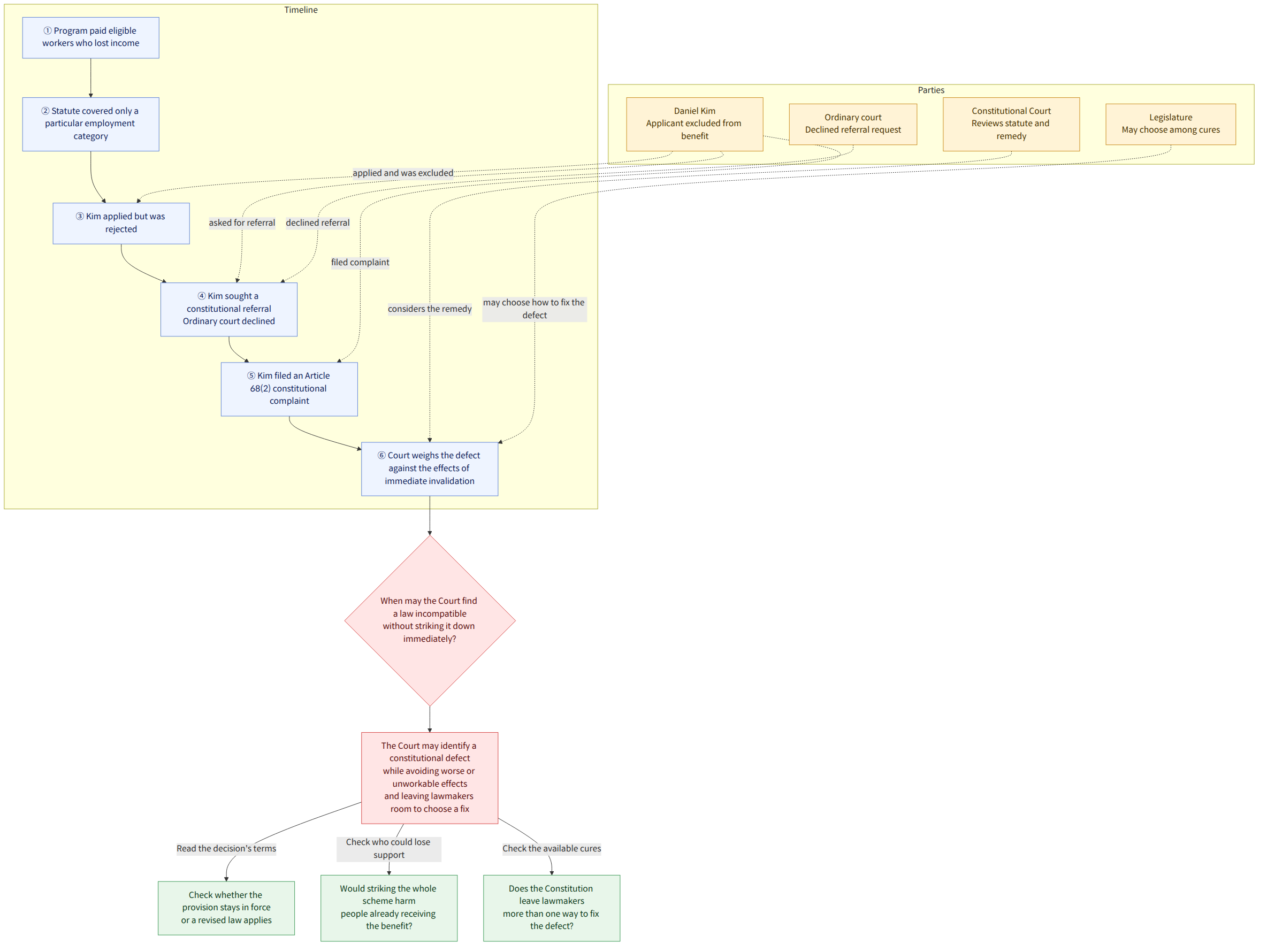
When Daniel Kim opened the letter, he read the same sentence twice: his application for a public income-support benefit had been rejected. The program paid eligible workers who had lost income, but the statute covered only people in a particular employment category. Daniel did the same kind of work as those who qualified, yet his contract placed him outside the favored group.
He challenged the exclusion in the court handling his underlying case and asked it to seek constitutional review of the law. The court declined. Daniel then filed a constitutional complaint under Article 68(2) of the Constitutional Court Act. He wanted the exclusion removed—but he also worried that if the entire provision were simply erased, the people already receiving support might lose it too.
That is the dilemma behind a constitutional nonconformity decision: a law can violate the Constitution, yet immediate annulment may not be the fairest or safest remedy.
2. The Legal Question
When may Korea’s Constitutional Court declare a statute incompatible with the Constitution rather than strike it down immediately?
The answer depends not only on whether the law is unconstitutional, but also on whether immediate invalidation would produce a worse or unworkable result—and whether the Constitution leaves lawmakers room to choose how to fix the problem.
3. What Korean Law Says
A complaint under Article 68(2) is a route for a litigant to ask the Constitutional Court to review a statute after the ordinary court has refused the litigant’s request to refer the constitutional question. The constitutional complaint concerns the law governing the litigant’s case.
A finding of constitutional nonconformity means that the Court has identified a constitutional defect but does not treat immediate, unconditional invalidation as the right response. Depending on the circumstances, the Court may leave the provision in force temporarily or direct that a revised law govern. The specific effect depends on the terms of the decision.
Core principle: A nonconformity ruling can recognize that a law violates the Constitution while avoiding the harmful consequences that could follow from striking it down at once.
The Court may use this remedy in several recurring situations:
- To correct unequal access to a benefit without taking the benefit away from everyone. A statute may grant social assistance or another lawful benefit to one group while arbitrarily excluding another. If the Court simply invalidates the whole scheme, those already receiving the benefit could lose it. Where the benefit itself is constitutionally permissible, the Court may instead identify the unequal exclusion as unconstitutional and leave lawmakers to address it.
- To respect choices that belong to the legislature. A law may contain both constitutional and unconstitutional elements, but their boundary may be difficult for the Court to draw. If lawmakers have several legitimate ways to remove the defect, the Court may leave that policy choice to them rather than selecting one solution itself.
- To prevent a damaging legal vacuum. Immediate invalidation may leave no rules in place. If temporarily applying the defective provision is less harmful than having no legal framework at all, the Court may preserve the provision for a transitional period to protect legal certainty and avoid disorder.
- Where the challenged law has already been replaced by a constitutional amendment. If the provision under review was unconstitutional but lawmakers have already revised it in a constitutionally acceptable way by the time the Court decides the case, the Court may frame its ruling so that the amended law can apply.
Important distinction: A nonconformity ruling is not a declaration that the challenged law is fully constitutional. It identifies a constitutional problem while tailoring the remedy to the consequences of immediate invalidation and the role of the legislature.
4. How Korean Courts Approach This
The Constitutional Court’s task is not simply to label a law valid or invalid. It must also consider what follows from its decision. The Court generally weighs constitutional compliance against legal certainty, the practical effects on affected people, and the institutional roles of the judiciary and legislature.
Where the Constitution permits more than one way to cure a defect, the Court may avoid choosing policy on the legislature’s behalf. But respect for legislative discretion does not excuse leaving a constitutional violation unaddressed.
In equality cases, the Court may ask whether the distinction between groups has a reasonable basis and whether invalidating the whole benefit scheme would punish people who are not responsible for the unequal exclusion. In cases involving a possible legal vacuum, it may compare the harm of temporarily applying the defective rule with the harm of having no rule at all.
A nonconformity decision is therefore a tailored remedy, not an automatic result whenever a law is found unconstitutional. The Court must explain why immediate invalidation, on the facts and legal structure before it, would be an unsuitable response.
5. Applying the Law to Daniel’s Case
Daniel’s claim is strongest if the following points are established:
- The law treats comparable people differently. Daniel performs work comparable to that of people who qualify for the benefit, but the statute excludes him because of his employment classification.
- The distinction lacks a reasonable justification. If the classification has no sound connection to the purpose of the support program, the exclusion may violate the constitutional guarantee of equality. The precise assessment would depend on the law’s purpose and the evidence in Daniel’s case.
- The benefit itself is constitutionally permissible. If the program’s support for the included group is lawful, invalidating the entire provision could take assistance away from eligible recipients. That would not necessarily cure the inequality in a sensible way.
- Lawmakers have choices about the remedy. The legislature might extend eligibility, revise the categories, or adopt another constitutional design. If more than one solution is available, the Court may leave that policy decision to elected lawmakers.
On those assumed facts, the case fits the first ground for a nonconformity ruling and may also involve the second. The Court could identify the exclusion as unconstitutional without immediately nullifying the entire support scheme. If an abrupt loss of the law’s framework would cause serious disruption, avoiding a legal vacuum could provide an additional reason for a transitional remedy.
The fourth ground would matter only if the legislature had already enacted a constitutional replacement before the Court issued its decision. It would not, by itself, prove that the old exclusion was lawful; it would affect how the Court handles the change in law.
6. Conclusion: What Happened, and What Should You Do?
In Daniel’s fictional case, the Court finds that excluding people in his position has no reasonable justification, while the support available to the included group is itself constitutionally acceptable. It therefore declares the exclusion incompatible with the Constitution rather than immediately wiping out the entire benefit scheme. Lawmakers then revise the eligibility rules to address the unequal treatment, and Daniel’s case is considered under the resulting legal framework.
For readers facing a similar issue:
- Document the comparison: Gather evidence showing how the law treats you differently from people in a comparable position, and why the distinction does not fit the program’s purpose.
- Explain the remedy, not just the defect: Consider whether striking down the whole provision would remove benefits, leave no rules in place, or require a policy choice that belongs to lawmakers.
- Get advice promptly: Article 68(2) complaints arise within a court case and involve procedural requirements. Ask a Korean lawyer to review the underlying litigation, the refusal to refer the question, and the applicable filing deadlines.