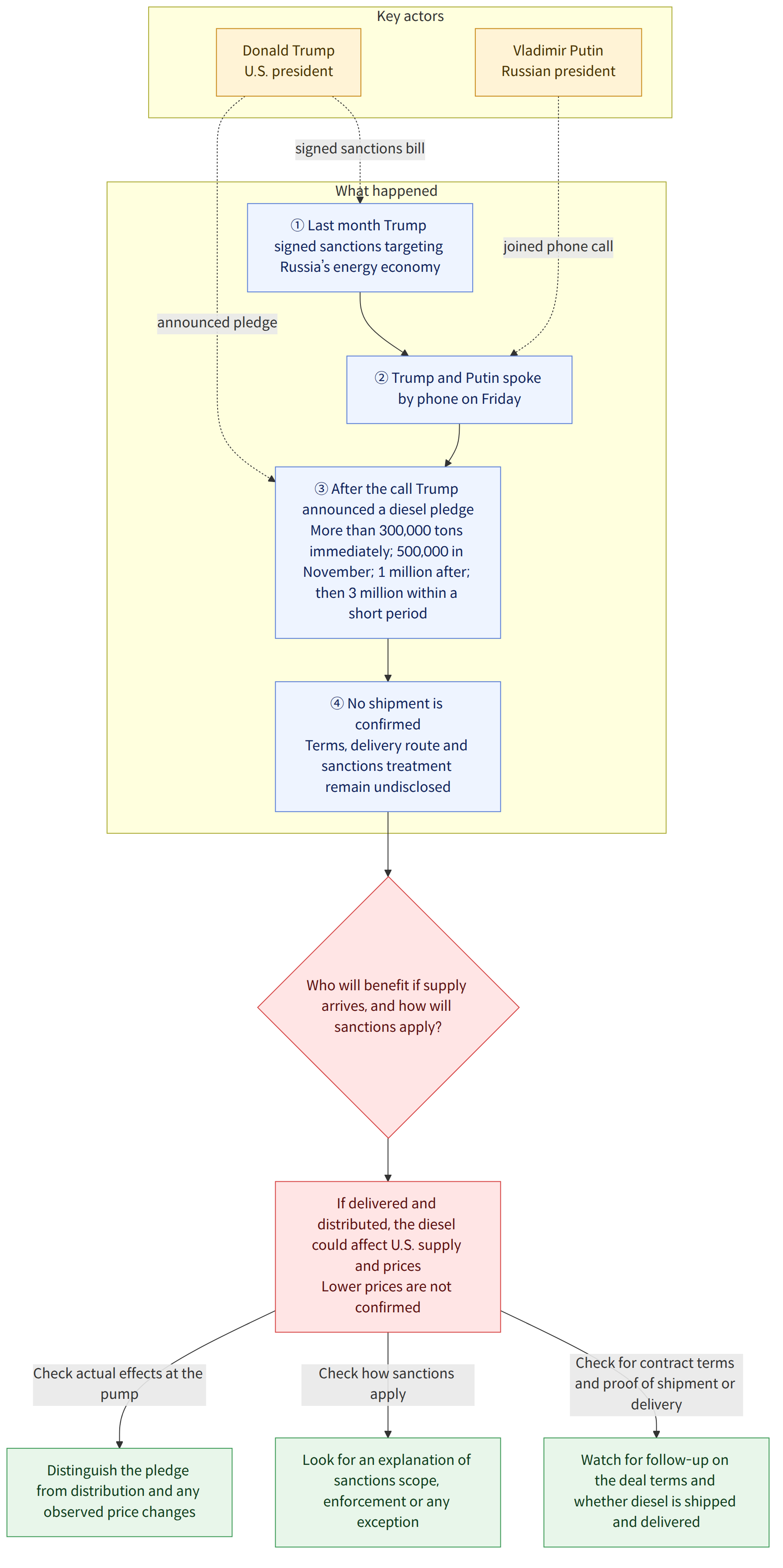
U.S. President Donald Trump wrote on social media Friday that he had agreed with Russian President Vladimir Putin during a phone call on a supply of Russian diesel. The supply plan Trump announced calls for more than 300,000 tons immediately, an additional 500,000 tons in November, 1 million tons right after that, and then 3 million tons “within a short period.” These are the terms of Trump’s announcement; there has been no confirmation that any shipment or delivery has taken place.
Background and context
The call had been expected to address suspected cases of plague in Russia, but Trump announced the diesel agreement afterward. According to the article, the announcement is connected to an effort to respond to high fuel prices ahead of the U.S. midterm elections. Trump referred to lowering prices for Americans, especially farmers, but the provided original text cuts off after “Great Farmers, R,” so what followed cannot be confirmed.
The announcement also intersects with U.S. policy to pressure Russia. Last month, Trump signed a sweeping Russian sanctions bill targeting areas that fund the war, including Russia’s energy economy. However, the diesel supply announcement made no mention of sanctions or Russia’s war in Ukraine. The publicly available explanation does not say how the sanctions (measures that restrict transactions or economic activity with a particular country or target) and the supply agreement would apply together.
What this news means
If the promised volumes are actually supplied, they could affect diesel supply conditions and fuel prices in the United States. However, the announcement alone does not mean that lower prices will materialize. The available information does not make it possible to determine whether the volumes will be supplied as planned or what effect the supply would have on prices in the United States.
From a policy perspective, it is notable that an announcement about bringing in Russian fuel came alongside sanctions intended to pressure Russia’s energy economy. If the deal goes ahead, an explanation may be needed of how it relates to the scope or enforcement of the sanctions. But the article provides no information on whether the sanctions permit the deal, whether an exception applies, or whether an actual transaction would conflict with the sanctions.
For example, even if U.S. farmers expect diesel prices to fall, the announced supply plan would have to lead to actual delivery and distribution to affect prices. This is a hypothetical explanation of a possible pathway; the original text does not say when farmers might see a price change or what that change might be.
What is confirmed and what remains unknown
Confirmed facts
- Trump wrote on social media that he had agreed with Putin during a phone call on a supply of Russian diesel.
- The volumes Trump announced were more than 300,000 tons immediately, an additional 500,000 tons in November, 1 million tons right after that, and then 3 million tons within a short period.
- The article describes the announcement as an effort to respond to high fuel prices ahead of the U.S. midterm elections.
- Last month, Trump signed a sweeping sanctions bill targeting Russia’s energy economy and other areas.
- The diesel announcement made no mention of sanctions or Russia’s war in Ukraine.
What remains unknown
- What are the price and payment terms for the diesel deal?
- How is the deal compatible with U.S. sanctions on Russia, and what process would be used to make any actual supply happen?
- If the supply takes place, how much will it affect fuel prices in the United States?
What readers should watch for
- Follow-up announcements may confirm the contract terms for Russian diesel and whether it has actually been shipped and delivered.
- Check how the deal relates to U.S. sanctions on Russia, including whether the way they apply or any exceptions are explained.
- When assessing whether fuel prices are falling, distinguish the supply pledge itself from actual distribution and price changes.