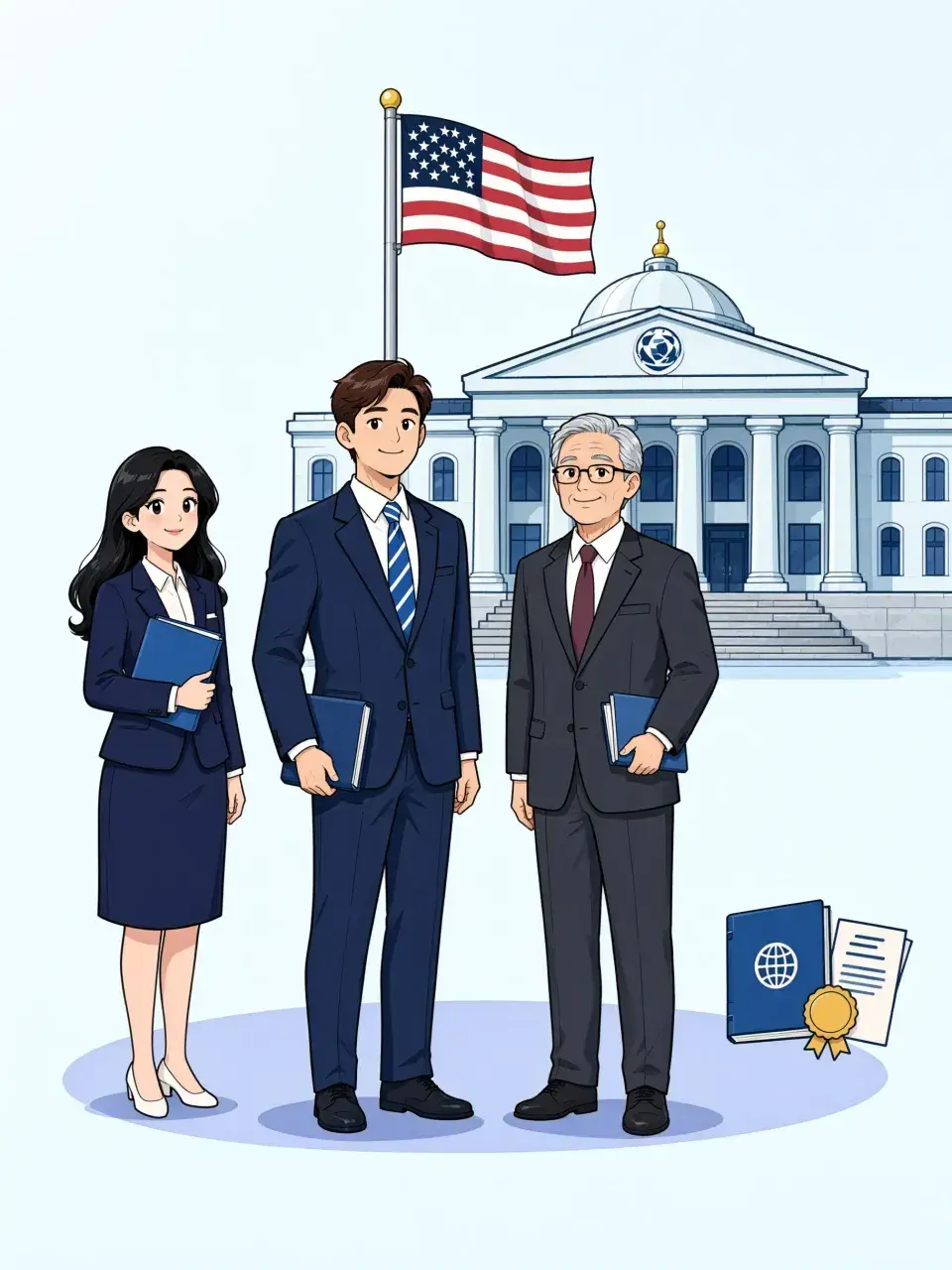
With the number of international students in South Korea exceeding 350,000 this fall, the Ministry of Justice (법무부) announced Wednesday that it would overhaul its visa policy, shifting from a focus on recruiting students to supporting graduates’ employment and long-term settlement. The government said it would introduce a flexible job-seeking visa allowing STEM graduates and skilled workers up to three years to find jobs, and create a “K-Tech Master Visa” to attract people with technical master’s degrees.
Background and context
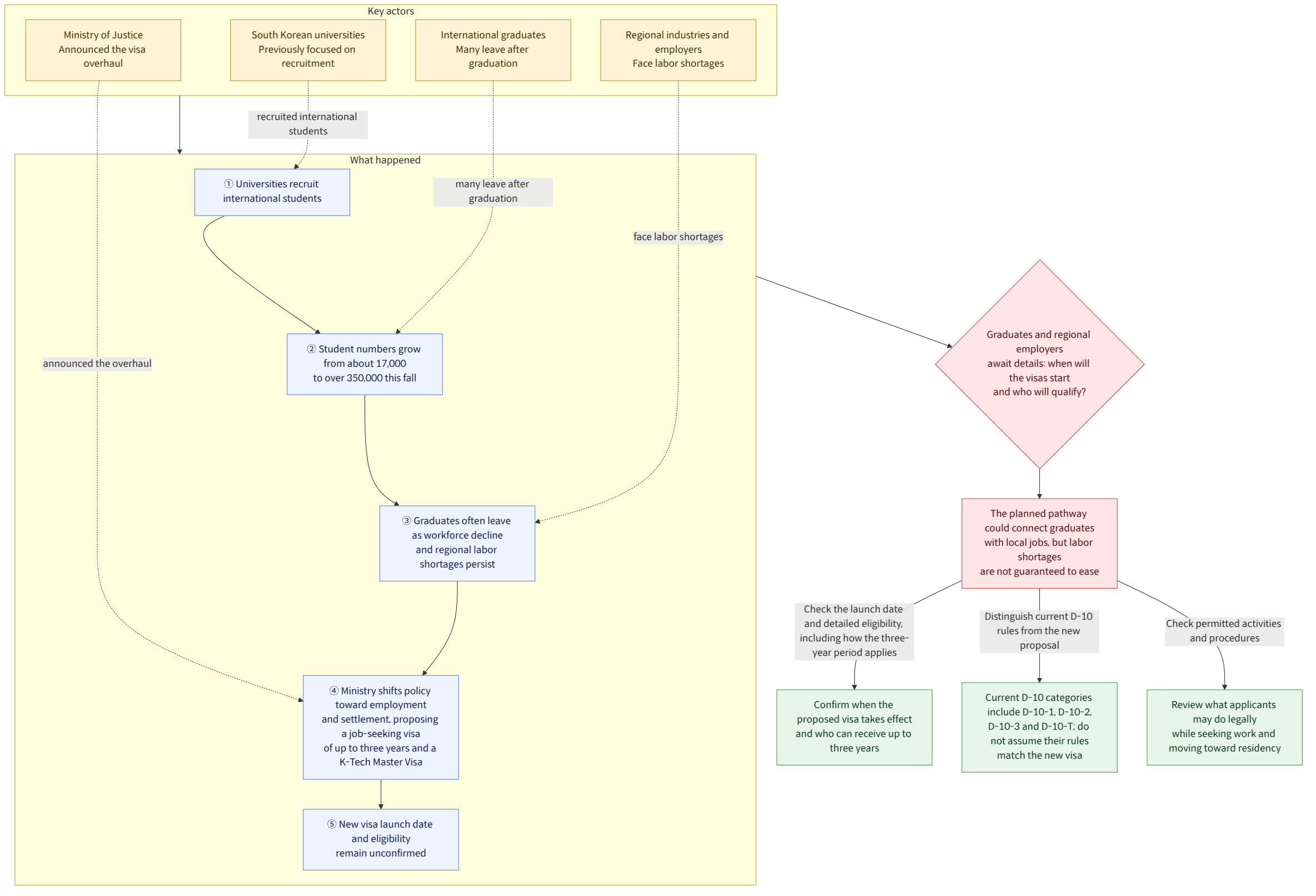
In the past, South Korean universities focused on recruiting international talent to fill classrooms. The number of international students rose from about 17,000 20 years ago to more than 350,000 this fall, but many leave South Korea soon after graduating, prompting the policy shift.
The change reflects the difficulty of addressing domestic labor shortages by increasing international student numbers alone. South Korea faces a rapid decline in its domestic workforce and severe labor shortages in regional industries. The government says the new framework aims both to simplify the path from graduation to full-time employment and residency, and to crack down on visa fraud and illegal employment.
According to the article, the current general job-seeking visa is typically valid for one to two years. The proposed new job-seeking visa would allow STEM graduates and skilled workers up to three years to find jobs. However, the announcement does not make clear whether this period would apply equally to all applicants or what requirements they would have to meet.
What this news means
For regional industries and employers, this is a potentially significant change: a process may be put in place to connect international graduates with local jobs after graduation. If the policy actually streamlines employment pathways, it could help industries facing labor shortages secure the talent they need. But the announcement of a visa overhaul alone does not establish that labor shortages in any particular region or industry will be resolved.
For international graduates, the possibility of having more time to look for work is important. For example, if a STEM graduate of a South Korean university were seeking a job in the country, the detailed requirements and effective date of the new visa allowing up to three years could affect their job-search plans. However, based on the information currently available, it is not possible to determine whether this hypothetical graduate would qualify for the new visa.
It is worth noting that the government has emphasized long-term settlement and integration while also identifying the crackdown on visa fraud and illegal employment as goals. This means that even when moving quickly to find work, applicants should check what activities and procedures are permitted. The policy’s success may depend not only on the length of the job-search period, but also on how clearly it establishes pathways for graduates to work legally and go on to reside in the country.
Related systems and support information
According to the internal visa guide, the current Job-Seeking (구직, D-10) status of stay is for foreigners seeking professional jobs in South Korea, preparing to launch technology startups, or undertaking internships in advanced technology fields. It is divided into General Job-Seeking (일반구직, D-10-1), Technology Startup Preparation (기술창업준비, D-10-2), Advanced Technology Internship (첨단기술인턴, D-10-3), and Top Talent (최우수인재, D-10-T). These are the current D-10 categories described in the guidance materials; they should not be assumed to have the same eligibility requirements as the new visa policy announced this time.
D-10-1 is for people who meet requirements including a bachelor’s degree or higher and a points-based system, and who are legally staying in South Korea. There are also exemptions from the points system, including a special provision for an initial job search after graduating from a South Korean university. D-10-2 requires a bachelor’s degree or higher and one of several specified qualifications, such as intellectual property rights or completion of OASIS training. D-10-3 is for current students in bachelor’s programs or higher in advanced technology fields at leading universities worldwide, or people who graduated no more than three years ago, among others; it also has an age requirement. D-10-T is for people who earned a master’s degree or higher within the past five years from a university ranked among the world’s top 100, among others.
The period of stay varies by category. In principle, a period of up to one year may be granted at a time, while some applicants may receive up to six months. Including extensions, the overall limit is up to three years or one year, depending on the applicant; D-10-3 and D-10-T allow a maximum of three years. Therefore, the article’s reference to a “current general job-seeking visa” lasting one to two years cannot be directly compared on the same basis with the periods of stay for individual D-10 categories.
Applications or changes of status may require basic documents such as an application form, photograph, copy of passport, job-seeking activity plan, and degree or graduation certificate. Depending on the category, applicants may need to provide evidence related to the points system, Korean-language proficiency, or work experience, as well as proof of financial support or place of residence. D-10-3 requires an internship contract and documents proving that the inviting company or institution meets the requirements.
D-10-1 holders may apply for permission to work part time if they meet certain requirements, but working before receiving permission may result in penalties for both the foreign national and the employer. This part-time work exception does not apply to D-10-2 or D-10-3. Anyone planning to start work while job hunting should therefore first check the details of their category and whether they have the required permission.
What is confirmed and what is not yet known
Confirmed
- The number of international students in South Korea rose from about 17,000 20 years ago to more than 350,000 this fall.
- The Ministry of Justice announced a comprehensive visa policy overhaul Wednesday.
- The policy’s central goal is shifting from recruitment alone to long-term settlement and integration.
- The government plans to introduce a flexible job-seeking visa allowing STEM graduates and skilled workers up to three years, as well as a K-Tech Master Visa.
Not yet known
- The announcement does not specify when the revised visa policy will take effect or what the eligibility requirements and review criteria will be.
- The target applicants, period of stay, and scope of permitted employment under the K-Tech Master Visa have not been confirmed.
- It is also not known how the new job-seeking visa will relate to or change the existing D-10 status of stay.
What readers should check
- Graduates looking into a job-seeking visa should check whether the effective date and eligibility requirements of the new policy have been officially clarified. They should not assume that the announced maximum of three years will apply to every applicant.
- Those preparing to apply for, change, or extend a current D-10 status should check the degree, job-seeking activity plan, points-system evidence, and other documentation required for their specific category, as well as the applicable period-of-stay rules.
- Anyone planning to work part time under D-10-1 should start only after receiving permission. Working before permission is granted carries the risk of penalties for both the foreign national and the employer.