1. Junho Park’s Unfortunate Bench Press
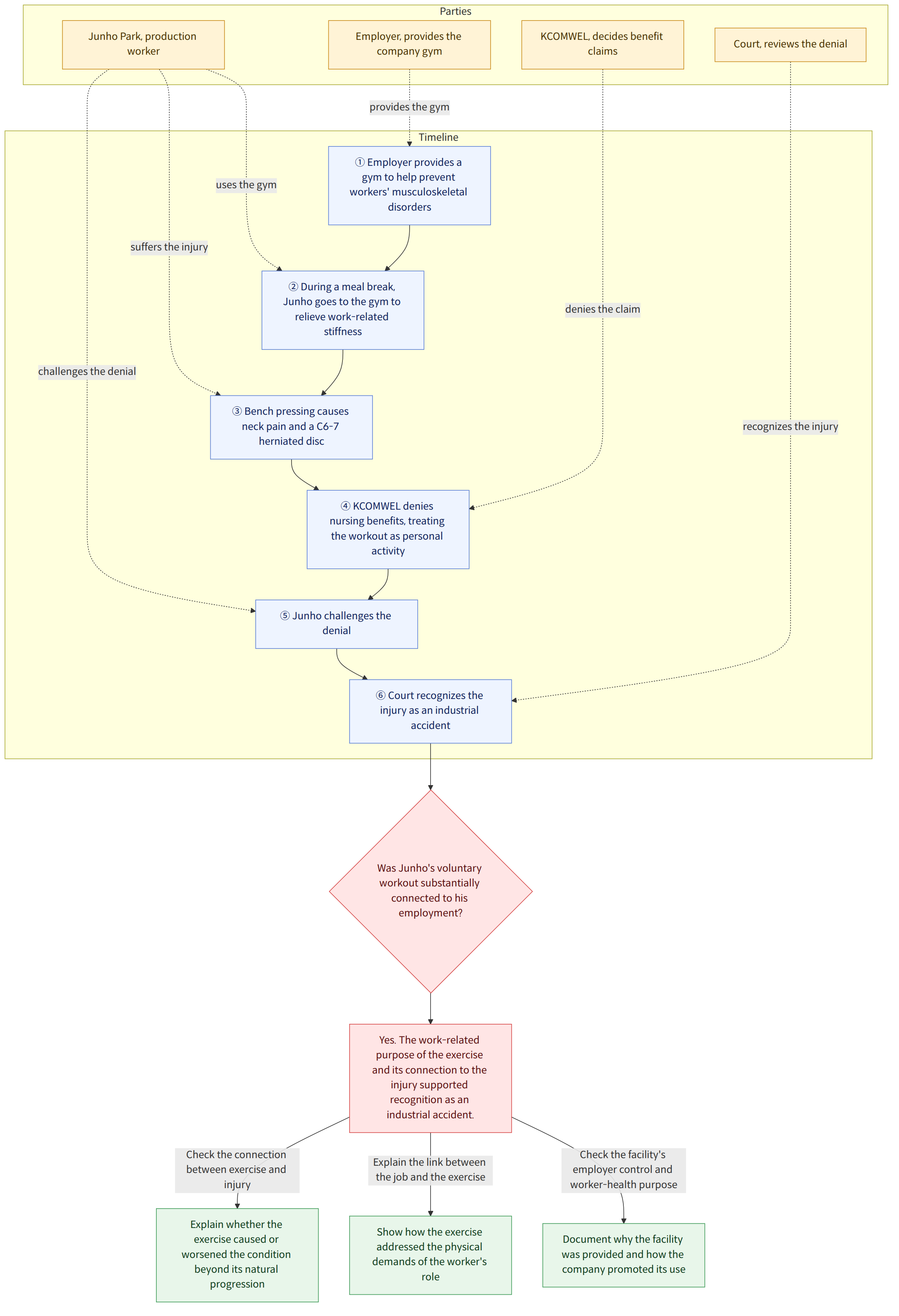
Junho Park is a dedicated 10-year veteran on the assembly line of an automotive parts factory. Recently, he began struggling with chronic stiffness in his neck and shoulders. Given his job—assembling heavy components in a fixed posture all day—muscle strain was a constant companion. To support its workers and prevent musculoskeletal disorders, the company had installed an on-site fitness center and encouraged employees to use it freely.
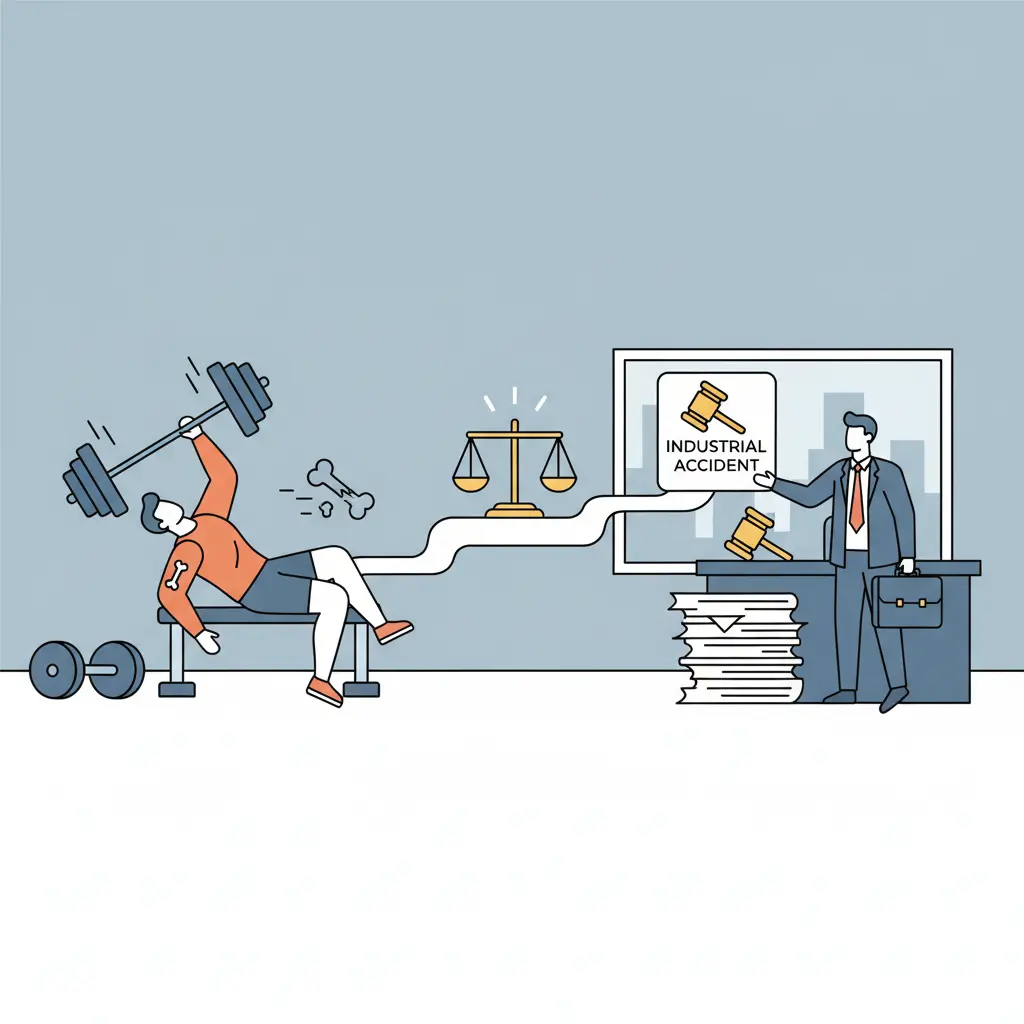
One evening, during his scheduled meal break on the night shift, Junho headed to the gym to stretch his tight muscles. He decided to do a set of bench presses. As he lifted the barbell, he felt a sickening 'pop' followed by an agonizing flash of pain in his neck. At the hospital, the diagnosis was grim: a herniated disc (C6-7). After undergoing surgery, Junho applied for nursing benefits from the Korea Workers' Compensation & Welfare Service (KCOMWEL). However, his claim was denied.
"The injury occurred during a personal workout, not during actual work hours," the official stated. Junho felt betrayed. He was using a company-provided facility to manage pain caused by his job so he could perform better. Was this really not a workplace accident?
2. The Core Legal Question
The central question in this case is: "Does an injury sustained during a voluntary workout in a company-provided facility during a break period qualify as an 'occupational disaster'?" In legal terms, we must determine if there is 'substantial causation' between the workout and the employment.
3. What Korean Law Says
Under the Industrial Accident Compensation Insurance Act, a disaster is recognized as work-related if it occurs in connection with the employee's duties. Regarding injuries in company facilities, the law provides a specific framework:
Article 37 of the Industrial Accident Compensation Insurance ActAn accident occurring while using facilities provided by the employer shall be regarded as an occupational accident if it is caused by a defect in or mismanagement of such facilities. However, accidents caused by the worker's violation of specific instructions or purely private activities are excluded.
Even without a physical defect in the facility, an accident can be deemed work-related if:
- The facility is under the management and control of the employer.
- The activity is considered a preparatory act for work or a necessary act accompanying work according to social norms.
- The exercise aims to maintain physical strength or prevent diseases required for the job.
4. How Korean Courts Approach This
Korean courts have taken an increasingly progressive stance on injuries occurring in company gyms. In similar precedents, judges have focused on the purpose of the facility. If a gym was installed specifically to 'prevent musculoskeletal diseases among production workers,' the court treats its use as part of the employment context.
Judges interpret exercising to relieve work-related physical strain not as a mere hobby, but as a 'reasonable and necessary act for the performance of work.' Furthermore, even if a worker has a pre-existing degenerative condition (like a mild disc issue), the court usually grants compensation if the workout caused the condition to worsen far beyond its natural progression.
5. Applying the Law to Junho’s Case
Let’s break down Junho’s situation step-by-step:
First, the fitness center was within the sphere of management of the company. Second, Junho’s role involved strenuous physical labor, making his attempt to alleviate pain through exercise a rational preparatory act for his next shift. It wasn't a random leisure activity; it was functional maintenance for his body.
Third, although Junho might have had some age-related wear and tear in his neck, the specific act of bench-pressing in the company gym served as the immediate cause of the herniation. Therefore, a substantial causal relationship exists between his work environment (including the gym provided for health maintenance) and the injury.
6. Conclusion: What Happened, and What Should You Do?
In the end, Junho challenged the denial and successfully had his injury recognized as an industrial accident. The court agreed that for a production worker, maintaining physical health is an extension of their professional duties.
If you find yourself injured while using company facilities, keep these two tips in mind:
- First, document the purpose of the facility. Evidence that the company promotes the gym for "worker health" or "safety management" (such as internal memos or company handbooks) is crucial for your claim.
- Second, connect the dots between your job and the exercise. Be prepared to explain how the exercise was intended to help you manage the physical demands of your specific role, rather than being just for fun.
Industrial accident insurance covers more than just the time you spend on the assembly line. In the eyes of the law, the time you spend preparing your body for work can also be protected.
This column is provided for informational purposes only and does not constitute legal advice. Individual outcomes may vary based on specific facts.