
Key Guide to General Labor and Employment: Employee Status, Transfers, and Severance Pay
Based on 61 consultation cases · Updated · Translated from the Korean original.
Whether someone is an employee is not determined solely by the wording of a contract or the method of payment. The assessment considers various factors, including the actual direction and supervision of the work and the working conditions. The outcome in matters involving transfers, dismissal, severance pay, and the transfer of employment when a business changes hands may also vary depending on the circumstances and substance of each case.
At a glance
Key points
- Employee status is determined primarily by whether a person provided labor for the purpose of earning wages in a subordinate relationship, rather than by the form of the contract. The assessment considers the circumstances as a whole, including direction and supervision of work, restrictions on working hours and location, the ability to substitute someone else, remuneration, and continuity (Cases 1, 5, and 8).
- Employee status cannot be ruled out solely because a person had no fixed salary, was registered as a business, or had no employment income tax withheld (Cases 5, 15, and 17).
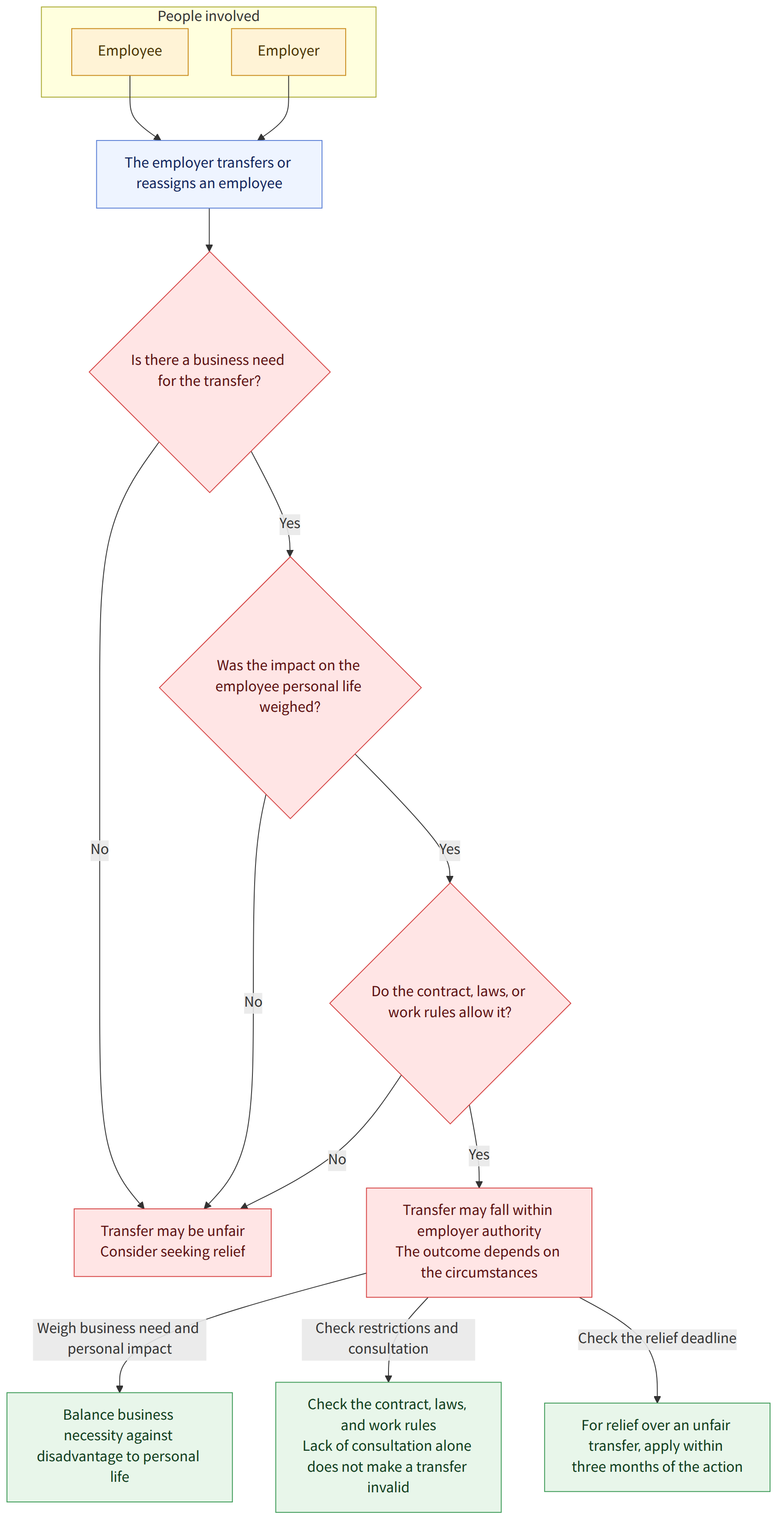
- Transfers and reassignments may fall within an employer’s personnel authority, but the business necessity must be weighed against the disadvantage to the employee’s personal life. An action is not automatically invalid merely because consultation procedures were not followed (Cases 3, 20, and 25).
- For an unfair transfer or reassignment, the case guide states that an application for relief must be filed within three months from the date of the action. Separate deadlines apply to appeals and administrative litigation challenging a Labor Relations Commission decision, so the date of service must be checked (Case 3).
- If leaving and rejoining the company was merely a formality under the company’s unilateral policy, the service may be recognized as continuous. Conversely, if the employee resigned of their own free will and received a settlement of severance pay, the continuous service period may be calculated from the date of rejoining (Case 10).
- In a company split, whether employment relationships transfer is assessed by considering the procedures, the purpose of the split, and other factors. If the transaction constitutes a transfer of business, employment relationships may transfer. Company splits and transfers of business must be assessed under different standards (Cases 16 and 23).
- If a dispatched worker is continuously used for more than two years, the user employer may be subject to a direct-employment obligation. That obligation may not be avoided solely because the dispatch agency has changed. The user employer may also owe dispatched workers duties of protection and care for their safety (Cases 7 and 13).
- Unemployed people and people seeking work may be included in the definition of a worker under the Trade Union Act (노동조합법) when it is necessary to protect the three labor rights through a regional trade union or similar organization (Case 12).
Frequently asked questions
Q. If my contract says I am an independent contractor or subcontractor, does that mean I am not an employee?
This is not determined solely by the title of the contract. It is assessed based on the circumstances as a whole, including who actually determines the work and how it is performed, whether the person is subject to specific direction and supervision, and whether they are bound by set working hours and locations.
Q. Can an instructor claim severance pay if they had no fixed salary or were registered as a business?
Those circumstances alone do not rule out employee status. If you worked in a relationship that was substantively subordinate—for example, if the company set and controlled class times, attendance, or dress—you may be recognized as an employee.
Q. Can I not receive severance pay if I am listed as a company executive?
The title of executive alone does not determine the outcome. In addition to the affairs entrusted to them, an executive may qualify as an employee if they provided regular labor under the employer’s direction and supervision and received remuneration in return.
Q. I was transferred without consulting the company. Is the transfer invalid?
A transfer is not automatically invalid just because there was no consultation. The business necessity for the transfer, the disadvantage it causes to the employee’s personal life, and any restrictions under the employment contract, laws, or rules of employment must all be considered.
Q. How long do I have to apply to challenge an unfair transfer?
The case guide advises applying to the Regional Labor Relations Commission for relief within three months from the date of the transfer or reassignment. Separate, shorter deadlines apply to appeals and administrative litigation challenging a Labor Relations Commission decision, so you should also check when the decision or ruling was served.
Q. I received severance pay due to the company’s circumstances and joined another company the next day. Is my period of service broken?
The answer may depend on whether the employee freely chose to leave and return to work, or whether the arrangement was merely a formality resulting from the company’s unilateral management policy. If the resignation was a formality required by company policy, the prior period of service may be combined when calculating severance pay.
Q. If the business owner changes or the company is split, does the employment relationship transfer to the new company?
If a transaction constitutes a transfer of business, the existing employment relationships may be transferred to the new owner. Excluding only some employees from the transfer without justifiable grounds may constitute unfair dismissal. In a company split, the procedures for explaining the matter to employees and seeking their understanding and cooperation, as well as the purpose of the split, must be considered separately.
Q. If the dispatch agency changes, is the period I worked for the user employer counted from the beginning again?
According to the case guide, if the user employer continues to use a dispatched worker, the rules on direct employment cannot be avoided solely because the dispatch agency has changed. The specific period of dispatch and the work relationship must be examined individually.
Q. Can I join a regional trade union even if I am currently unemployed?
Under the Trade Union Act (노동조합법), a worker may not be limited to someone currently employed by a particular employer. The case guide explains that, for a regional trade union, people seeking work may also be eligible to join when this is necessary to protect the three labor rights.
Relevant laws
- Labor Standards Act, Article 2(1), items 1 and 2 (근로기준법 제2조 제1항 제1호 및 제2호)
- Labor Standards Act, Article 6 (근로기준법 제6조)
- Labor Standards Act, Article 7 (근로기준법 제7조)
- Labor Standards Act, Article 11 (근로기준법 제11조)
- Labor Standards Act, Article 17 (근로기준법 제17조)
- Labor Standards Act, Article 23(1) (근로기준법 제23조 제1항)
- Labor Standards Act, Article 24 (근로기준법 제24조)
- Labor Standards Act, Article 28 (근로기준법 제28조)
- Labor Standards Act, Article 34 (근로기준법 제34조)
- Labor Standards Act, Article 35 (근로기준법 제35조)
- Labor Standards Act, Article 36 (근로기준법 제36조)
- Labor Standards Act, Article 104(2) (근로기준법 제104조 제2항)
- Enforcement Decree of the Labor Standards Act, Article 2 (근로기준법 시행령 제2조)
- Enforcement Decree of the Labor Standards Act, Article 7-2 (근로기준법 시행령 제7조의2)
- Enforcement Decree of the Labor Standards Act, Article 12 (근로기준법 시행령 제12조)
Watch out for
- Do not determine employee status solely by occupation or contract title. Consider actual evidence of work instructions and supervision, remuneration, and working arrangements.
- There are deadlines for applying for relief concerning a transfer and for challenging a Labor Relations Commission decision. Check the periods stated in the case guide, and take care not to miss the date of the action or the date a document was served.
- If an employee leaves and is rehired, whether their service is continuous may depend on whether the resignation was voluntary or merely formal, following a unilateral company decision.
- A case guide cites a court ruling stating that the method for calculating the number of employees regularly employed for severance-pay purposes does not simply follow the calculation method in the Enforcement Decree of the Labor Standards Act (근로기준법 시행령). Therefore, do not reach a conclusion based only on the number of employees in the month immediately before retirement (Case 22).
Related articles
- The Invisible Boss: Who is Truly Liable for Your Unpaid Wages in Korea?
- The Cost of Illegal Strikes: Why Your Severance Pay Might Shrink
- Strangers at the Construction Site: Why the Truck Driver Wasn't Protected by Workers' Comp
- The Monthly Pay Illusion: Why 'Severance Split Agreements' Are Invalid in Korea
- Who Pays the Union Leader During a Strike? - Legal Status of Full-Time Union Officials
- The Hidden Key to Your Severance Pay: What Truly Counts as 'Average Wage'?
Source cases
This guide was compiled by AI from the following Korea Legal Aid Corporation consultation cases (in Korean).
- 학교법인이 운영하는 대학교의 시간강사가 근로자인지
- 이력서에 허위경력을 기재한 경우 징계사유에 해당되는지
- 전보·전직 처분에 대하여 불복할 수 있는지
- 외국인회사의 경우에도 근로기준법이 적용되는지
- 화물운송회사와 화물자동차운전용역계약을 체결한 운송기사의 근로자성
- 골프장 캐디가 근로기준법상 근로자에 해당하는지 여부
- 파견근로자의 사용사업자에 대한 근로자지위확인
- 학습지판매위탁 상담교사도 근로기준법상의 근로자인지
- 아파트관리업자와 근로계약한 자의 입주자대표회의에 대한 임금청구권
- 회사분할로 퇴직금 일괄수령 후 재입사 형식 취한 경우 계속근로인지
- 부당한 징계에 대해 사용자 등에게 불법행위책임 있는지
- 실업자도 노동조합 및 노동관계조정법상의 근로자에 해당되는지
- 사용사업주의 보호의무 또는 안전배려의무
- 경리부장 겸 상무이사의 경우 근로기준법상의 근로자에 해당되는지
- 학원강사의 근로자성 인정여부
- 근로관계의 승계 여부
- 자기소유 버스로 사업주의 회원 운송을 하면 근로기준법상 근로자인지
- 대학병원의 전공의가 근로기준법상의 근로자에 해당하는지
- 수습사원으로 재직 중 당한 일방적인 해고
- 근로자와 협의 없이 행한 전보처분의 효력
- 회생회사 임원의 근로자성
- 근로자수 산정기준
- 영업양도수 근로자지위 승계여부
- 산업기술연수생도 근로기준법상 근로자인지
- 근로자와 협의절차를 거치지 않은 전보처분이 당연히 권리남용에 해당하는지
This guide is general legal information about Korean law, not legal advice for your situation. For a specific case, consult a lawyer or the Korea Legal Aid Corporation (call 132 in Korea).