
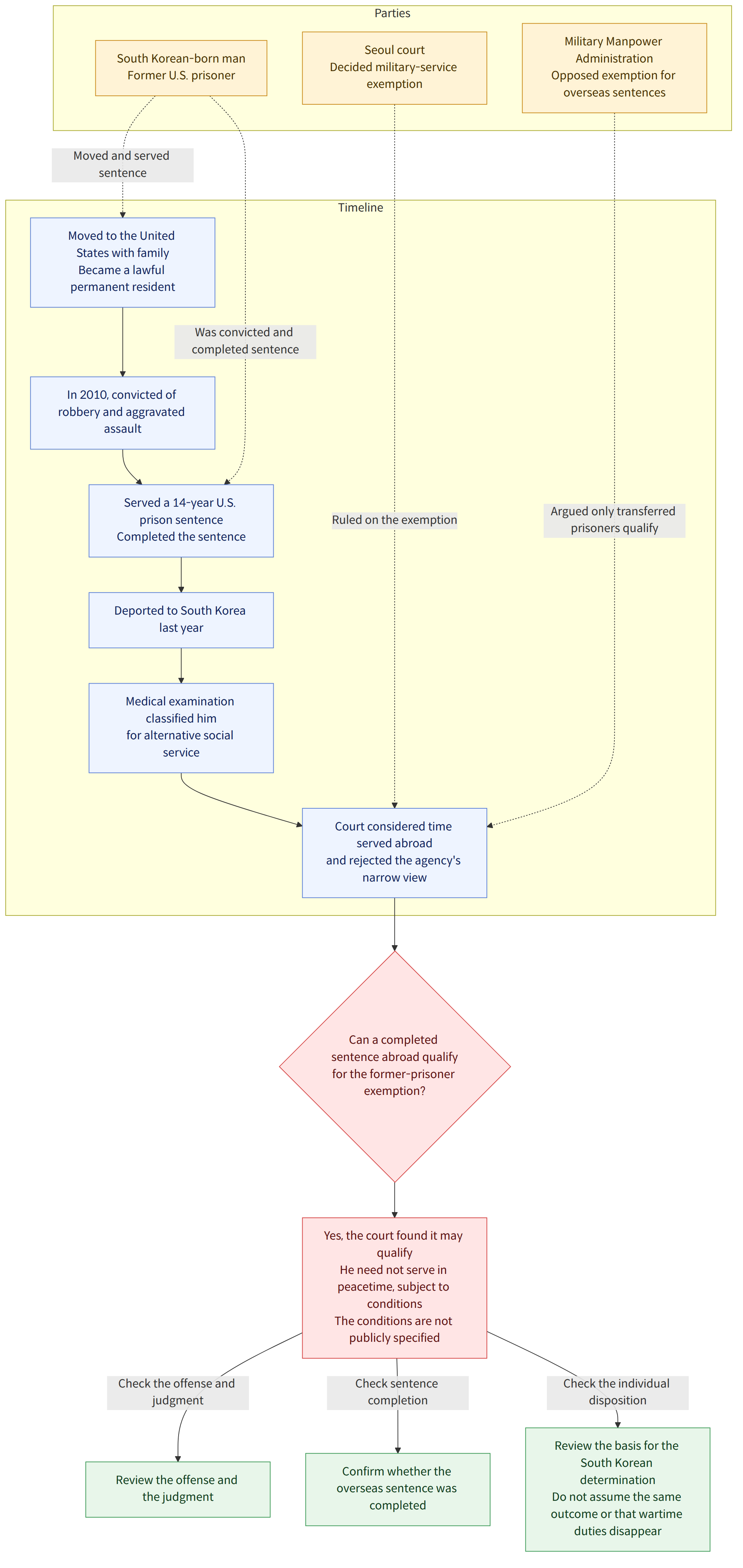
A Seoul court ruled that a South Korean-born man who served 14 years in a U.S. prison for armed robbery does not have to perform military service in South Korea. The court found that an exemption from military service for prisoners who have completed their sentences may also apply to people who served their sentences abroad. However, it imposed conditions to prevent the exemption from being exploited as a loophole for evading military service; the available reporting does not specify what those conditions are.
Background and context
The man moved to the United States with his family and became a lawful permanent resident there. In 2010, he was convicted of robbery and aggravated assault, and after completing his sentence in the United States, he was deported to South Korea last year. The article did not disclose the man’s name.
A medical examination in South Korea classified him as eligible for alternative service as a Social Service Personnel member (사회복무요원). However, the court took his time served in the United States into account in determining whether he qualified for a military-service exemption, and found that he did not have to serve in South Korea. The central issue in the case was whether prisoners who completed their sentences abroad could also be covered by the relevant exemption provision.
The Military Manpower Administration (병무청) maintained that only prisoners transferred to South Korea to complete their sentences qualified for the exemption, but the court rejected that position. The ruling can therefore be read as finding that people cannot be excluded from consideration for the exemption solely because they served their sentences abroad. However, it cannot be assumed that the ruling guarantees the same result for all people who served prison sentences overseas. Reports said the court imposed conditions to prevent abuse, but the applicable criteria and the content of those conditions have not been disclosed.
According to the article, under the Military Service Act (병역법), people sentenced to at least 18 months in prison are placed in the wartime labor service category (전시근로역), a category exempt from military service in peacetime whose members may be called up to provide labor support in the event of war. This category exempts people from peacetime service; it does not mean they have no obligations even in wartime. The man’s 14-year sentence far exceeds the 18-month threshold cited in the article, but the court’s decision also appears to have considered the scope of the exemption as it applies to people who served sentences abroad and the conditions imposed to prevent abuse.
What this means
The ruling is notable because it indicates that serving a sentence abroad may also affect a person’s military-service determination in South Korea. This is because the court rejected the Military Manpower Administration’s restrictive interpretation. At the same time, the ruling alone does not support a general conclusion that anyone who serves a sentence of a certain length abroad will be exempt from military service. The eligible group and the specific conditions imposed by the court have not been made public.
For people with military-service obligations and their families, this may mean that they need to check not only the fact of a prison sentence but also the offense and judgment, whether the sentence has been completed, and any military-service determination made in South Korea. For example, if someone who completed a prison sentence abroad receives a military-service determination in South Korea, they should check the basis for their own disposition or determination rather than assume the outcome based solely on the existence of this ruling. This is a hypothetical explanation; it does not mean that the person would receive the same outcome as in this case.
One distinction that is especially important in this case is the difference between “exemption from peacetime service” and “the elimination of all military-related obligations.” The wartime labor service category described in the article exempts people from peacetime service, but they may be called up to provide labor support if war breaks out. The ruling should therefore not be interpreted broadly to mean that all military-related obligations have been eliminated.
Related systems and support information
Anyone seeking to challenge a similar military-service determination should first consider whether the Military Manpower Administration’s action qualifies as an “administrative disposition” that can be challenged through an administrative cancellation lawsuit (항고소송), a lawsuit asking a court to revoke an administrative agency’s disposition, and whether they have a legally recognized interest in challenging it. A guide based on consultation cases from the Korea Legal Aid Corporation (대한법률구조공단) explains that a disposition is an action, such as the exercise of public authority by an administrative agency, that directly affects people’s rights and obligations. It notes that whether a particular action qualifies is determined by considering its content, procedures, and other factors as a whole. The available reporting does not identify which administrative action was the subject of the lawsuit in this case, so this guidance cannot be definitively applied as a description of the specific legal proceedings.
According to the guide, the general deadline for filing a cancellation lawsuit is 90 days from the date the person became aware of the disposition and one year from the date it was issued; the earlier deadline must be observed. A separate deadline set by a specific law may take precedence. Filing a complaint or objection with an administrative agency does not necessarily restart or extend the deadline for challenging the original disposition, so the deadlines for objections and lawsuits should be checked separately.
The guide also explains that filing a lawsuit does not automatically suspend the effect or enforcement of a disposition. If the requirements are met, such as an urgent need to prevent irreparable harm, a separate application can be made to suspend enforcement. However, not every action by an administrative agency is subject to an administrative cancellation lawsuit. It is therefore necessary to first determine whether the action in question is a disposition and to check the applicable deadlines and procedures against the relevant laws or through legal advice.
What is known and what remains unknown
Confirmed facts
- The man was born in South Korea and served 14 years in a U.S. prison for armed robbery.
- He was convicted of robbery and aggravated assault in 2010 and was deported to South Korea last year after completing his sentence.
- A medical examination classified him as eligible for alternative service as a Social Service Personnel member.
- The Seoul court found that the exemption from military service for prisoners could also apply to people who completed their sentences abroad, and rejected the Military Manpower Administration’s position.
- The court imposed conditions to prevent the exemption from being abused to evade military service, but reports did not specify what they were.
What remains unknown
- What are the specific conditions the court attached to the exemption, and what criteria govern their application?
- When was the ruling issued, and which court panel heard the case?
- Did the Military Manpower Administration appeal the ruling?
- What specific administrative disposition and legal proceedings were involved in the case?
What readers should check
- In a similar case, check the documents and grounds for the military-service determination or the Military Manpower Administration’s disposition, and determine whether it is actually a disposition that can be challenged.
- When considering a cancellation lawsuit, check both the date you became aware of the disposition and the date it was issued, so you do not miss whichever of the general deadlines—90 days or one year—expires first. It is important not to assume that filing a complaint or objection extends the deadline.
- Filing a lawsuit does not itself suspend a disposition, so check separately whether an application to suspend enforcement is needed. The specific conditions attached to this ruling and whether an appeal was filed cannot be determined from the publicly available reporting.