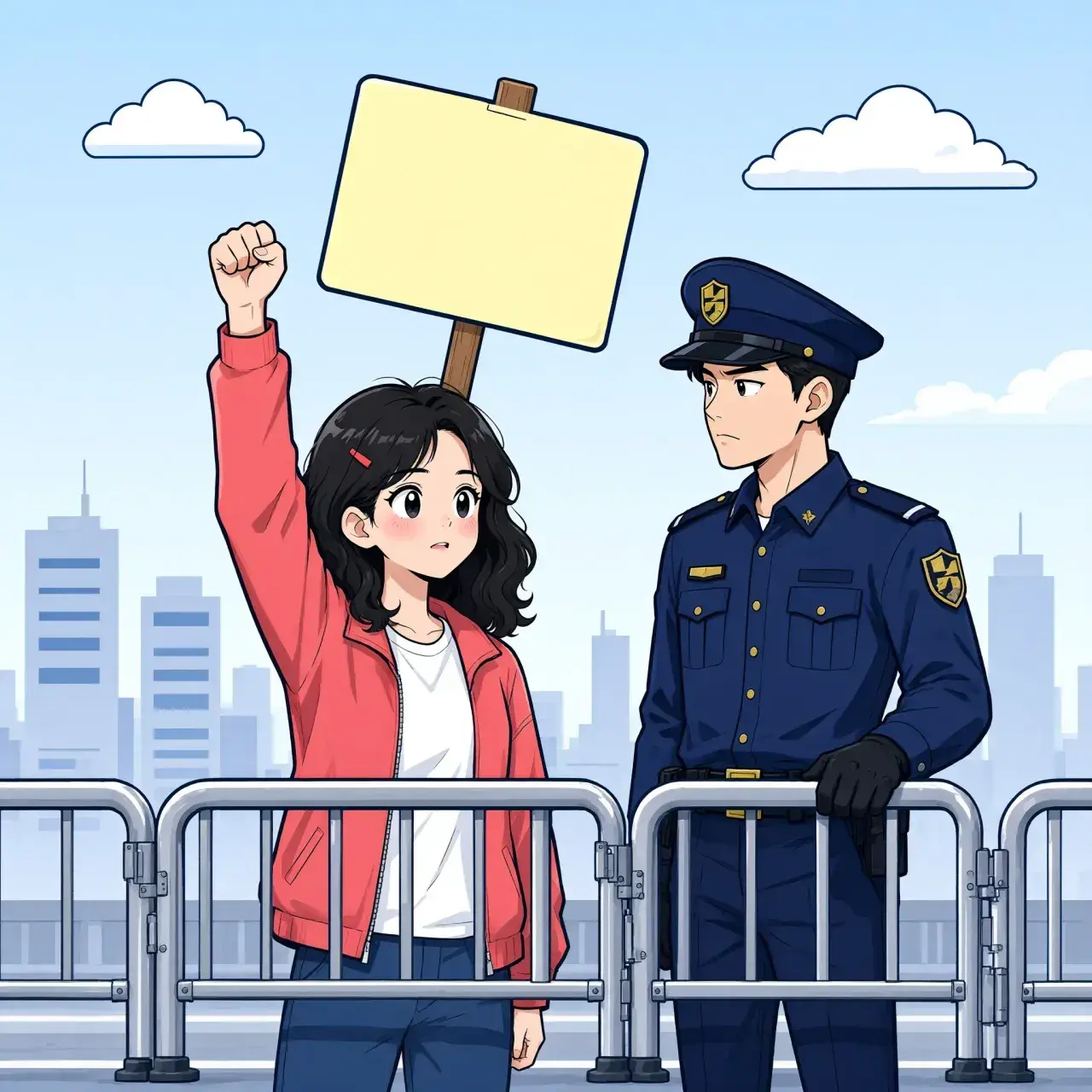
1. A Human Story
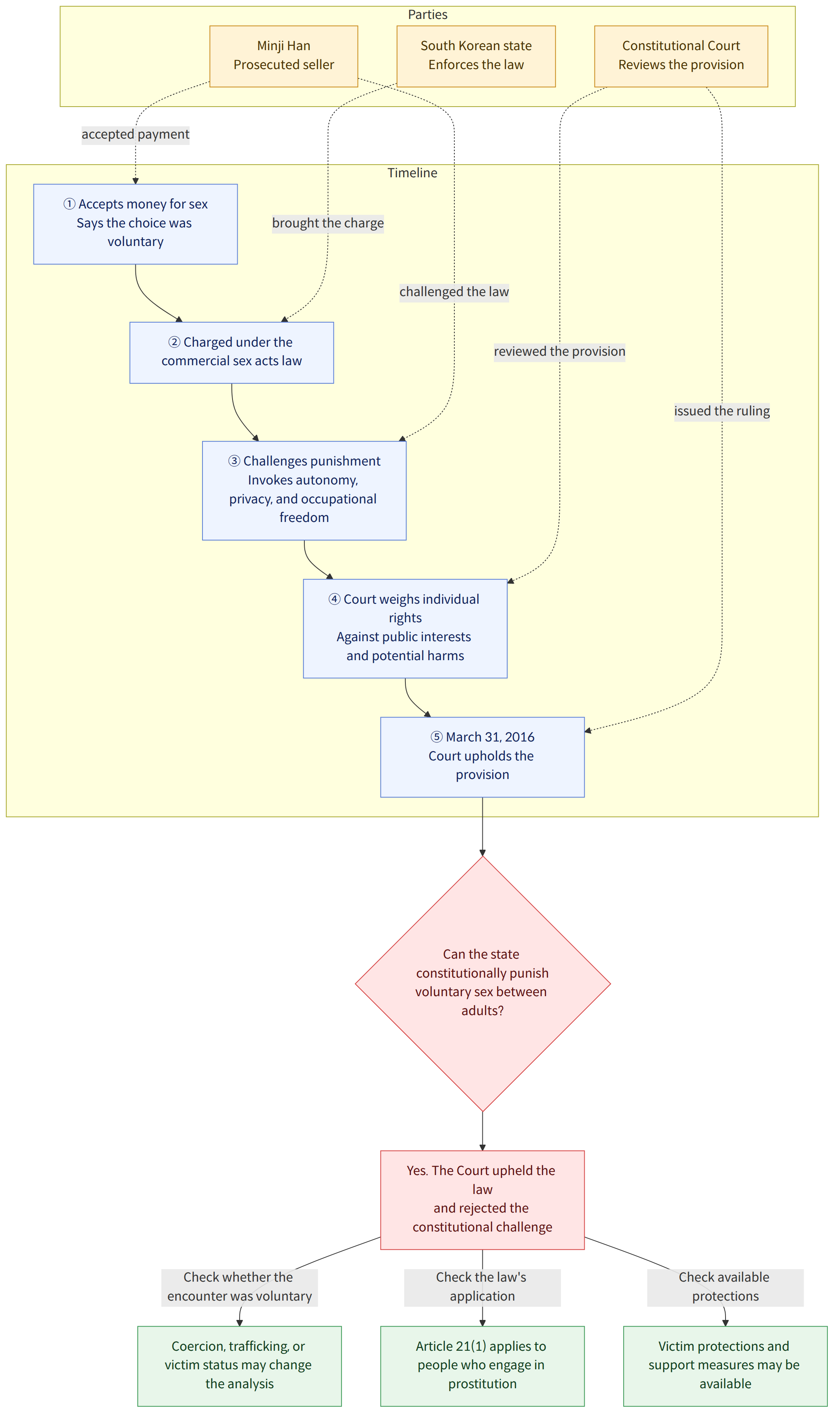
Minji Han had spent months trying to keep up with rent and medical bills. One evening, she accepted money from an adult man in exchange for sex. She says the decision was hers: no one threatened her, and she did not believe she was being controlled by anyone else.
Weeks later, Minji was charged under South Korea’s Act on the Punishment of Arrangement of Commercial Sex Acts. At the police station, she asked a question that seemed simple but carried enormous consequences: if two adults consent, why should the state be allowed to punish them for what happened in private? She believed the charge invaded her sexual autonomy, her privacy, and her freedom to choose how to earn a living.
2. The Legal Question
Can South Korea constitutionally impose criminal penalties on a person who voluntarily sells sex, despite the person’s rights to sexual self-determination, privacy, and occupational choice?
The question is not whether coercion or trafficking is permissible; those raise distinct and serious issues. It is whether the Constitution prevents the state from criminalizing prostitution between adults when the seller claims to have acted voluntarily.
3. What Korean Law Says
Article 21(1) of South Korea’s Act on the Punishment of Arrangement of Commercial Sex Acts provides for criminal penalties for a person who engages in prostitution. The provision applies to the people involved in the transaction, not only to those who arrange or profit from it.
A person who engages in prostitution may be punished by imprisonment for up to one year, a fine of up to three million won, penal detention, or a minor fine.
The Constitutional Court considered whether this restriction violated several constitutional freedoms:
- Sexual self-determination: the ability to make choices about one’s own sexual life.
- Privacy: the protection of intimate personal conduct from unjustified state interference.
- Occupational freedom: the ability to choose one’s work.
The Court acknowledged that criminal punishment limits these freedoms. It nevertheless concluded that the limit was constitutionally permissible. In its view, sexual conduct may warrant legal regulation when it is expressed publicly in ways that affect wider social interests. The Court also reasoned that prostitution can commodify human sexuality and may involve economic inequality, exploitation, and control over a seller’s body and personhood—even when a transaction appears voluntary.
The Court’s analysis also addressed the purposes and effects of the law. It found that discouraging prostitution and establishing what the law regards as healthy sexual norms were legitimate aims. It accepted that penalizing prostitution could help reduce demand and prevent the market from expanding, and it did not find that alternatives such as education or counseling were clearly as effective.
The Court did not hold that every person involved in prostitution is free of coercion or exploitation. The law recognizes that people who qualify as prostitution victims may be excluded from criminal punishment, and protective or support measures may be available.
That distinction matters. A person’s claim that the encounter was voluntary may put the person within the general prohibition; evidence of coercion, trafficking, or victim status may change the legal analysis. The precise treatment depends on the facts and the applicable legal process.
4. How Korean Courts Approach This
In a constitutional review decided on March 31, 2016, the Constitutional Court upheld the provision, finding that it did not violate sexual self-determination, privacy, or occupational freedom. It also rejected the argument that the provision violated equality rights.
The Court weighed the burden on individual freedoms against the public interests the law seeks to protect. It accepted the legislature’s view that prostitution can be bound up with exploitation and that demand helps sustain and enlarge the market. It also considered the risk that a less restrictive approach might make prostitution easier to access or encourage the market to grow.
The Court’s central principle was that sexual autonomy and privacy are important, but they do not automatically exempt conduct from regulation when the legislature reasonably identifies broader harms and adopts criminal penalties to address them.
The ruling did not erase the difference between a seller acting freely and someone subjected to force or exploitation. Rather, the Court considered the availability of victim protections, non-criminal protective procedures, and support for recovery and independence as part of its conclusion that the law was not excessive.
5. Applying the Law to the Case
Minji’s challenge raises the same rights the Court considered. The reasoning unfolds in several steps.
- The law restricts protected freedoms. Minji’s argument is not frivolous: the provision reaches private sexual conduct and can affect both her autonomy and her ability to earn income. The Court expressly recognized those burdens.
- The state identifies public purposes. The government’s stated interests include discouraging prostitution, reducing the conditions in which exploitation may occur, and protecting broader social values. The Court considered these aims legitimate.
- The Court accepted a connection between punishment and those aims. It reasoned that criminal penalties could deter demand and limit the growth of prostitution markets. It did not require the legislature to prove that punishment eliminates prostitution or that it is the only possible policy.
- The Court found the restriction proportionate under the constitutional test. It considered whether less restrictive options—such as education or treatment—would be comparably effective, and concluded that the record did not establish that they would be. It also accepted the legislature’s decision to include sellers within the prohibition, while recognizing that a person identified as a prostitution victim may be treated differently.
- Minji’s account does not itself invalidate the law. If the facts are as she describes—an adult transaction without coercion or victim status—her consent alone is unlikely to defeat the charge on constitutional grounds. The 2016 ruling already rejected the argument that applying the provision to voluntary prostitution necessarily violates the protected freedoms she invokes.
That constitutional conclusion is not a finding that Minji is guilty. The prosecution must still establish the facts required for the charge, and her individual circumstances may matter to how the case is handled and what outcome follows.
6. Conclusion: What Happened, and What Should You Do?
Minji’s constitutional argument did not make voluntary prostitution lawful. Under the Constitutional Court’s 2016 ruling, Article 21(1) remains enforceable against a person who engages in prostitution, and the Court found that its application did not unconstitutionally violate sexual autonomy, privacy, occupational freedom, or equality. If Minji’s case involved only a voluntary exchange between adults, she could not rely on consent alone to have the law set aside.
But the ruling does not mean that coercion, trafficking, or victimization should be overlooked. Those facts can be legally decisive. Anyone facing investigation or prosecution should explain their circumstances to a qualified Korean lawyer and ask specifically whether victim protections or other procedures apply.
For readers in a similar situation:
- Get legal advice early. Do not assume that a constitutional objection, or an informal explanation to investigators, will resolve the case.
- Preserve relevant evidence. Keep messages, payment records, travel or work documents, and any evidence of threats, control, recruitment, or exploitation.
- Ask about victim status and support. If force, deception, trafficking, or another form of exploitation was involved, raise it promptly; it may affect criminal liability and access to protection.