
1. A Human Story
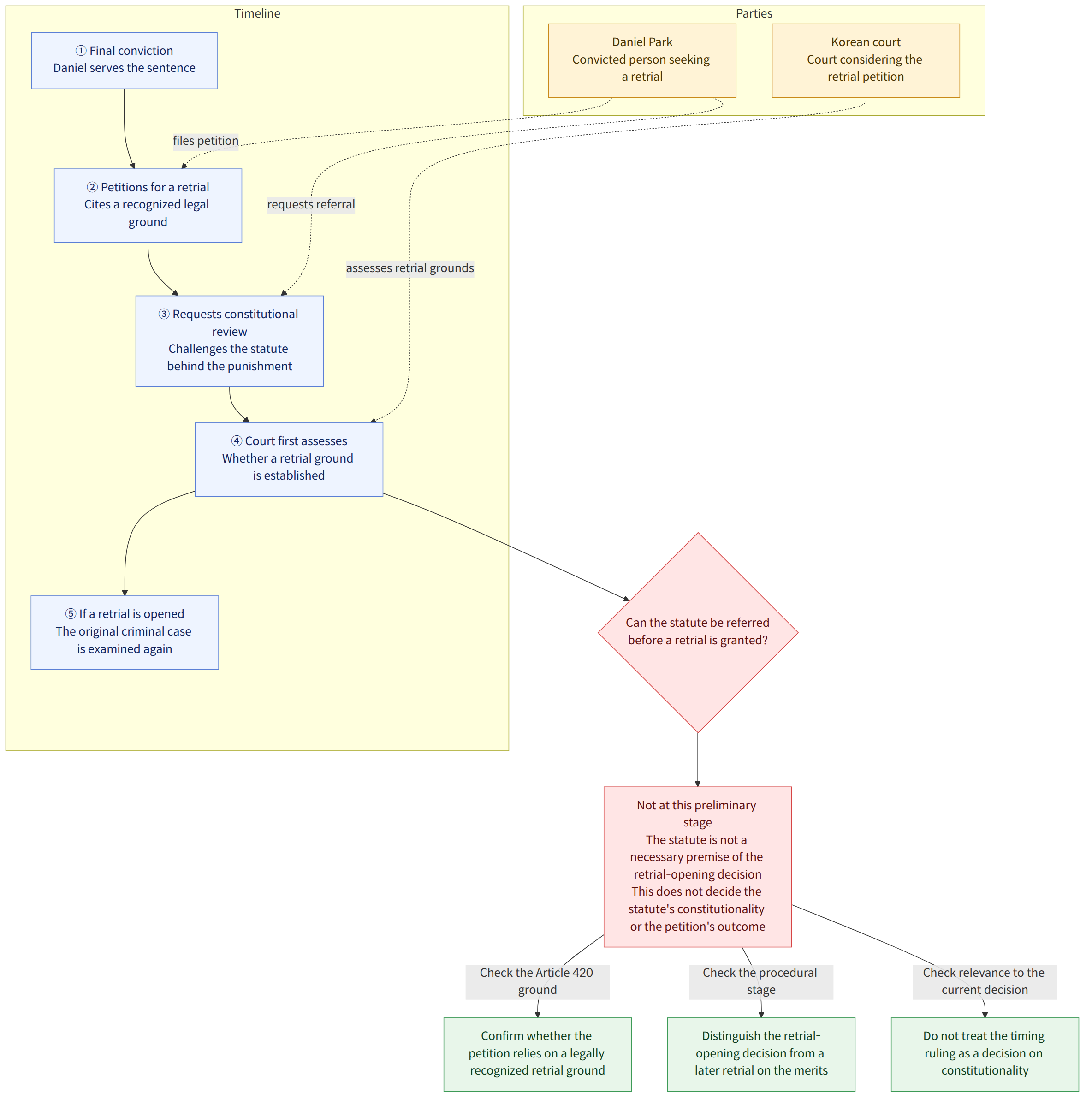
Daniel Park has already served the prison term imposed on him under a criminal statute that he now believes is unconstitutional. His conviction is final, but he has petitioned a Korean court for a retrial, arguing that his case qualifies for one of the grounds set out in law.
At the same time, Daniel has asked the court handling the retrial petition to refer the statute behind his punishment to the Constitutional Court. He hopes that a ruling against the statute could change the course of his case. The court, however, has not yet decided whether to open a retrial. That timing matters: Daniel’s request asks the court to examine the law before it has decided whether there will be a new trial at all.
2. The Legal Question
Can a court refer the criminal statute underlying a final conviction for constitutional review while it is still deciding whether to grant a retrial?
In general, not at that preliminary stage. The challenged law must be relevant to the decision the court is currently making. Whether Daniel is entitled to a retrial is a different question from whether he was properly punished under the statute in the original case.
3. What Korean Law Says
Korean law treats a retrial as an exceptional procedure, not an automatic continuation of a concluded criminal case. Under Article 420 of the Criminal Procedure Act, a person may seek a retrial only on specified legal grounds. The court first examines whether one of those grounds has been established.
The court must decide whether the retrial petition is justified before proceeding to a new examination of the original criminal case. It may dismiss the petition or issue an order opening a retrial.
The constitutional-review process has its own threshold. A court may refer a statute to the Constitutional Court when the statute’s constitutionality is a necessary premise for the judgment the referring court must make. Put simply, the answer to the constitutional question must matter to the decision currently before that court—not merely to the case in a broader sense.
That creates two distinct stages:
- The retrial-opening stage: The court asks whether a legally recognized ground for reopening has been shown.
- The retrial on the merits: If the order opening the retrial becomes final, the court again examines the criminal case according to the relevant trial level. The law that supported the original punishment may then become relevant to the decision on guilt or punishment.
Article 47(4) of the Constitutional Court Act also provides a route to seek a retrial when a person was convicted under a law or provision later declared unconstitutional. But that provision does not eliminate the need to meet the separate procedural requirements for a retrial, nor does it make the underlying criminal statute automatically relevant to the earlier question of whether a retrial should be opened.
A request for constitutional review is not enough by itself. The challenged provision must be a necessary premise of the court’s decision at the stage it is actually considering.
4. How Korean Courts Approach This
Korean courts generally distinguish between deciding whether to reopen a case and deciding the case again. At the first stage, the court is not yet reconsidering the defendant’s guilt under the original criminal law. It is deciding whether the petition satisfies the restricted grounds for a retrial.
For that reason, courts generally do not treat the law underlying the conviction as a necessary premise when deciding whether to open a retrial. The constitutional issue may become material later, once a retrial has been opened and the court is again examining the criminal case. The distinction is procedural, not a ruling that the challenged law is constitutional.
5. Applying the Law to Daniel’s Case
Daniel’s petition is still at the preliminary stage. The court has not yet ruled that a retrial should proceed, so its immediate task is to determine whether his petition rests on a ground recognized by Article 420 of the Criminal Procedure Act.
The statute Daniel challenges was the basis for the punishment in his final conviction. But the court is not yet deciding whether that conviction should stand under the statute. It is deciding whether Daniel has met the legal conditions for reopening the case. On the facts described, the constitutionality of the punishment provision does not determine that preliminary question.
That means the provision is not yet a necessary premise of the decision before the court. The court therefore cannot properly refer it for constitutional review at this point. This does not mean the Constitutional Court has upheld the statute, or that Daniel has lost his retrial petition. It means only that his constitutional challenge is premature in the current procedural posture.
If the court later issues an order opening the retrial and that order becomes final, the case moves to a different stage. The court will then rehear the criminal matter, and the statute behind the original punishment may be relevant to the decision. Daniel could seek a constitutional referral then, provided the constitutional question is necessary to decide the retried case.
6. Conclusion: What Happened, and What Should You Do?
Daniel’s request for a constitutional referral should be rejected as procedurally premature while the court is still deciding whether to open a retrial. That outcome does not decide the merits of his retrial petition or the constitutionality of the criminal statute. If the court opens the retrial and its order becomes final, Daniel may raise the constitutional issue again at the stage when the statute can affect the court’s decision.
For anyone in a similar position:
- Separate the two questions: First establish a statutory ground for retrial; do not assume that challenging the punishment provision answers that question.
- Track the procedural stage: A constitutional referral may be more appropriate after the retrial-opening order becomes final, when the underlying law can matter to the reheard case.
- Get advice on timing and records: Consult a Korean criminal-law attorney about the retrial grounds, filing deadlines, and how to preserve the constitutional argument for the proper stage.