
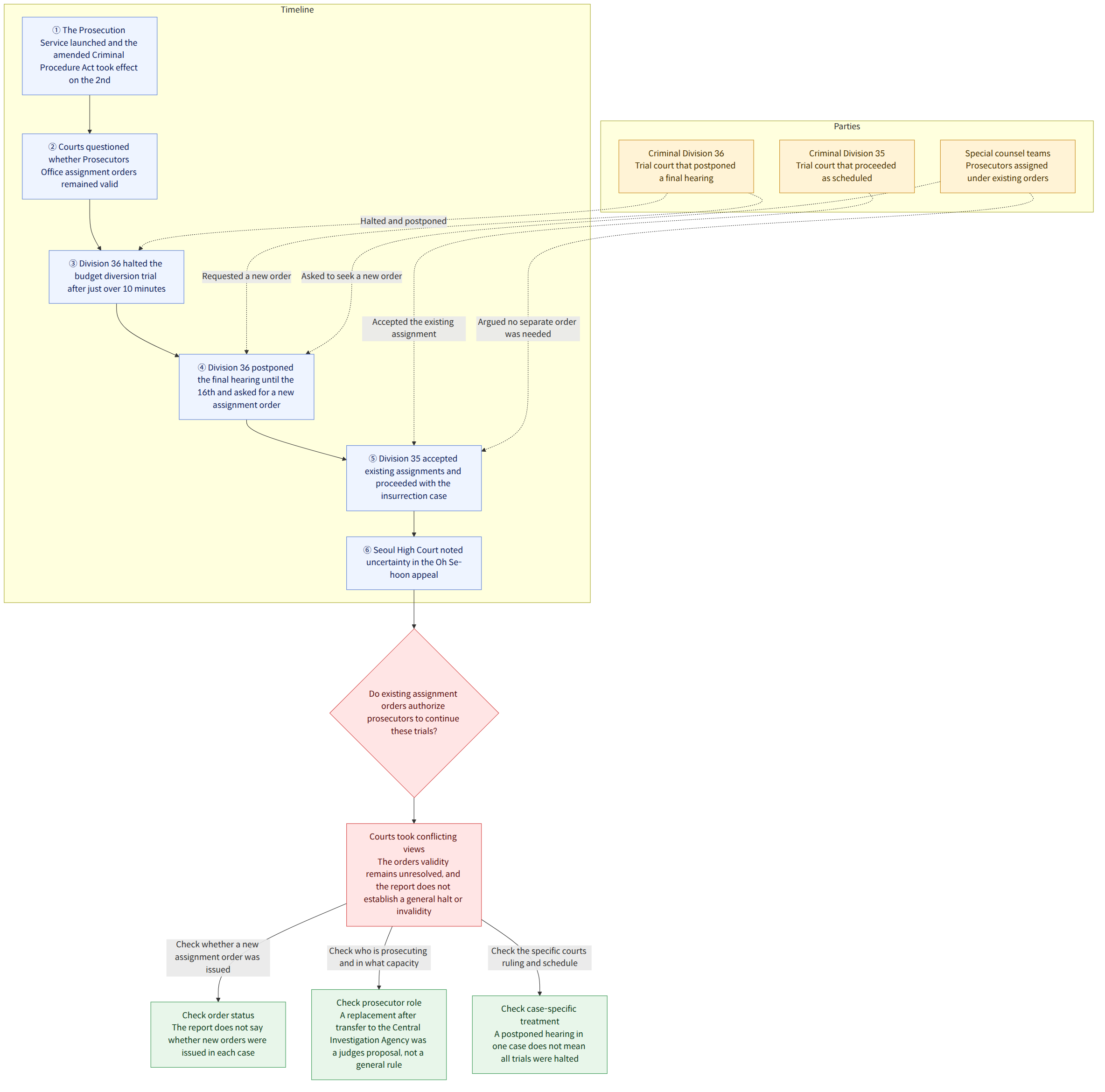
Since the amended Criminal Procedure Act (개정 형사소송법) took effect on the 2nd, courts have seen confusion over whether prosecutors assigned to special counsel teams (특검팀) can continue prosecuting cases. The central question is whether assignment orders issued by the abolished Prosecutors’ Office remain valid at the newly launched Prosecution Service (공소청). Seoul Central District Court’s Criminal Division 36 halted a related trial and postponed its final hearing until the 16th, but another division on the same day recognized the existing assignment and proceeded with its trial as scheduled.
Background and context
The issue began with whether a prosecutor assigned to a special counsel team from the Prosecutors’ Office could continue participating in trials under the same order after the new agency, the Prosecution Service, launched. The court is examining not simply whether the prosecutor took part in the special counsel investigation, but whether the prosecutor is legally authorized to continue prosecuting the case in the current trial. Continuing a prosecution means that a prosecutor continues to handle a case they have charged and to move the trial process forward.
On the 2nd, Seoul Central District Court’s Criminal Division 36 halted, after just over 10 minutes, the trial over the “diversion of the budget for the residence relocation” involving former presidential chief of staff Kim Dae-ki and former Interior and Safety Minister Lee Sang-min, among others. The court found that the transitional provision (a provision specifying how existing procedures are to continue when the law changes) was unclear as to whether an existing assignment order remained valid after the prosecutor’s institution changed. It therefore postponed the scheduled final hearing until the 16th and asked the special counsel team to pursue a new assignment order under the Prosecution Service.
By contrast, Seoul Central District Court’s Criminal Division 35 proceeded as scheduled with the case against Hwang Kyo-ahn, leader of the Freedom and Innovation Party, on charges of inciting insurrection. The division accepted the special counsel team’s position that a separate personnel or assignment order was unnecessary, citing a supplementary provision of the Prosecution Service Act (공소청법) stating that “prosecutors of the Prosecutors’ Office are deemed to be prosecutors of the Prosecution Service.” In effect, courts took different views on the validity of existing assignment orders on the same day.
In the appeal of Seoul Mayor Oh Se-hoon’s “alleged payment of polling costs by another party,” Seoul High Court’s Criminal Division 7 noted that it was not legally clear whether a prosecutor assigned to Special Counsel Min Joong-ki’s team, which investigated allegations involving First Lady Kim Keon-hee, was qualified to participate in the hearing. In that trial, the special counsel’s final arguments and sentencing recommendation were delivered by a deputy special counsel, not the assigned prosecutor. A presiding judge in the Seoul area said the special counsel team should receive new assignment orders and that, when a prosecutor responsible for continuing a prosecution had moved to the Central Investigation Agency (중수청), another trial prosecutor should be assigned.
What this news means
This issue is not limited to the qualifications of one assigned prosecutor; it also affects whether trials can proceed on schedule. As in the case before Criminal Division 36, a final hearing may be postponed if a court decides it must first verify that the procedure is lawful. However, another division recognized the existing assignment and proceeded with its trial, so there is no basis to conclude that all special counsel trials have been halted or that all existing assignments have been invalidated.
For defendants and their lawyers, as well as special counsel teams, it may matter who is participating in a current trial and in what capacity. In particular, one view raised was that another prosecutor should be assigned when the prosecutor responsible for continuing a prosecution has moved to the Central Investigation Agency. It is important to distinguish this from a general rule established by the courts: it was a procedural proposal raised by one presiding judge in the Seoul area.
For example, parties to a trial involving a similar issue may need to check not only whether the trial schedule has changed, but also how the court has dealt with the validity of the assignment order. This report alone does not establish whether new assignment orders were actually issued in each case or how the trials proceeded as a result.
Related制度 and support information
The in-house legal guide L1 (사내 법률 가이드 L1) explains that whether evidence can be used in a criminal trial may depend on how it was collected and prepared and on whether the parties had an opportunity to challenge its contents in court. Evidence collected unlawfully generally cannot be used to prove guilt, although exceptions may be considered; admissibility (whether evidence is qualified for use in a trial) is a separate issue from the evidence’s credibility and probative value.
However, L1 is guidance on the admissibility of evidence, not a resource for determining whether existing assignment orders remain valid after the transition from the Prosecutors’ Office to the Prosecution Service. The issue at hand therefore cannot be treated as the same as an evidentiary-admissibility issue. Nor does this material provide a basis for concluding that any particular evidence automatically becomes valid or invalid solely because of a ruling on an assigned prosecutor’s qualification to participate in a trial.
What is confirmed and what is still unknown
Confirmed facts
- After the amended Criminal Procedure Act took effect, confusion arose in the courts over whether prosecutors assigned to special counsel teams were qualified to continue prosecuting cases.
- Seoul Central District Court’s Criminal Division 36 halted the trial over the “diversion of the budget for the residence relocation” and postponed the final hearing until the 16th.
- Criminal Division 36 asked the special counsel team to pursue a new assignment order under the Prosecution Service.
- Seoul Central District Court’s Criminal Division 35 accepted the special counsel team’s position that a separate assignment order was unnecessary, citing the supplementary provision of the Prosecution Service Act.
- In the case before Seoul High Court’s Criminal Division 7, a deputy special counsel, rather than an assigned prosecutor, delivered the special counsel team’s final arguments and sentencing recommendation.
Still unknown
- What is the final legal determination on whether assignment orders issued by the former Prosecutors’ Office remain valid after the Prosecution Service launched?
- Did the Prosecution Service actually reassign prosecutors to the special counsel team?
- Did the final hearing postponed until the 16th actually take place, and what changes, if any, were made to the procedures and schedules of other trials afterward?
What readers should check
- Parties to the relevant trials can check how the court ruled on the assigned prosecutor’s qualification to participate and whether the next hearing date has changed.
- This report does not establish whether a new assignment order from the Prosecution Service was issued, so that should be checked separately through the proceedings in the relevant case.
- If the use of evidence is at issue, readers should distinguish that question from the assigned prosecutor’s qualifications and examine how the evidence was collected and prepared and whether there was an opportunity to challenge it in court.