
1. A Human Story
When Jae-min Han walked out of prison, he tried to return to the quiet routine he had left behind. He had served six months after being convicted of adultery. The conviction had become final, and he believed the case was over—even though the stigma followed him into work and family life.
Years later, Jae-min heard that South Korea’s Constitutional Court had ruled the adultery offense unconstitutional. The decision raised two urgent questions: could he reopen a conviction that was already final, and could he recover anything for the six months he had spent behind bars?
2. The Legal Question
Can someone whose adultery conviction was already final before the Constitutional Court struck down the offense seek a retrial? If that retrial results in an acquittal, can the person claim compensation for the time spent in custody?
The answer turns first on when the conviction became final. A retrial is not available in every case simply because the criminal law was later invalidated.
3. What Korean Law Says
On February 26, 2015, the Constitutional Court held that punishing consensual sexual conduct between adults as adultery violated constitutional protections for sexual self-determination and the privacy of personal life. The Court reasoned that intimate private conduct ordinarily belongs to individual choice, and that criminal punishment should be reserved for situations in which it is necessary to protect important interests.
The Court’s central principle was that the state should avoid intruding into the intimate sphere of private sexual life. Making consensual adult conduct a crime, it concluded, infringed sexual self-determination and the right to privacy.
The Constitutional Court Act sets out what happens to a criminal provision after it is declared unconstitutional:
Under Article 47(3), a provision concerning criminal punishment generally loses its force retroactively. But if the Constitutional Court had previously ruled that provision constitutional, the loss of force dates back to the day after that earlier ruling.
Article 47(4) permits a retrial of a final guilty judgment based on a law or provision declared unconstitutional.
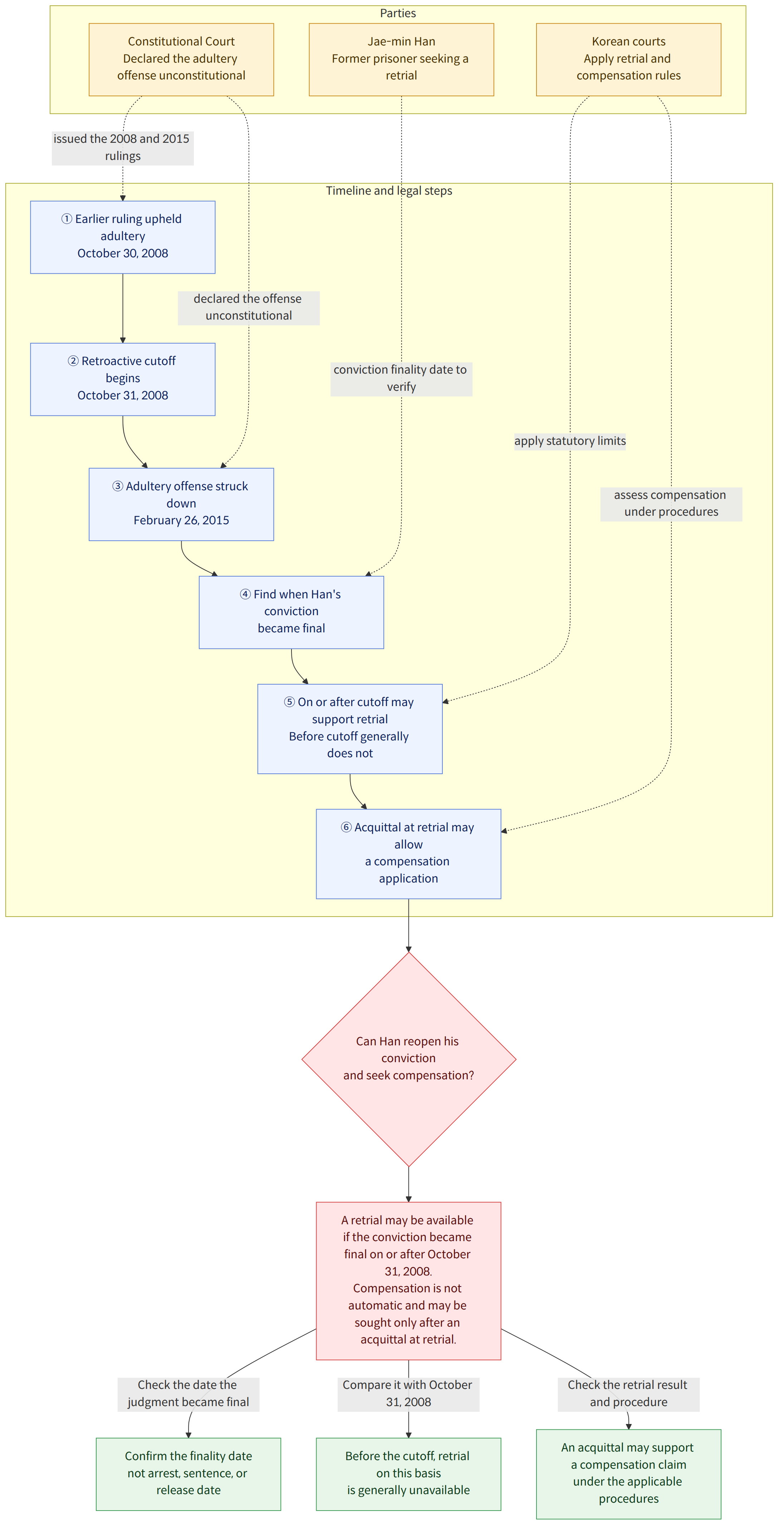
For the adultery offense, the relevant earlier ruling upholding the provision was issued on October 30, 2008. As a result, the key practical points are:
- If the adultery conviction became final on or after October 31, 2008, the later unconstitutionality ruling may provide grounds to seek a retrial.
- If the conviction became final before October 31, 2008, the special retroactive effect described above generally does not reach it, so a retrial on this basis is generally unavailable.
- A person who was imprisoned and later receives an acquittal at retrial may apply for compensation under the Criminal Compensation and Restoration of Reputation Act. Compensation is not automatic; it must be sought under the applicable legal procedures.
4. How Korean Courts Approach This
Korean courts treat a constitutional ruling against a criminal statute as significant, but they also apply the limits written into the Constitutional Court Act. The fact that a law has been struck down does not, by itself, erase every earlier conviction. Courts look at whether the particular conviction falls within the statute’s retroactive effect and whether the person has a legally available ground for retrial.
The controlling distinction is not simply whether the conviction predates the 2015 decision. For a criminal provision previously upheld as constitutional, the statutory cutoff is tied to the day after that earlier ruling.
Courts also distinguish between reopening a case and obtaining compensation. A person must first secure a qualifying result—such as an acquittal at retrial—before seeking compensation for detention. The claim is then assessed under the criminal compensation statute and its procedural requirements.
5. Applying the Law to the Case
Jae-min’s six-month imprisonment matters, but it does not alone establish that he can reopen his case or receive money. The legal analysis proceeds in stages:
- Find the date his conviction became final. The relevant date is when the judgment became final, not the date he was arrested, sentenced, or released.
- Compare that date with the cutoff. If Jae-min’s conviction became final on or after October 31, 2008, it falls within the period potentially affected by the 2015 constitutional ruling. He may seek a retrial under Article 47(4). If it became final before that date, the retroactive effect generally does not extend to his conviction on this basis.
- Determine the outcome of the retrial. Eligibility to request a retrial is not the same as an acquittal. The retrial must proceed, and its result will determine whether the conviction is set aside.
- Address compensation only after an acquittal. If Jae-min is acquitted at retrial, he may apply for criminal compensation for the period he was detained. His six months in custody would be relevant to that application, but the amount and entitlement would be determined under the governing statute and procedures.
The facts given do not specify when Jae-min’s conviction became final. That missing date prevents a single unconditional answer. If it was finalized after the cutoff, he has a route to ask for a retrial; if finalized earlier, the constitutional ruling generally does not reopen the case through this mechanism.
6. Conclusion: What Happened, and What Should You Do?
Jae-min checked the court record and learned that his conviction had become final in November 2008. Because that was after October 31, 2008, he could seek a retrial based on the Constitutional Court’s ruling. In this fictional case, the retrial ended in an acquittal. He then applied for criminal compensation for the six months he had been imprisoned. The law allowed him to pursue that claim, though the amount depended on the statutory assessment—not simply on multiplying six months by a fixed sum.
Anyone in a similar position should take these practical steps:
- Obtain the final judgment and confirm the exact date it became final. That date may decide whether a retrial is available.
- Get legal advice promptly about filing a retrial application. Eligibility, evidence, and procedural deadlines can matter.
- If acquitted at retrial, ask about a separate compensation application. Keep records showing the period of detention and follow the applicable filing procedure.