
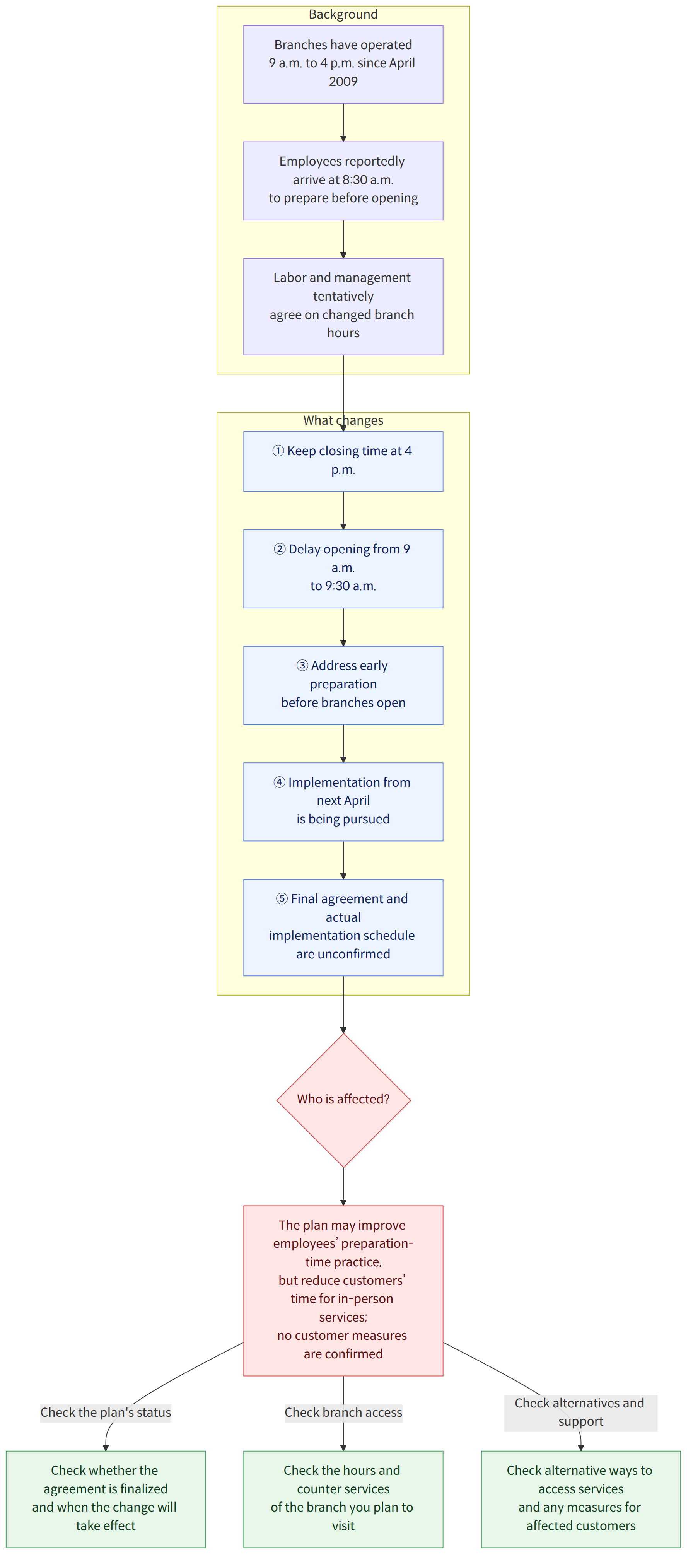
Labor and management in the financial industry have tentatively agreed on a plan to change bank branch hours. According to the article, the plan would keep closing time at 4 p.m. and delay opening time by 30 minutes, from 9 a.m. to 9:30 a.m., with implementation from next April being pursued. The change is intended to end the practice of branch employees having to arrive by 8:30 a.m. to prepare for opening, even though that time is not recognized as working hours. However, the article does not confirm whether the tentative agreement has been finalized or whether the actual implementation schedule has been set.
Background and context
Until now, bank branches have operated from 9 a.m. to 4 p.m. on weekdays. These hours were introduced in April 2009. The intention was to have branches open and close 30 minutes earlier than before, reducing bank employees’ chronic overtime and allowing them to leave work earlier.
However, after the hours changed, complaints also emerged that the convenience of financial consumers was being pushed aside in favor of workers’ convenience. Three years after the change, the Financial Industry Union (금융노조) raised concerns that although banks were closing earlier, employees were not leaving work any earlier and were simply starting 30 minutes earlier. A debate arose over whether to delay opening and closing times by 30 minutes, but then-Financial Services Commission (금융위원회) Chair Kim Seok-dong publicly opposed the idea, saying it would disregard customer convenience, and the hours remained unchanged.
This change would go in the opposite direction from the one proposed then. Rather than pushing closing time later, it would delay opening time and address how employees’ preparation time before opening is treated. The practice of arriving at 8:30 a.m. described in the article means that working conditions not reflected in the posted business hours prompted the adjustment. At the same time, branch hours have remained unchanged for 17 years, so changing opening time will also affect the hours during which customers can access in-person services that they have grown accustomed to using.
What this news means
For employees, the measure could change the practice of arriving early to prepare for opening. But with branch hours shortened by 30 minutes, customers who need in-person services may have less time available to visit. The article identifies older people who have difficulty using online banking, workers who take annual leave to visit a bank, and self-employed people as groups who may face greater inconvenience.
This issue is notable because employees’ working practices and consumers’ access to financial services should not be treated as mutually exclusive choices. Even while pursuing better working conditions, it is necessary to examine the actual hours when customers who need in-person services can receive them. The article does not say that any measures have been put in place to reduce inconvenience for financial consumers. The change to branch hours and measures to address its impact on consumers therefore need to be assessed separately.
For example, if a customer who has difficulty using online banking has routinely visited a bank counter shortly after 9 a.m., a later opening time could mean changing their schedule or looking into another way to access services. This describes a possible situation and does not mean that the same inconvenience will occur at every bank. To assess the actual impact, customers should check the hours of the branch they plan to visit, what counter services are available and whether there are alternative ways to access them.
Related rules and support information
This article discusses bank employees’ preparation time before opening and their work practices, but the article alone does not show how that preparation time is treated under the law or how working hours are recorded at individual banks. Internal working-hours guidance says that actual working time and breaks should be distinguished, and records of arrival and departure should be checked alongside the time employees were actually able to take breaks. This does not mean that the specific working conditions of bank employees have been confirmed; it is general guidance on what records to examine when assessing working hours.
The same guidance says that overtime pay for work exceeding 40 hours a week may additionally be recognized at workplaces with five or more employees. According to the guidance, pay for hours exceeding scheduled working hours is also subject to the condition that the workplace has five or more employees. Therefore, the early-arrival practice mentioned in this article alone is not enough to determine whether wages were paid or whether the practice was illegal. Actual working hours, break times, workplace size and applicable conditions must all be checked.
Another part of the context for this discussion is that, in 2002, the Financial Industry Union introduced a five-day workweek across the domestic industrial sector for the first time through a labor-management agreement, helping pave the way for the wider social adoption of the five-day workweek and its statutory implementation in 2004. This is why the article links the current change to the rationale of reducing working hours. However, the fact that an earlier change to the system spread throughout society does not in itself mean that this change to branch hours will have the same result. How to reduce inconvenience for customers must also be discussed.
What is confirmed and what remains unknown
Confirmed facts
- Bank branches currently operate from 9 a.m. to 4 p.m. on weekdays, and these hours were introduced in April 2009.
- Labor and management in the financial industry have tentatively agreed on a plan to delay opening time to 9:30 a.m. while keeping closing time at 4 p.m.
- The change is intended to end the practice of employees arriving by 8:30 a.m. to prepare for opening, even though that time is not recognized as working hours.
- The article notes that older people, workers who take annual leave to visit a bank and self-employed people may face greater inconvenience.
What remains unknown
- It is not confirmed whether the tentative labor-management agreement has been finalized or whether the actual implementation schedule has been set.
- It is not confirmed whether measures have been put in place to reduce the consumer inconvenience expected from the shorter branch hours.
- The article does not discuss how branch operations or alternative services available to customers may change.
- It is not confirmed how employees’ preparation time before opening is actually recorded or treated as working time.
What readers should check
- Once implementation and its timing are confirmed, check the actual opening and closing times of the branch you use regularly. The agreement has been reported as tentative for now, so it should be distinguished from a finalized schedule.
- If you need to visit a branch for an in-person service, check its hours and available options before going. The article does not establish that alternative services or other measures are in place.
- When assessing bank employees’ working hours, distinguish among arrival and departure records, time actually spent working and break time. Whether overtime pay is due depends on applicable conditions, including workplace size and the specific work arrangements.