1. A Human Story
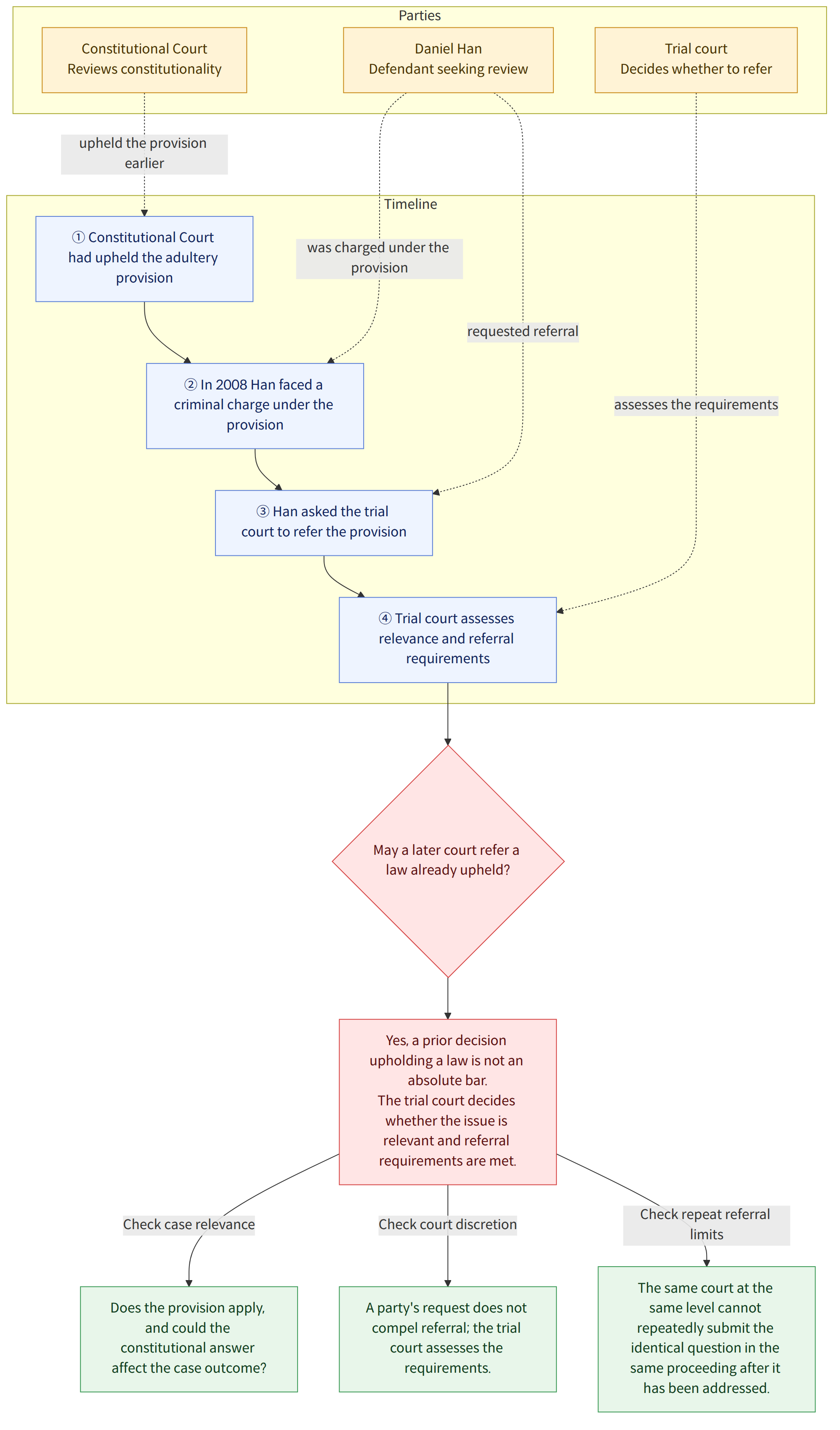
In 2008, Daniel Han sat through another day of a criminal trial that threatened to reshape his family’s life. He had been charged under the Criminal Act’s adultery provision, and his lawyer argued that the law intruded too deeply into private relationships. Daniel asked the trial court to refer that provision to the Constitutional Court for review.
There was a complication: the Constitutional Court had already ruled the adultery provision constitutional. Daniel wondered whether that earlier decision had ended the argument before it could begin. His case raised a broader question about how much weight a past constitutional ruling carries when a law is challenged again.
2. The Legal Question
If the Constitutional Court has previously upheld a law, may a court hearing a later case still refer that same law for constitutional review? The answer is generally yes, provided the law is relevant to the case before the court. But that does not mean every request must be granted, or that the same court may repeat the same referral without limit.
3. What Korean Law Says
South Korea uses a system of concrete constitutional review. In broad terms, a court may ask the Constitutional Court to decide whether a statute is constitutional when that question arises in a real case and the answer could affect the case’s outcome. A party may ask the court to make such a referral, but the court decides whether the legal requirements are met.
Under Article 107(1) of the Constitution, when the constitutionality of a law is at issue in a trial, the court is to request a decision from the Constitutional Court and decide the case in accordance with that decision.
Article 41(1) of the Constitutional Court Act allows a court to request constitutional review, either on a party’s motion or on its own initiative, when the constitutionality of a law applicable to the trial is in question.
Three practical points follow:
- The law must be relevant. The challenged provision must apply to the case, and the constitutional answer must be capable of affecting the decision.
- A party’s application is not an automatic referral. The trial court assesses whether the legal conditions are satisfied and whether a referral is warranted.
- A prior decision upholding the law is not an absolute bar. South Korean constitutional practice has allowed courts to refer a statute again even after an earlier decision found it constitutional.
This last point reflects an important distinction. A prior decision that a law is constitutional does not have the same binding effect as a decision declaring a law unconstitutional. The legislature remains free to amend or repeal a law that has been upheld, and a court in a later case may still raise a new constitutional question about it.
4. How Korean Courts Approach This
Korean courts generally treat constitutional review as a tool for resolving genuine disputes, not as an abstract invitation to revisit any statute a litigant dislikes. The court first asks whether the challenged law governs the case and whether the constitutional issue could change its outcome. If not, a referral is not appropriate.
A constitutional challenge must arise from the case before the court: the court does not refer a law merely to obtain an advisory opinion on a question unrelated to the judgment it must deliver.
If the necessary connection exists, an earlier ruling upholding the statute does not automatically prevent a new referral in a different case. Legal arguments, circumstances, and the court’s assessment may develop over time. But procedural limits remain: a court cannot itself strike down a statute through ordinary adjudication, and the same court at the same level cannot simply submit the identical question repeatedly in the same proceeding after it has already been addressed.
5. Applying the Law to Daniel’s Case
First, the adultery provision was central to the prosecution. Daniel was charged under that provision. Whether it could constitutionally be applied was therefore not an abstract matter; it was connected to the legal basis for the criminal case.
Second, the previous decision did not automatically prevent a new referral. The earlier ruling had upheld the provision, but that alone did not make the constitutional question permanently closed to every later court. The trial court could consider Daniel’s request and, if it concluded the requirements were met, refer the issue to the Constitutional Court.
Third, Daniel could not demand a referral simply by filing an application. The trial court had to decide whether the constitutional issue was properly before it and whether the law’s validity mattered to the judgment. It could refuse the request if those conditions were not satisfied or if it did not consider a referral justified.
Finally, the distinction between a separate case and a repeated request matters. A new court handling a later case could consider a fresh referral despite the earlier uphold ruling. But if the same court, at the same procedural level, had already obtained a decision on the same constitutional question in Daniel’s proceeding, it could not keep resubmitting that identical question as though the earlier step had never happened.
6. Conclusion: What Happened, and What Should You Do?
On the facts of Daniel’s case, the trial court was not barred from referring the adultery provision merely because it had previously been upheld. It still had to find that the provision applied to the prosecution and that the constitutional issue could affect the result. If it made that assessment in Daniel’s favor, it could send the question to the Constitutional Court; the earlier ruling did not, by itself, decide the matter for every future case.
There is an important update for readers today: in 2015, the Constitutional Court held South Korea’s adultery offense unconstitutional. The provision is no longer a criminal offense. Daniel’s story is set before that ruling, but the wider lesson remains relevant whenever a statute is challenged in a live case.
If you are facing a similar issue:
- Identify the law’s direct effect on your case. Explain precisely how the provision applies and how a constitutional ruling could affect the outcome.
- Treat a referral request as a legal argument, not an automatic entitlement. Present the constitutional grounds clearly and address why the court should consider the question.
- Check the law’s current status and the procedural history. A law may have since been amended, repealed, or invalidated, and a prior ruling in the same proceeding may affect whether another referral is possible.