1. A Human Story
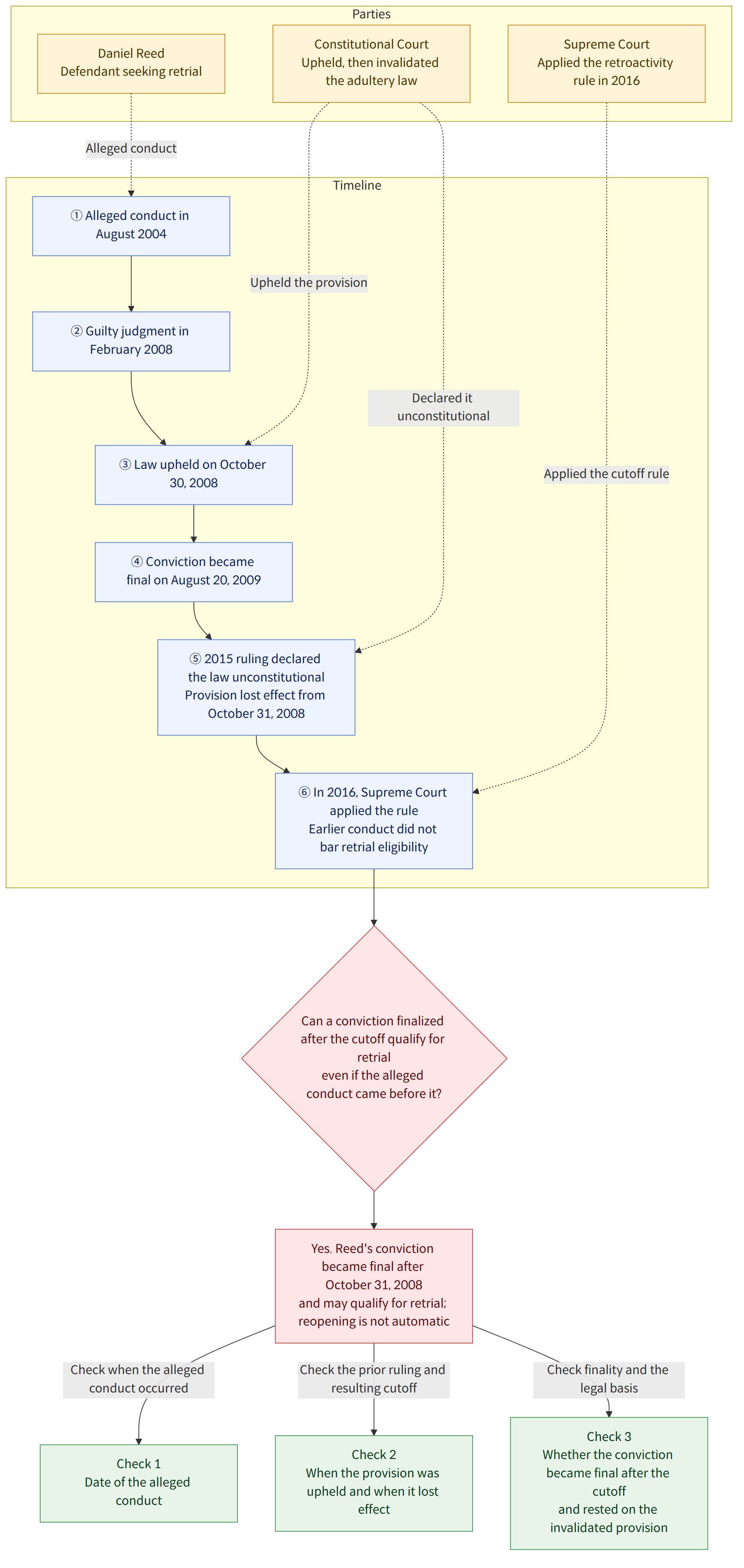
In the summer of 2004, Daniel Reed made a choice that would follow him for years. He was accused of adultery under South Korea’s criminal law and, after prosecution, received a guilty judgment in February 2008. Daniel appealed, but the conviction did not become final until August 20, 2009.
By then, the constitutional landscape had shifted—though not yet in the way Daniel needed. In October 2008, South Korea’s Constitutional Court had upheld the adultery law. Years later, on February 26, 2015, the Court reversed course and ruled the offense unconstitutional. Daniel now faced a difficult question: did the 2015 decision offer a way to challenge a conviction that had become final after the earlier ruling, even though the alleged conduct came before it?
2. The Legal Question
Can someone seek a retrial when the alleged crime occurred before the Constitutional Court’s earlier decision upholding the law, but the conviction became final afterward—and the law was later declared unconstitutional?
For Daniel, the key issue is not only when the alleged conduct occurred. It is also whether his final conviction relied on a criminal provision that, under the rules governing the later constitutional ruling, had lost effect before his conviction became final.
3. What Korean Law Says
South Korea’s Constitutional Court Act sets out what happens when a law is declared unconstitutional. The rule for criminal laws gives the decision retroactive effect, subject to an important qualification: if the Constitutional Court had previously upheld that same provision, the law loses effect from the day after that earlier decision.
“A law or provision declared unconstitutional loses effect retroactively” when it concerns criminal punishment, but if it was previously upheld as constitutional, it loses effect from the day after that constitutionality decision. A final guilty judgment based on the unconstitutional law may then be challenged through retrial. — Constitutional Court Act, Article 47(3)–(4), in substance
The rule therefore requires attention to three dates:
- The alleged conduct: When did the person’s actions take place?
- The earlier constitutionality decision: Had the Constitutional Court previously upheld the criminal provision, and when?
- The final conviction: Did the guilty judgment become final after the date from which the provision lost effect?
A declaration of unconstitutionality does not itself erase every past conviction. Article 47(4) provides a route to seek a retrial for a final conviction based on the invalidated criminal law. The person must apply to the court; reopening and resolving the case are judicial steps, not an automatic administrative cancellation.
4. How Korean Courts Approach This
Korean courts have treated the phrase “a final guilty judgment based on a law or provision declared unconstitutional” as covering convictions that applied a criminal provision which lost effect retroactively under Article 47(3). The decisive point is how the statute operated in relation to the conviction—not simply whether the alleged conduct predated the Constitutional Court’s first decision.
Where a prior decision upheld a criminal provision, but the later unconstitutionality ruling means the provision lost effect from the day after that prior decision, a guilty judgment that was pronounced and became final after that date may be eligible for retrial—even if the alleged offense occurred earlier.
The Supreme Court applied this reasoning in a 2016 decision concerning the adultery offense. It held that a conviction finalized after the relevant cutoff could be challenged even though the conduct occurred before the Constitutional Court had first upheld the law. That approach reflects a basic distinction: the date of the alleged act determines the law’s historical context, while the statutory retroactivity rule determines whether the provision could continue to support a later-final conviction.
5. Applying the Law to the Case
Daniel’s dates fit the rule the courts applied.
- His alleged conduct took place in August 2004. That was before the Constitutional Court’s October 30, 2008 decision upholding the adultery provision.
- The law was later declared unconstitutional on February 26, 2015. Because the Court had previously upheld it, the criminal provision lost effect from the day after the earlier decision—October 31, 2008—not from the date of the 2015 ruling.
- Daniel’s conviction became final on August 20, 2009. That was after October 31, 2008. Although the alleged conduct predated the cutoff, the conviction became final after the law had, under Article 47, lost effect retroactively from that cutoff date.
- The conviction relied on that criminal provision. It therefore falls within the category of final convictions for which Article 47(4) permits a retrial, as the Supreme Court’s approach indicates.
The earlier trial judgment in February 2008 does not change the conclusion. The important point for this issue is that the conviction did not become final until after the date from which the provision was treated as having lost effect. Daniel would still need to file a retrial application and have the court grant it; the constitutional ruling does not by itself revise his record. But on these facts, he has a strong basis to seek that relief, and an acquittal would be expected because the criminal provision supporting the conviction can no longer sustain it.
6. Conclusion: What Happened, and What Should You Do?
Daniel filed for a retrial. The court reopened the case and, applying the constitutional ruling and the retroactive rule for criminal laws, entered an acquittal. His alleged conduct had occurred years before the law was first upheld, but the timing of his final conviction placed him within the retrial rule.
If you are in a similar position:
- Build a precise timeline. Gather the dates of the alleged conduct, every judgment, the date the conviction became final, and the relevant Constitutional Court decisions.
- Obtain the full court record. The retrial question depends on whether the final conviction actually relied on the provision later declared unconstitutional.
- Ask a Korean criminal-law lawyer to assess and file a retrial application. Eligibility is not the same as automatic relief, and the court must decide whether the statutory requirements are met.