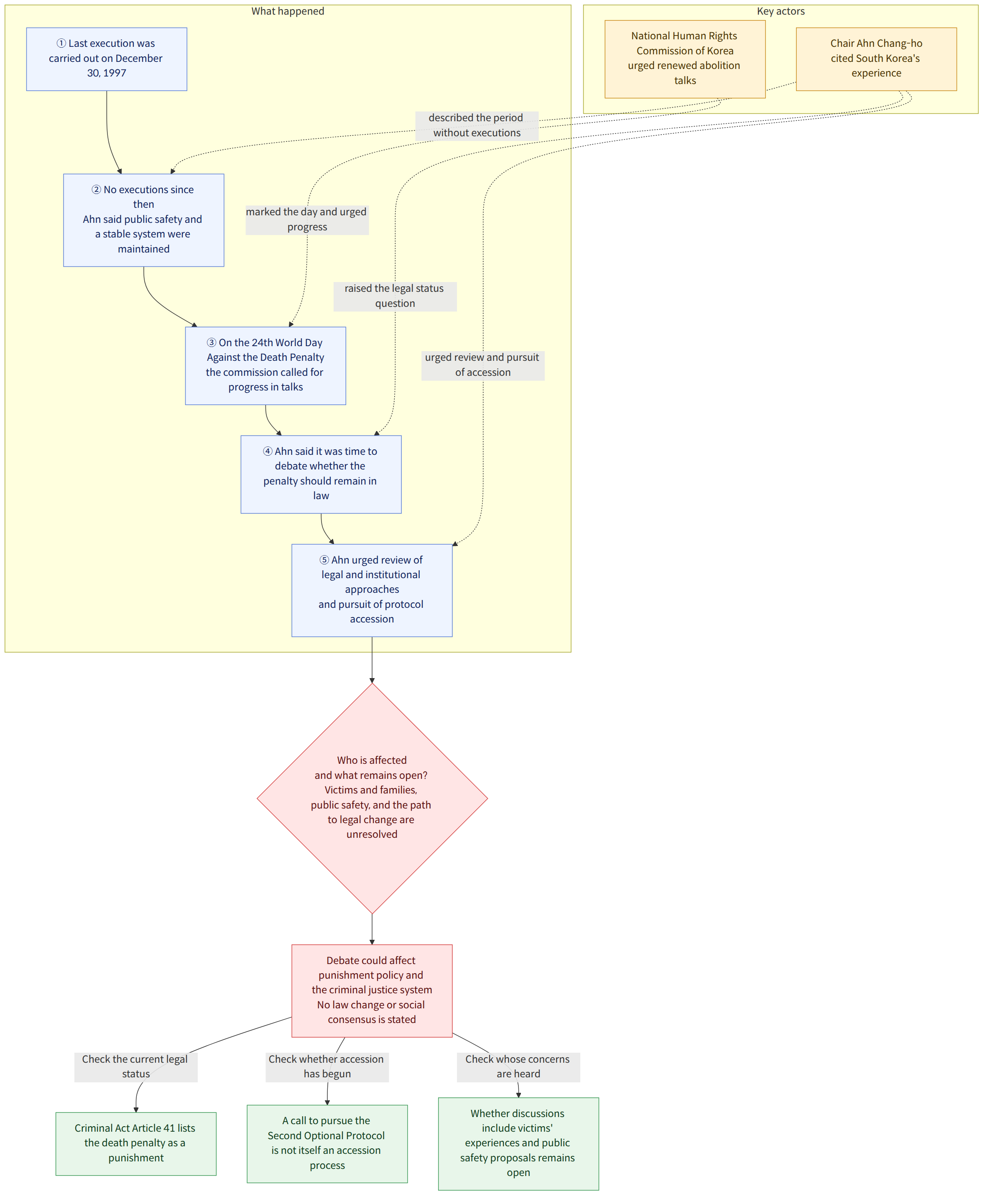
The National Human Rights Commission of Korea (국가인권위원회; NHRCK) called for renewed progress in discussions on abolishing the death penalty to mark the 24th World Day Against the Death Penalty. Chair Ahn Chang-ho said South Korea had carried out no executions since December 30, 1997, and had maintained public safety and a stable criminal justice system despite the suspension of executions. He described this experience as an asset that goes beyond simply suspending executions and said it was time to discuss whether the death penalty should remain in law.
Background and context
The central point of the call is that the long absence of executions should be grounds for reconsidering whether to retain the death penalty. A suspension of executions and abolition under the law are not the same thing. The fact that no executions have taken place does not, by itself, mean that the death penalty has been removed from the law; Chair Ahn called for discussion of precisely this question of its continued legal status.
A second report provided further detail on the call. It said Chair Ahn urged a review of legislative and institutional approaches to abolition and called for South Korea to pursue accession to the Second Optional Protocol to the International Covenant on Civil and Political Rights (시민적 및 정치적 권리에 관한 국제규약 제2선택의정서), also known as the Protocol to Abolish the Death Penalty (사형폐지의정서). According to that report, the protocol was adopted in December 1989 with the aim of abolishing the death penalty, and 92 countries, including Germany, France and Australia, had signed it. A reported call to pursue accession should be distinguished from the actual commencement of an accession process.
According to Amnesty International, as of the end of last year, 145 countries had abolished the death penalty in law or in practice—about three-quarters of all countries worldwide. Another report added that 113 of those countries had fully abolished the death penalty. These figures show an international trend, but do not, in themselves, determine what legal amendments or policies South Korea should adopt.
The second report also relayed Chair Ahn’s remarks that an execution is irreversible and that there have been cases in which people were found innocent in retrials after their execution. This raises the question of whether the possibility of error and the impossibility of reversing an execution should be considered together when weighing the severity of a punishment. However, this report alone cannot establish all the circumstances of any particular system or individual case.
What this news means
If discussions on abolishing the death penalty gain momentum, the direction of punishment policy and the criminal justice system could become issues. The continuation of the suspension of executions may provide a starting point for debate, but it does not mean that social consensus has been reached or that the law has been amended. For actual change to take place, the direction of the law and institutions would need to be reviewed, and victim protection and public safety considered together.
The suffering of victims and their families was cited as a consideration that cannot be left out of the debate on abolition. At the same time, Chair Ahn was reported to have said that strengthening protections for victims’ rights and the social safety net should be treated separately from the question of retaining the death penalty. This could lead to questions about whether measures to support victims and improve safety are being treated as arguments that substitute for deciding whether to retain the death penalty—or, conversely, whether victims’ voices are being excluded from discussions of abolition. The article does not say how those voices would be heard or taken into account.
For example, if a discussion on whether to abolish the death penalty were held, it would be possible to look at whether it included both a process for hearing the experiences of victims and their families and proposals for addressing public safety. This is an example of a possible way to hold such a discussion; it does not mean that such a process is currently underway.
Relevant laws and support information
According to the legal guide provided, the Criminal Act (형법) lists the death penalty as one of nine types of punishment, alongside imprisonment, penal servitude and fines (Article 41 of the Criminal Act). The suspension of executions and removing the death penalty from the list of punishments in law are therefore separate matters. The question of whether to retain the death penalty in law raised in these reports is directly related to the list of punishments in the Criminal Act, underscoring the need to understand this distinction.
However, the legal guide provided offers general explanations of types of punishment and their mitigation and execution; it does not provide information about a bill to abolish the death penalty, the process for acceding to the protocol, or how to apply for victim support. The information therefore does not allow specific claims about the status of legislative efforts or available support programs. The law applicable to an actual case must be checked separately in light of the specific facts and relevant statutes.
Differences between the reports
The first report focused on the experience of suspending executions, the international trend toward abolition, and the need to consider the suffering of victims and their families. The second report added the call to pursue accession to the Protocol to Abolish the Death Penalty, cases in which people were found innocent in retrials after execution, and the point that victim protection and the social safety net should be treated separately from the question of retaining the death penalty. The reports also used different names for the commemorative day: the first called it the World Day Against the Death Penalty, while the second called it the World Day for the Abolition of the Death Penalty.
What is confirmed and what remains unknown
Confirmed facts
- The National Human Rights Commission of Korea called for discussion on abolishing the death penalty to mark the 24th World Day Against the Death Penalty.
- Chair Ahn Chang-ho said South Korea had carried out no executions since December 30, 1997.
- According to figures cited from Amnesty International, as of the end of last year, 145 countries had abolished the death penalty in law or in practice.
- According to the second report, Chair Ahn called for South Korea to pursue accession to the Protocol to Abolish the Death Penalty.
- Chair Ahn said the suffering of victims and their families, victim protection and public safety should be considered in discussions on abolition.
What remains unknown
- It is not known whether specific legislative or policy measures to abolish the death penalty are being pursued in South Korea, or, if so, what their timetable and details are.
- The articles do not say whether an official process to accede to the Protocol to Abolish the Death Penalty has begun.
- No specific process for incorporating the views of victims and their families or public opinion into discussions on abolition has been confirmed.
What readers should check
- It is worth distinguishing the suspension of executions from abolition of the death penalty in law, and checking whether related legislative discussions are actually moving forward.
- Readers can check whether calls to accede to the Protocol to Abolish the Death Penalty remain at the policy-review stage or lead to an official process.
- It is worth watching whether concrete measures to protect victims’ rights and ensure public safety are proposed during the discussion, and whether a way is established to incorporate the views of victims and their families.
References
- Guide to Types of Criminal Punishment and Sentence Reduction and Enforcement
- Other coverage consulted: hani.co.kr