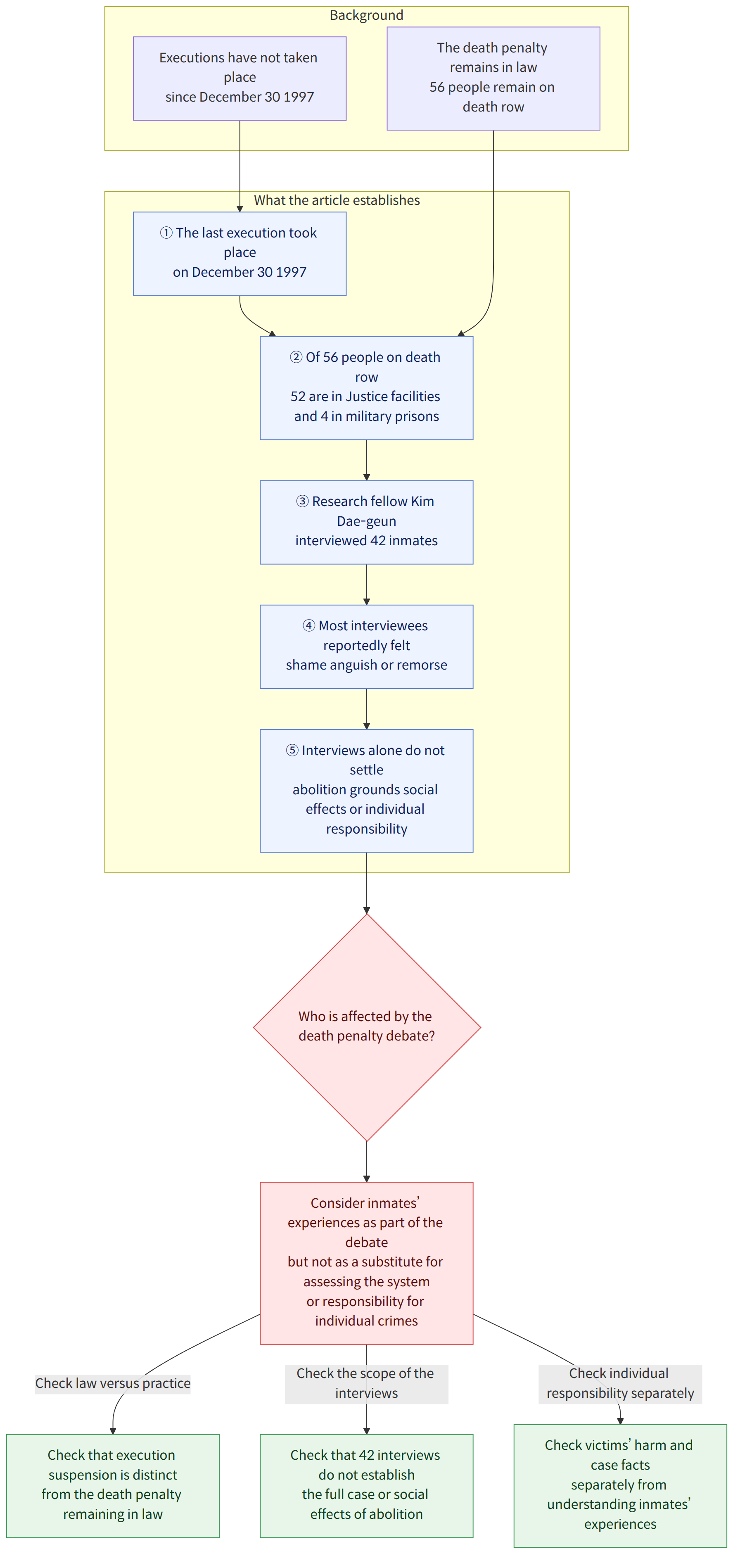
In South Korea, no execution has been carried out since December 30, 1997. The death penalty, however, remains on the books, and according to the article, 56 people are currently on death row. Kim Dae-geun, a research fellow at the Korean Institute of Criminology and Justice (한국형사·법무정책연구원), interviewed 42 of them. As a researcher who has examined death-row inmates’ experiences, he reportedly believes the death penalty should be abolished.
Background and context
Of the 56 people currently on death row, 52 are held in correctional facilities run by the Ministry of Justice and four are in military prisons. The long suspension of executions and the reality that people sentenced to death remain in custody must be considered together. The existence of the death penalty in law and its actual implementation are two different matters.
According to the article, before 1997, death-row inmates endured weekdays believing that executions could take place between 6 and 9 a.m. They felt relieved if nothing happened by 9 a.m., but went to sleep thinking that the following morning might be their last, the article explains. This highlights the contrast between the circumstances of people who remain on death row after executions stopped and the wait experienced by death-row inmates in the past.
Kim said that most of the death-row inmates he interviewed felt shame, anguish, or remorse about what they had done. He said he imagined they had appeared cruel and frightening at the time of their crimes, but that many of the death-row inmates he met in prison were older, frail men. Rather than erasing their crimes or judging on behalf of victims, these interviews offer an opportunity to consider the present circumstances and feelings of people in custody as part of the debate over the death penalty.
What this news means
Debate over the death penalty concerns not only the severity of punishment but also how to understand the purpose of punishment and justice. Even if executions have not taken place for a long time, the question of whether to retain the system is not merely an abstract debate detached from reality: the death penalty remains on the books, and people sentenced to death remain in custody. However, the interviews described in the article alone cannot establish the specific grounds for abolishing the death penalty or its social effects.
The account that interviewees felt remorse or anguish is also just one aspect of the current circumstances of individual death-row inmates. It cannot, by itself, determine their responsibility for their crimes, the scale of the harm to victims, or what punishment is appropriate. It is important not to conflate understanding death-row inmates with judging responsibility for their crimes.
For example, readers considering whether to retain or abolish the death penalty may take into account the experiences of death-row inmates revealed in the interviews without treating those experiences as a substitute for the full case for abolishing the system. Distinguishing individual experiences from judgments about the system in this way may help clarify the issues in the debate.
Relevant legal and support information
According to an in-house legal guide, the Criminal Act (형법) prescribes nine types of punishment (Article 41 of the Criminal Act). The suspension of executions must therefore be distinguished from the fact that the death penalty remains on the books as a type of punishment. The article also reports that the death penalty remains in South Korean law but is widely considered a punishment that cannot be carried out.
The legal guide provided, however, explains general matters concerning types of punishment, mitigation, and execution; it does not cover procedures for abolishing the death penalty or the individual cases of the death-row inmates mentioned in the article. The guide explains that a sentence is not automatically reduced or its execution waived solely because of particular circumstances such as turning oneself in or the expiration of a sentence’s limitation period. This principle cannot be applied directly to the cases of the death-row inmates to reach a conclusion; legal judgments in individual cases require separate examination of the specific facts and applicable laws.
What is confirmed and what remains unknown
Confirmed facts
- South Korea has not carried out an execution since December 30, 1997.
- According to the article, of the 56 people on death row, 52 are held in correctional facilities run by the Ministry of Justice and four are in military prisons.
- Research fellow Kim Dae-geun interviewed 42 death-row inmates.
- He said that most of the death-row inmates he interviewed felt shame, anguish, or remorse about their actions.
- The World Day Against the Death Penalty is an annual international observance calling for the abolition of the death penalty as a form of judicial punishment. It falls on October 10.
What remains unknown
- The original article does not say what specific grounds Kim gave for advocating the abolition of the death penalty.
- It is not possible to establish how the 42 interviewees were selected or when the interviews took place.
- It is not known how representative the views of the death-row inmates featured in the article are of the views of all death-row inmates.
What readers should check
- It is necessary to distinguish between the fact that executions are not actually being carried out and the fact that the death penalty remains a punishment under the law.
- The interviews are a report on the experiences of 42 participants, and readers should also bear in mind that the selection method and timing of the research are not provided.
- Types of punishment and whether a sentence in an individual case is reduced or carried out are separate matters. Anyone who needs a specific legal judgment should separately check the relevant laws and the facts of the case.