
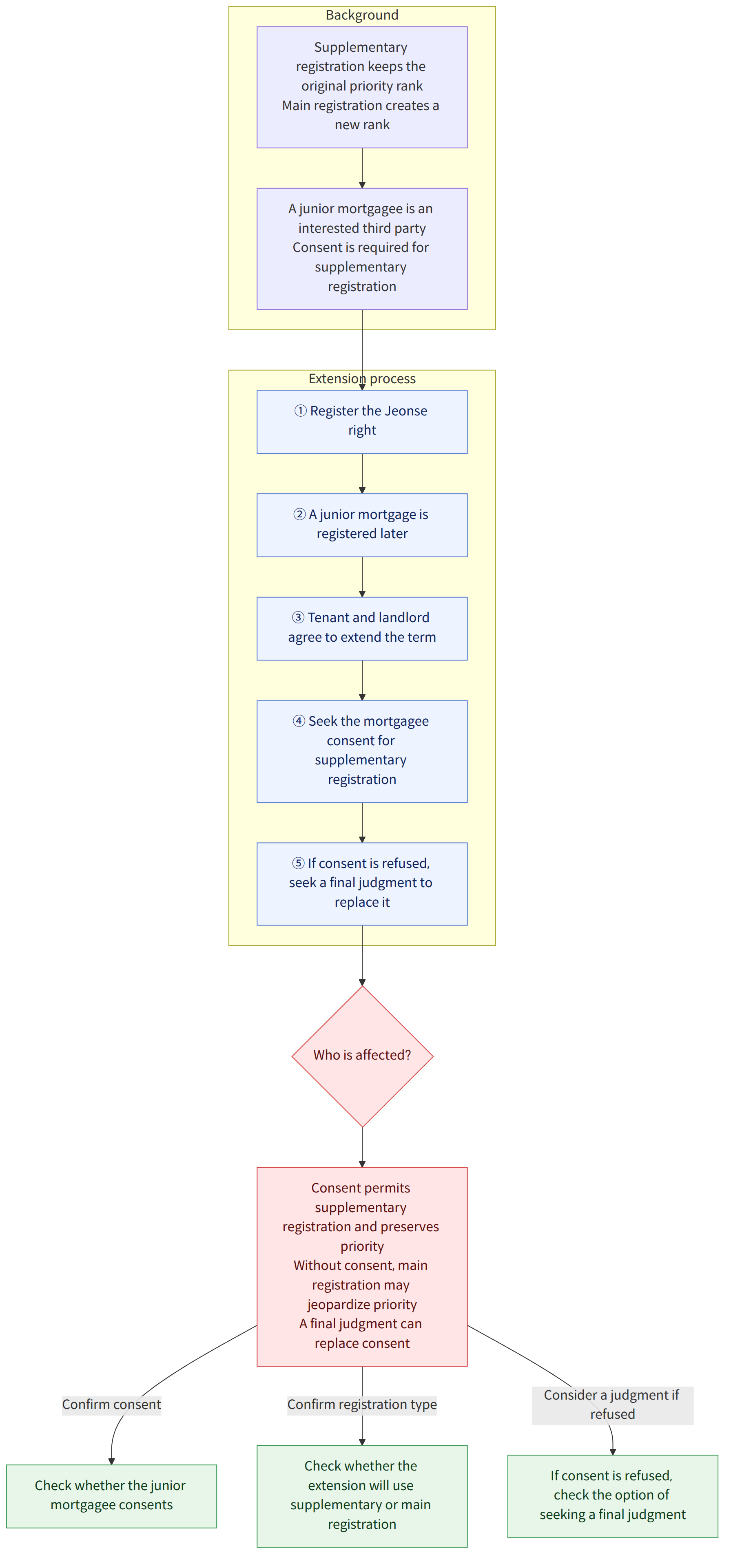
Protecting Your Priority When Extending a Jeonse Contract
For many foreigners living in Korea, the Jeonse system (a large lump-sum deposit instead of monthly rent) is a common way to secure housing. However, legal complications can arise when you want to extend your stay, especially if the landlord has taken out a loan and registered a mortgage (Geun-jeodang) on the property after you moved in.
The Legal Dilemma
Imagine you have a Jeonse deposit of 50 million KRW with a 2-year term. After you registered your Jeonse right, a bank or another person registered a mortgage on the same building. Now, your 2 years are up, and you and the landlord agree to extend the contract for another 2 years.
To ensure your deposit stays protected ahead of that bank, you need to update the registration. The question is: Do you need the bank's (the junior mortgagee's) permission?
The Importance of 'Supplementary Registration'
Under the Real Estate Registration Act, there are two ways to change a registration:
- Supplementary Registration (Bugidenggi): This allows the change to keep the same priority rank as the original registration (e.g., staying at rank #1).
- Main Registration (Judeunggi): This creates a new rank, potentially putting you behind the bank.
Key Legal Rule: To perform a 'Supplementary Registration' for extending the duration, you MUST have the consent of any 'interested third party.' A junior mortgagee is considered an interested party because extending your term could technically affect their interests.
What the Courts Say
According to Korean legal precedents, even if the deposit amount remains the same, extending the duration of the Jeonse right requires the consent of the junior mortgagee if you want to use supplementary registration to maintain your priority.
- If you get consent: You can file for supplementary registration, and your 1st-rank status is preserved for the extended period.
- If you don't get consent: The extension might only be registered as a 'Main Registration,' which could jeopardize your priority over the existing mortgage.
What if the Mortgagee Refuses?
If the junior mortgagee refuses to give their consent, you cannot simply force the supplementary registration.
- You may need to file a lawsuit to obtain a court judgment that replaces the mortgagee's consent.
- Once you have the final judgment, you can proceed with the supplementary registration without their signature.
--- This information is provided for general guidance. If you are facing issues with Jeonse extensions or property rights, it is highly recommended to consult with a legal professional.