Unauthorized Access to Former Colleagues' Emails
In professional settings, it is common for team members to share email credentials for business continuity. However, many foreigners in Korea are unaware that continuing to use these credentials after a colleague has resigned can lead to serious criminal liability.
The Case of Shared Passwords
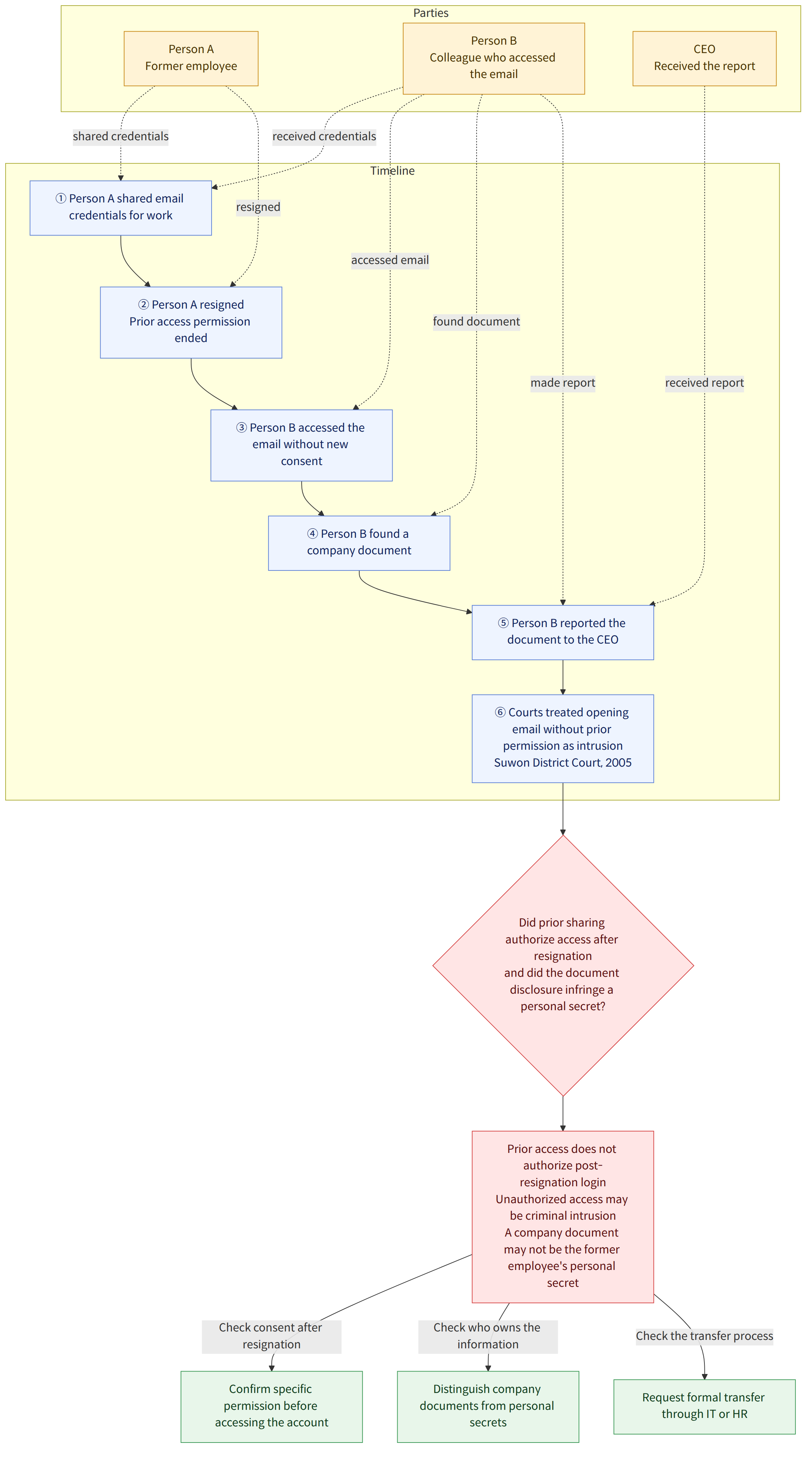
Imagine a scenario where an employee (Person A) shared their email ID and password with a colleague (Person B) for work purposes. After Person A resigned, Person B accessed the email and used a document found there to report to the CEO.
Even if the email was practically 'open' to colleagues during employment, that permission immediately expires upon resignation.
1. Intrusion into Information Networks
According to the Act on Promotion of Information and Communications Network Utilization and Information Protection, no one should enter an information network without proper authority.
- The Rule: Accessing a retired person's email without their specific consent after they leave the company is considered an illegal 'intrusion'.
- The Penalty: Violators can face up to 5 years in prison or a fine of up to 50 million KRW.
- Precedent: Korean courts have ruled that even if the intent wasn't malicious initially, opening the email without prior permission is a violation (Suwon District Court 2005).
2. Infringement of Others' Secrets
Korean law also prohibits the 'leakage' or 'infringement' of others' secrets. However, there is a legal distinction regarding what counts as a "secret."
- Definition of 'Secret': It must be a fact not generally known, where keeping it private provides an interest to the individual.
- Company Documents: If the document found in the email (e.g., a business plan) was created by the CEO or the company, it is considered a company secret, not the individual's personal secret. Therefore, sharing such a document might not constitute a 'Secret Infringement' against the retired employee.
Important Warning for Foreign Residents
If you are taking over duties from a departing colleague, ensure that all official files are transferred to a company drive or shared folder.
- Do not log into a former employee's personal or business email account using saved passwords.
- Always request formal data transfer through the IT department or HR to avoid being accused of illegal intrusion.
This content is for informational purposes and should not replace professional legal advice.