
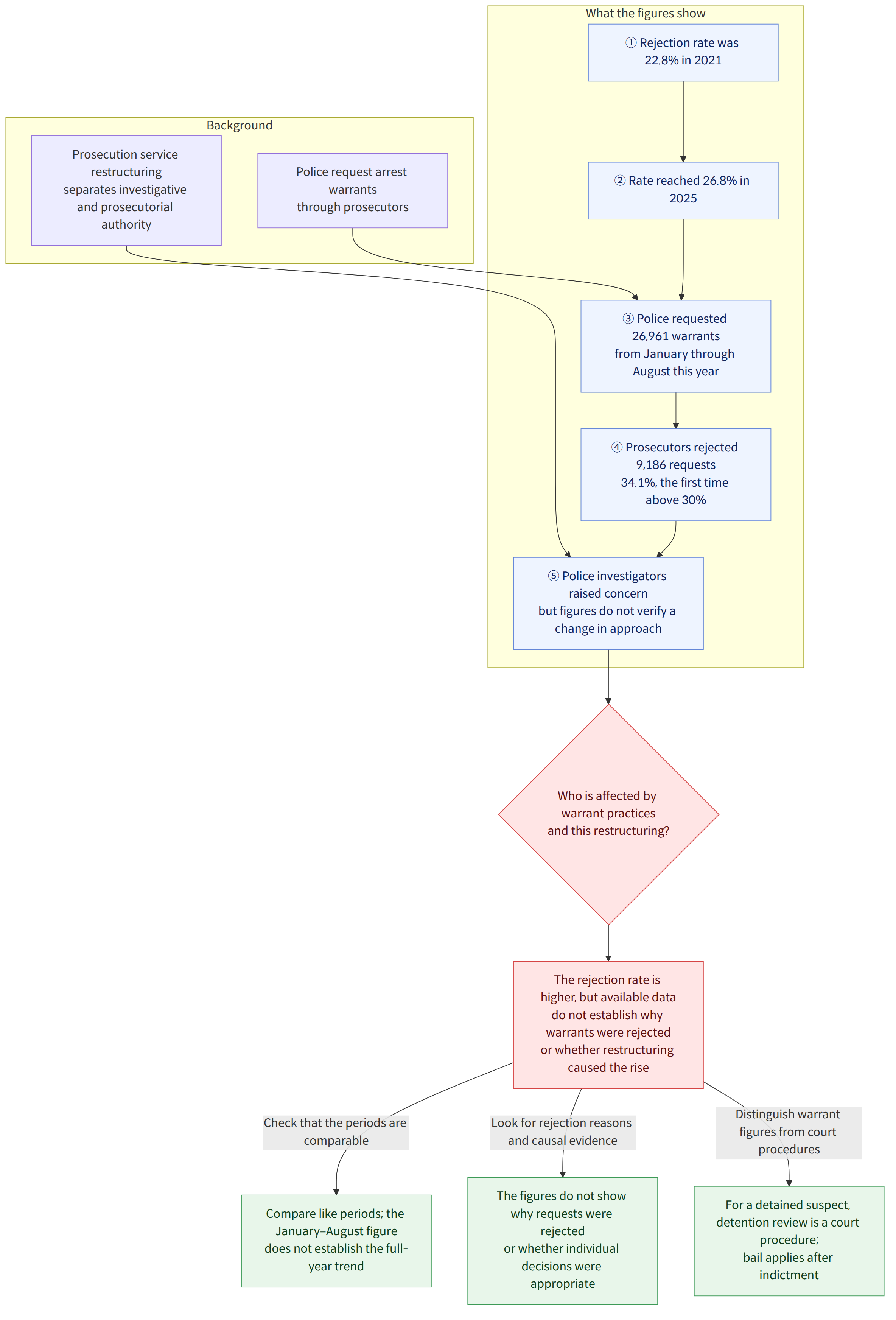
From January through August this year, prosecutors rejected 9,186 of the 26,961 arrest warrants that police requested. According to reports citing data from the Supreme Prosecutors' Office (대검찰청), the rejection rate was 34.1%. This is the first year that prosecutors have rejected more than 30% of the arrest warrants requested by police.
Background and context
According to reports, the rejection rate rose after reaching 22.8% in 2021, reaching 26.8% in 2025. The figure for January through August this year is higher still. However, because the periods and years covered differ, these figures alone cannot show how the trend will end for the full year.
This change coincides with a restructuring of the prosecution service. A report said South Korea abolished the Prosecutors' Office (검찰청) last Friday, after 78 years, and launched two agencies that separate investigative authority from prosecutorial authority (the power to decide whether to bring a case to trial). The restructuring came amid long-standing criticism that prosecutors had exercised excessive power.
Police investigators complained that, during the restructuring, prosecutors had become reluctant to seek warrants requested by police after losing their investigative authority. This is a concern raised by police investigators; the publicly available figures do not confirm a change in prosecutors' approach or establish that the restructuring caused the increase in the rejection rate.
What this news means
Applications for arrest warrants and their rejection are figures about a decision-making process between investigative agencies. The fact that the rejection rate has risen does not, by itself, show whether detention was necessary in any individual case or whether prosecutors' decisions were appropriate. Since the reasons for rejection have not been provided, the number of rejections alone also cannot establish whether there were problems with investigations or whether prosecutors were reluctant to seek warrants.
These statistics may draw attention to how police applications for warrants are handled by prosecutors. They also come at a time when a restructuring that separates investigative and prosecutorial powers is underway, making it important to watch how the new division of authority affects warrant practices. However, the available data do not directly compare the periods before and after the restructuring or establish a causal relationship.
For example, someone with a detained family member cannot assume that their relative will soon be released simply because the overall rejection rate is high. Release depends on a separate court procedure and circumstances considered on a case-by-case basis.
Related procedures and support information
According to an in-house legal guide, a suspect detained during the investigation stage, as well as people legally authorized to apply, can ask a court for a review of the legality of detention (구속적부심사)—a procedure in which a court takes another look at whether detention is appropriate. Those authorized to apply include the suspect's lawyer, legal representative, spouse, lineal relatives, siblings, family members, cohabitants or employer. The application should include information about the suspect and applicant, the date of detention, and the purpose and reasons for the application. Supporting materials that may help the case, such as proof of family relationship or a settlement agreement, can be attached.
After a person has been indicted, the defendant—not the suspect—can apply for bail (보석). In addition to the defendant, the application can be made by a lawyer, spouse, relative, family member, cohabitant or employer. The court decides whether to grant bail and what conditions to impose based on the specific circumstances. Conditions may include an undertaking to appear in court or restrictions on where the defendant may live, in addition to payment of bail money. If the defendant fails to appear in court without a valid reason or violates the conditions, bail may be revoked and all or part of the bail money may be forfeited.
A review of the legality of detention applies to suspects at the investigation stage; bail applies to defendants who have been indicted. Statistics on arrest warrants rejected at the prosecutorial stage should be distinguished from the procedure by which someone already detained asks a court to order their release.
What is known and what remains unclear
What is known
- From January through August this year, police requested 26,961 arrest warrants from prosecutors.
- Prosecutors rejected 9,186 of them, for a rejection rate of 34.1%.
- This is the first year that prosecutors have rejected more than 30% of the arrest warrants requested by police.
- According to reports, the rejection rate rose from 22.8% in 2021 to 26.8% in 2025.
- Police investigators complained that prosecutors had become reluctant to seek warrants after the prosecution service was restructured.
What remains unclear
- What were the specific reasons prosecutors rejected police requests for arrest warrants?
- What other rejection-rate data on police requests was the report expected to provide?
- To what extent, if any, did the prosecution service’s restructuring actually affect the change in the rejection rate?
What readers can check
- A detained suspect or their family can check who is eligible to request a review of the legality of detention and what information and documents to submit, and can consult a lawyer if needed.
- If considering the release of a defendant who has already been indicted, check who is eligible to apply for bail, what conditions the court may impose, and what obligations apply to appearing in court.
- Whether bail is granted and what conditions apply depend on the individual circumstances, so the overall rejection rate should not be applied directly to the outcome of a particular case.
References
- Other coverage consulted: en.yna.co.kr