1. A Human Story
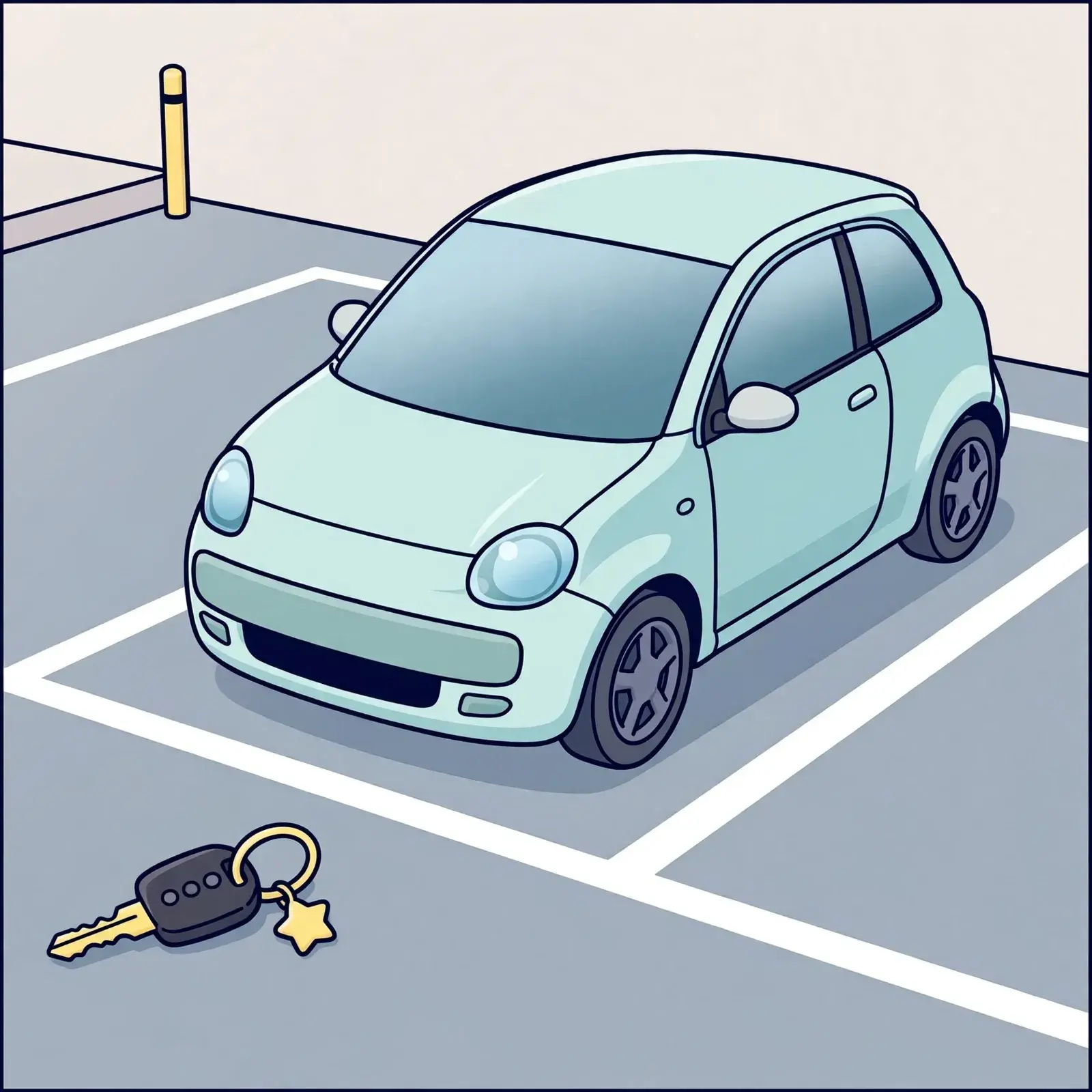
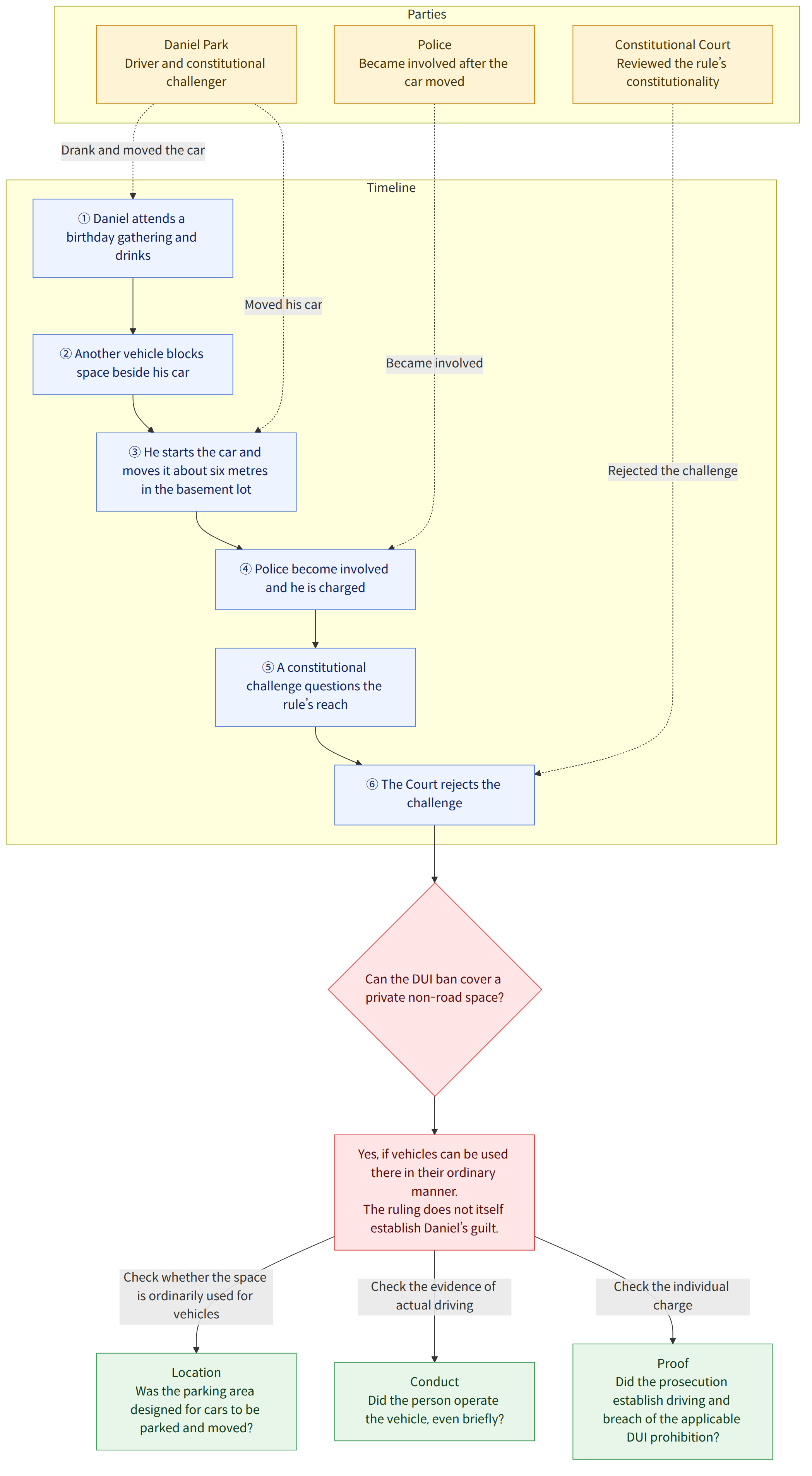
Daniel Park had been at a friend’s birthday gathering in an apartment complex. He knew he should not drive home, so he planned to leave his car in the basement parking area and take a taxi. But another vehicle was blocking the narrow space beside his car, and he thought he could make room by moving forward a few metres.
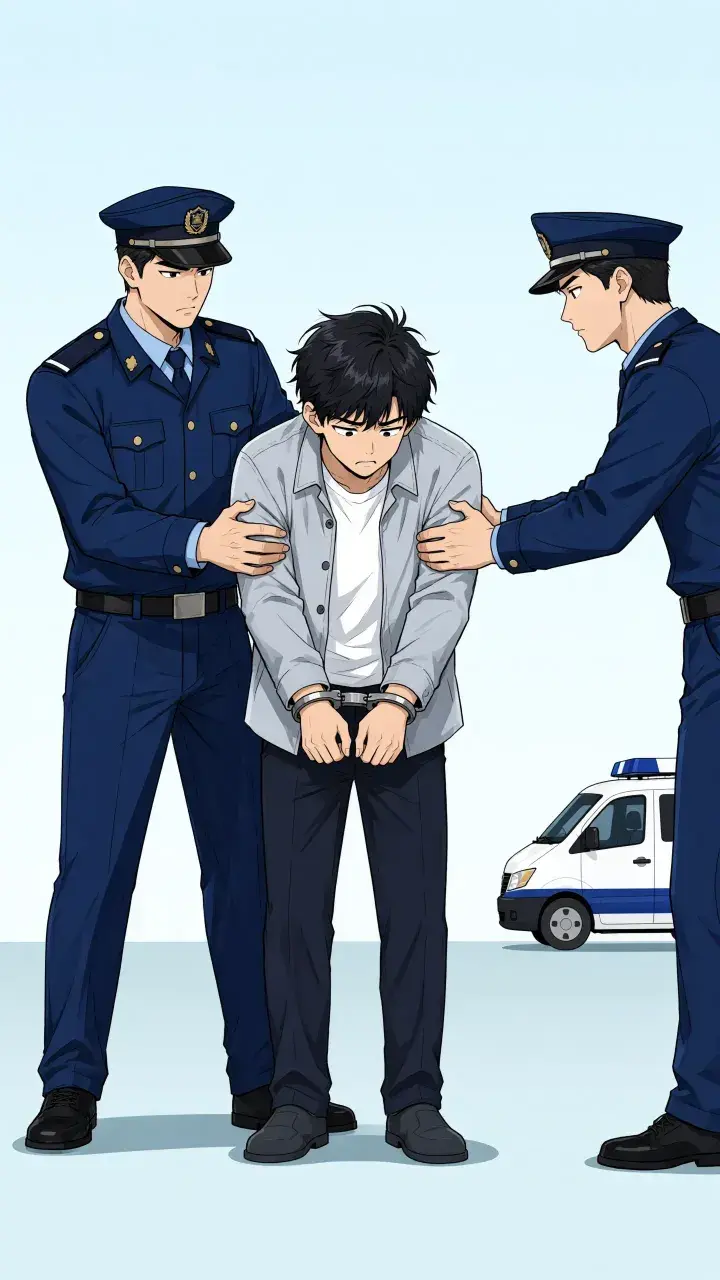
After drinking, Daniel started the engine and moved the car about six metres. No public street was involved, and no one was hurt. Still, police became involved, and Daniel was charged with driving under the influence. He wondered how a brief manoeuvre in a private parking area could count as drink-driving—and whether the law could constitutionally reach a place that was not a road.
2. The Legal Question
Can Korea prohibit and punish driving under the influence in a place outside a public road, such as a parking area? More specifically, does applying the drink-driving rule to such a place violate constitutional protections because the boundary of the offence is unclear or the restriction is unfairly broad?
3. What Korean Law Says
Korea’s Road Traffic Act treats driving for certain offences—including driving under the influence—as conduct that can occur outside a road as well as on one. The key idea is not simply whether a place is publicly accessible or officially designated as a road. It is whether the vehicle is being used in the way a motor vehicle is ordinarily used.
For the drink-driving provisions, “driving” includes using a vehicle in its ordinary manner in places other than roads.
The Constitutional Court interpreted “places other than roads” as spaces outside roads where motor vehicles can be used according to their ordinary function. That interpretation matters: the law does not turn every patch of land into a driving area merely because a car is present. The space must be one in which a vehicle can ordinarily be operated.
The constitutional objections were assessed through several familiar principles:
- Clarity: A criminal rule must give people a reasonably understandable account of what conduct is prohibited. The Court considered the ordinary-use interpretation sufficiently clear.
- Legitimate purpose: Preventing injuries, deaths, and property damage from impaired driving is a proper public-safety objective.
- Proportionality: The restriction must be reasonably connected to that objective and not impose an excessive burden compared with the safety benefit.
- Equality: Different treatment is constitutionally problematic only when the groups being compared are alike in the relevant way.
The Court concluded that applying the drink-driving prohibition beyond public roads does not, for these reasons, violate the freedoms of general action or the principle of equality.
4. How Korean Courts Approach This
Korean courts and the Constitutional Court focus on the risks created by operating a vehicle while impaired, rather than treating the public-road boundary as decisive. Alcohol can reduce a driver’s ability to control a car and respond to unexpected situations. Those risks do not disappear in a private lot, a building’s parking garage, or another place not ordinarily used by public traffic.
The Constitutional Court has reasoned that listing only specific kinds of non-road locations would leave gaps in the safety rule. An impaired driver might enter or travel through places not covered by a narrow list, even though a vehicle can be driven there and people or property may be at risk. The Court also considered the seriousness and recurrence of drink-driving, weighed against the limited interest in being free to drive while intoxicated in a non-road location.
That constitutional ruling answers whether the law may cover such places. It does not automatically determine whether every person charged in a parking lot is guilty. The prosecution must still establish the relevant facts in the individual case, including that the person drove and was in breach of the applicable drink-driving prohibition.
5. Applying the Law to Daniel’s Case
Daniel’s constitutional argument would face a substantial obstacle, but the reasoning can be applied step by step.
- The location was not necessarily outside the rule. The basement parking area was not a public road, but it was designed for cars to be parked and moved. It is therefore the kind of place that may fall within the statutory concept of a non-road area where vehicles are used in their ordinary manner.
- The short distance does not create a constitutional exception. Daniel moved the car only about six metres. The constitutional decision does not set a minimum distance. A brief movement may still be “driving” if the car is being operated in its ordinary manner.
- The public-safety rationale applies. Even at low speed in a parking area, an impaired driver may misjudge space, strike another vehicle, or fail to react to a pedestrian. The danger is not identical to speeding on a busy highway, but the Court accepted that non-road locations can carry real risks.
- The rule was held sufficiently clear and proportionate. Because the category is tied to places where vehicles can ordinarily be operated, the Court rejected the claim that the rule was impermissibly vague. It also found the safety benefits sufficient to justify limiting the freedom to drive while intoxicated in such places.
- The constitutional ruling is not the whole criminal case. Daniel could still dispute the evidence or the legal elements of the charge on case-specific grounds. The precise circumstances—what he did, where he did it, and what the evidence shows—remain important. But simply arguing, “It was private property, not a road,” would not by itself defeat the charge.
6. Conclusion: What Happened, and What Should You Do?
Daniel’s challenge to the law’s constitutionality would not succeed on the ground that his car was moved in a private parking area. The Constitutional Court has upheld the rule’s application to appropriate non-road places, and a six-metre manoeuvre is not automatically exempt. Whether Daniel is ultimately convicted, however, depends on proof of the specific offence in his case—not on the constitutional ruling alone.
If you face a similar situation:
- Do not drive after drinking, even to move a car within a private lot. Arrange a sober driver, taxi, or other safe option.
- Preserve the details and evidence. Record where the car was, what movement occurred, and any relevant video, witness information, or police documents.
- Get advice promptly from a Korean criminal-defence lawyer. Ask about the evidence and the legal elements of your particular charge, rather than relying only on the argument that the place was not a public road.