
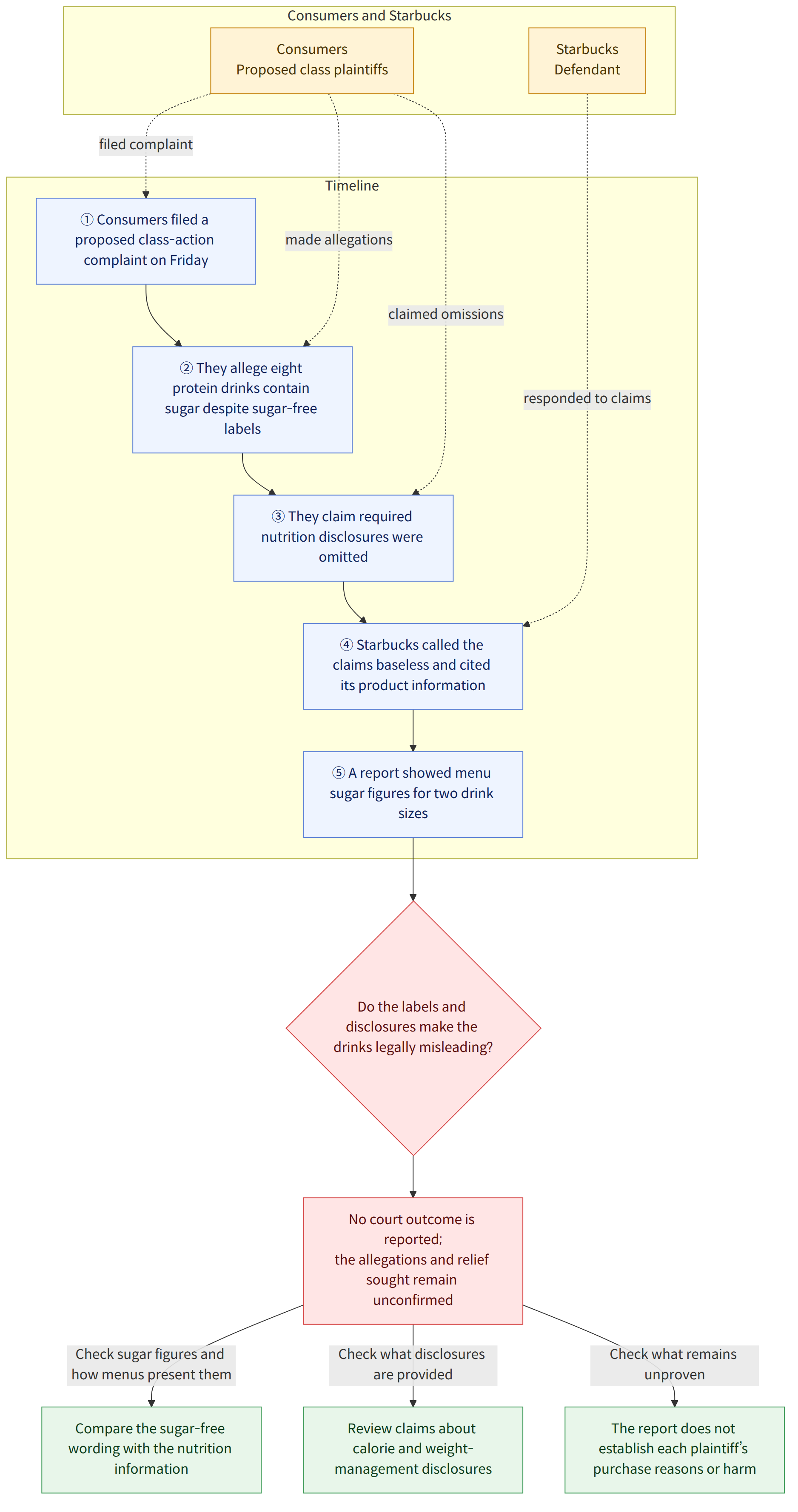
Starbucks consumers sued the company, alleging that labeling eight protein drinks as ‘sugar-free’ is false advertising. The consumers claim the drinks contain lactose, a sugar that occurs naturally in milk, and filed a proposed class-action complaint on Friday. Starbucks said the consumers’ claims are baseless, and countered that it has consistently and clearly provided information about its protein drinks, sugar-free options, customization choices, and nutrition through product announcements, menus, and marketing materials.
Background and context
According to the complaint, the consumers argue that an ordinary consumer would not expect a 20- or 24-ounce Venti drink to contain 13 to 21 grams of sugar. The complaint also states that federal law prohibits labeling a drink as ‘sugar-free’ if it contains more than 0.5 grams of sugar per 12 ounces. These are claims made in the complaint; it has not yet been confirmed how this standard will apply in this case.
A report also said that, as of Monday, the Starbucks U.S. website menu listed 16 grams of sugar for a 16-ounce ‘Sugar-Free Caramel Protein Matcha’ and 21 grams for the 20-ounce version. These figures are examples of information shown on the menu; they do not provide the product names or sugar content for each of the eight drinks mentioned in the complaint.
The consumers accused Starbucks of seeking to capitalize on the fact that 75% of Americans are trying to reduce or eliminate their sugar intake. They also claimed that Starbucks failed to provide federally required disclosures stating that the protein drinks are not low-calorie foods and are not intended for weight management. These, too, are claims made by the consumers in the complaint.
What this news means
The lawsuit highlights that the term ‘sugar-free’ and a product’s sugar content can affect consumer choices. If consumers choose a product because they consider certain nutrition information important, they may look not only at the wording on the label but also at what the nutrition information and related disclosures on the menu say. However, the reports provided do not establish why the consumers in this lawsuit actually bought the products or how the labeling influenced each plaintiff’s purchase.
For example, a consumer trying to reduce sugar intake might choose a drink after seeing a ‘sugar-free’ label and then check the nutrition information on the menu. They could consider how the label and the figures are presented together. This is a hypothetical example to illustrate consumer choice; it does not mean that the plaintiffs who bought the drinks actually made their decisions this way.
The fact that a lawsuit has been filed does not, by itself, establish that the advertising is legally false or that consumers are entitled to damages. The meaning of the ‘sugar-free’ label, the overall impression created by the label and nutrition information together, and whether the claims about required disclosures are true are all matters that remain to be determined.
Related laws and support information
The Internal Legal Guide (L1) explains consumer harm and damages claims involving false or misleading advertising in South Korea. It does not provide standards that directly apply to this lawsuit filed in the United States, but it can serve as a reference framework for understanding what may be considered in an advertising dispute.
According to the guide, whether advertising in South Korea is false or misleading is generally assessed objectively based on the overall and ultimate impression it creates for an ordinary consumer. The assessment also considers whether the advertising differs from reality or is excessively exaggerated, and whether it is likely to mislead consumers. Applied to this case, this suggests that it may be necessary to consider not only the phrase ‘sugar-free’ in isolation but also the drinks’ sugar-content information and how that information is presented in menus and marketing materials. This does not mean that the legal outcome of the U.S. lawsuit can be predicted from this analysis.
The guide explains that a person seeking damages must establish the necessary facts, which may include not only a problem with the advertising but also actual harm and a causal connection between the advertising and that harm. It is also important to note that damages are not automatically awarded simply because a person made a transaction after seeing an advertisement. The guide does not specify a particular claim deadline or limitation period, so the deadline for filing a claim cannot be determined from this material alone.
What is known and what is not yet known
What is known
- Consumers filed a proposed class-action complaint challenging the ‘sugar-free’ labels on eight Starbucks protein drinks.
- The consumers claim that the drinks contain lactose, a sugar that occurs naturally in milk.
- The complaint includes claims about the sugar content of Venti drinks, federal labeling standards, and missing required disclosures related to low-calorie foods and weight management.
- Starbucks said the claims are baseless and stated that it has clearly provided related information and nutrition details through its products, menus, and marketing materials.
What is not yet known
- The specific relief sought in the lawsuit and any subsequent court ruling have not been confirmed.
- The complete product names and individual sugar contents of the eight protein drinks mentioned in the complaint have not been provided.
- It is not yet known whether a court will uphold the consumers’ claims about the ‘sugar-free’ labels and required disclosures.
What readers can check
- When comparing nutrition information, readers can check not only wording such as ‘sugar-free’ but also how the menu presents sugar content, serving size, and related disclosures.
- Anyone claiming harm from a similar advertising dispute should distinguish between evidence of the advertising’s content, the purchase, and actual harm. Those considering legal action in South Korea can refer to the standards in L1, but should separately check which laws and evidentiary requirements apply to their specific case.
- L1 does not specify a particular claim deadline. If a deadline may matter, readers should check the applicable procedures and time limits rather than relying on this material alone.
References
- Guide to Claims for Compensation for Consumer Harm
- Other coverage consulted: koreatimes.co.kr