
Section 1 — A Human Story
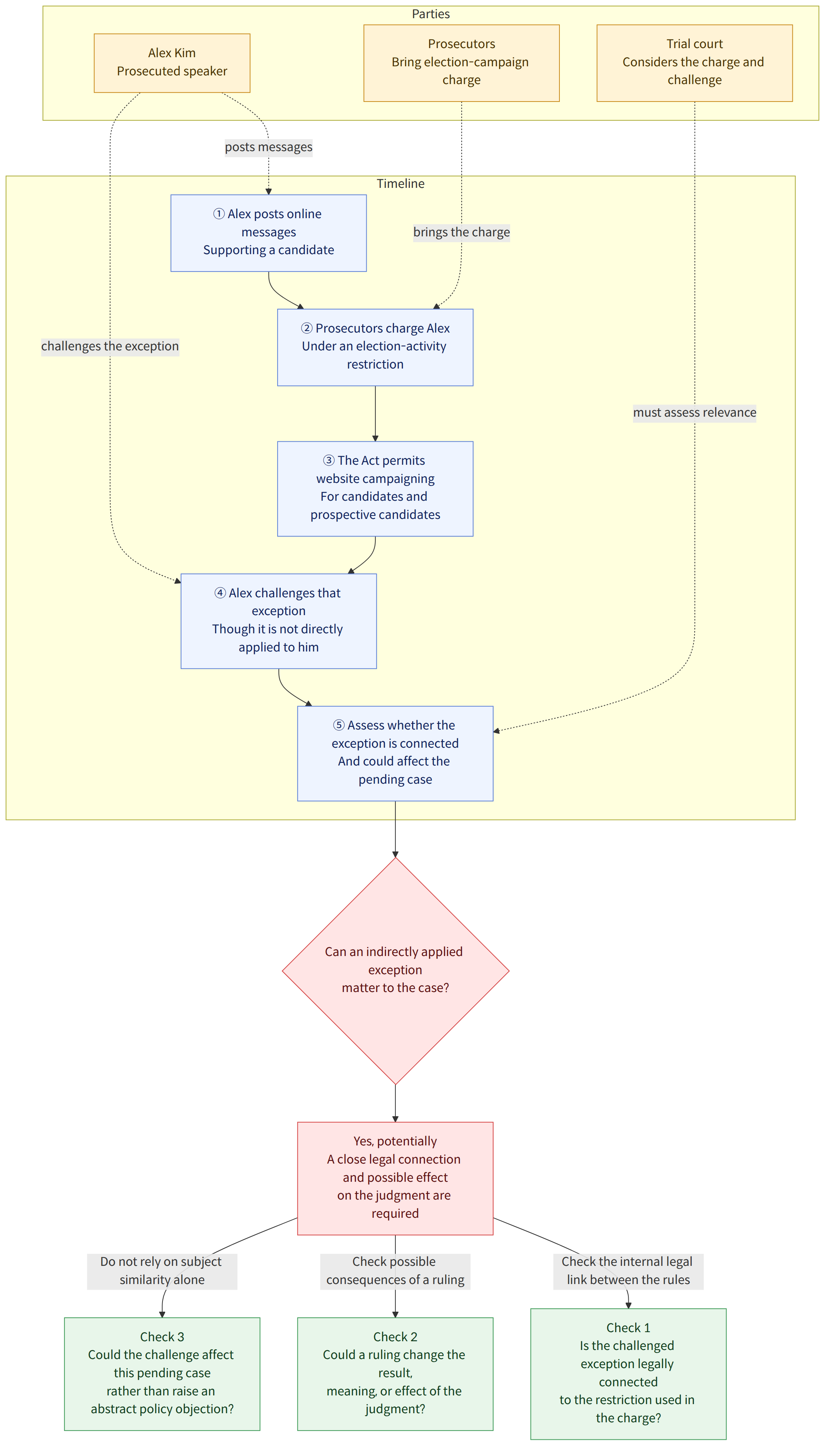
On the last weekend before a local election, Alex Kim posted a series of messages on his personal website urging readers to support a particular candidate. He was not running for office and had not declared an intention to do so. To Alex, the posts were ordinary political speech; to prosecutors, they amounted to prohibited election campaigning.
His case was brought under a provision of the Public Official Election Act that restricted certain election-related expressions. Alex soon learned, however, that the same Act allowed candidates—and people seeking to become candidates—to campaign through personal internet websites. He challenged that exception, arguing that the law treated speakers differently. The trial court was not charging him under the exception, but the exception helped define the legal landscape in which his charge arose.
Section 2 — The Legal Question
Can Alex challenge the constitutionality of a provision that is not directly applied to him, when that provision creates an exception closely connected to the rule under which he is being prosecuted?
Under Korean constitutional procedure, the answer can be yes—but only if the challenged provision has a meaningful legal connection to the pending case and a constitutional ruling could affect its outcome or legal significance.
Section 3 — What Korean Law Says
A constitutional challenge raised during an ordinary trial must satisfy a requirement often described as “relevance to the judgment” or “precondition to the trial.” The point is practical: constitutional review is not an abstract debate about whether a law is fair. The challenged provision must matter to the case before the court.
A law’s constitutionality is a precondition to a judgment when the law applies to the trial and its validity could change the judgment’s result, the legal meaning of the judgment, or the effect of the rules the court must apply.
The relevant provision need not always be the one the prosecutor cites directly. Korean constitutional law recognizes that one rule can be indirectly relevant when it is legally connected to another rule that governs the charge.
Even when a provision is not directly applied, the required connection may exist if its validity affects the constitutionality of the directly applied provision, changes the result of the pending case, or alters the meaning of the rule the court must apply.
In practical terms, the court asks:
- Does the challenged provision apply to the legal framework of the pending case? Direct application is common, but not essential.
- Is there an internal legal relationship between it and the provision applied by the trial court? Mere subject-matter similarity is not enough.
- Could the constitutional ruling make a difference? The judgment, its legal meaning, or the effect of the applicable rules must potentially change.
This requirement is especially important for a constitutional complaint brought while a case is pending. A litigant must show more than disagreement with the legislature’s policy: the challenged law must be capable of affecting the dispute being tried.
Section 4 — How Korean Courts Approach This
Korean courts and the Constitutional Court generally take a functional approach. They look beyond the label attached to a provision and examine how the rules operate together in the actual case. A law can therefore be indirectly relevant if it shapes the scope, meaning, or constitutional status of the rule the trial court is applying.
At the same time, indirect relevance is not automatic. A litigant cannot bring any related provision before the Constitutional Court simply because it concerns the same subject. The connection must be close enough that a ruling on the challenged provision could have a real legal consequence for the pending trial.
The central question is not simply, “Was this section named in the charge?” It is, “Could the validity of this section change the legal basis or consequences of the judgment in this case?”
Section 5 — Applying the Law to the Case
Alex’s prosecution directly relies on the provision restricting election-related activity. The provision he challenges, by contrast, permits a particular group—candidates and prospective candidates—to campaign through their websites. The two rules are not isolated: one sets a restriction, while the other identifies an exception within the same election-law framework.
The analysis proceeds in several steps:
- Identify the rule applied to Alex. The trial court must decide whether his website posts fall within the prohibition on election campaigning.
- Identify what the challenged provision does. The website-campaigning provision grants permission to candidates and prospective candidates, a permission not granted to Alex as an ordinary supporter.
- Examine the legal connection. Because the exception helps define who may use this form of campaigning, its validity may affect how the restriction is understood and applied. Alex’s challenge is therefore more than a complaint about a separate provision on the same general topic.
- Ask whether a constitutional ruling could matter to the trial. If the exception were held unconstitutional, that decision could affect the legal structure or interpretation of the restriction and exception, and potentially the legal significance of the judgment against Alex. That possibility can establish the required connection.
This does not mean that Alex automatically wins his constitutional challenge—or that the criminal charge must be dismissed. The procedural question is narrower: whether the challenge is sufficiently connected to his trial to be considered. The court must assess that connection in the context of the actual charge, the relevant statutory language, and the effect a constitutional ruling could have.
On the facts described, there is a strong basis for treating the exception as indirectly relevant: it is part of the same statutory scheme and bears on the boundary between prohibited and permitted online campaigning. The fact that prosecutors did not charge Alex under the exception does not, by itself, defeat the required relevance.
Section 6 — Conclusion: What Happened, and What Should You Do?
Alex’s constitutional challenge can satisfy the trial-relevance requirement even though the provision he contests is not the provision directly cited against him. The exception for candidates and prospective candidates is closely linked to the restriction applied in his case, and a ruling on its constitutionality could affect the legal framework or meaning of the judgment. Whether the challenge ultimately succeeds—and whether it changes the result of his prosecution—depends on the substantive constitutional analysis and the precise relationship between the provisions.
For readers in a similar position:
- Map the provisions together. Explain exactly how the challenged section affects the rule applied in your case; do not rely on the fact that both provisions concern the same subject.
- Show the possible consequence. Identify how a ruling could change the outcome, legal reasoning, or effect of the judgment in your pending case.
- Raise the issue through the proper procedure and on time. Constitutional challenges during litigation have specific procedural requirements, so obtain advice from a Korean lawyer familiar with constitutional and election law.