1. A Human Story
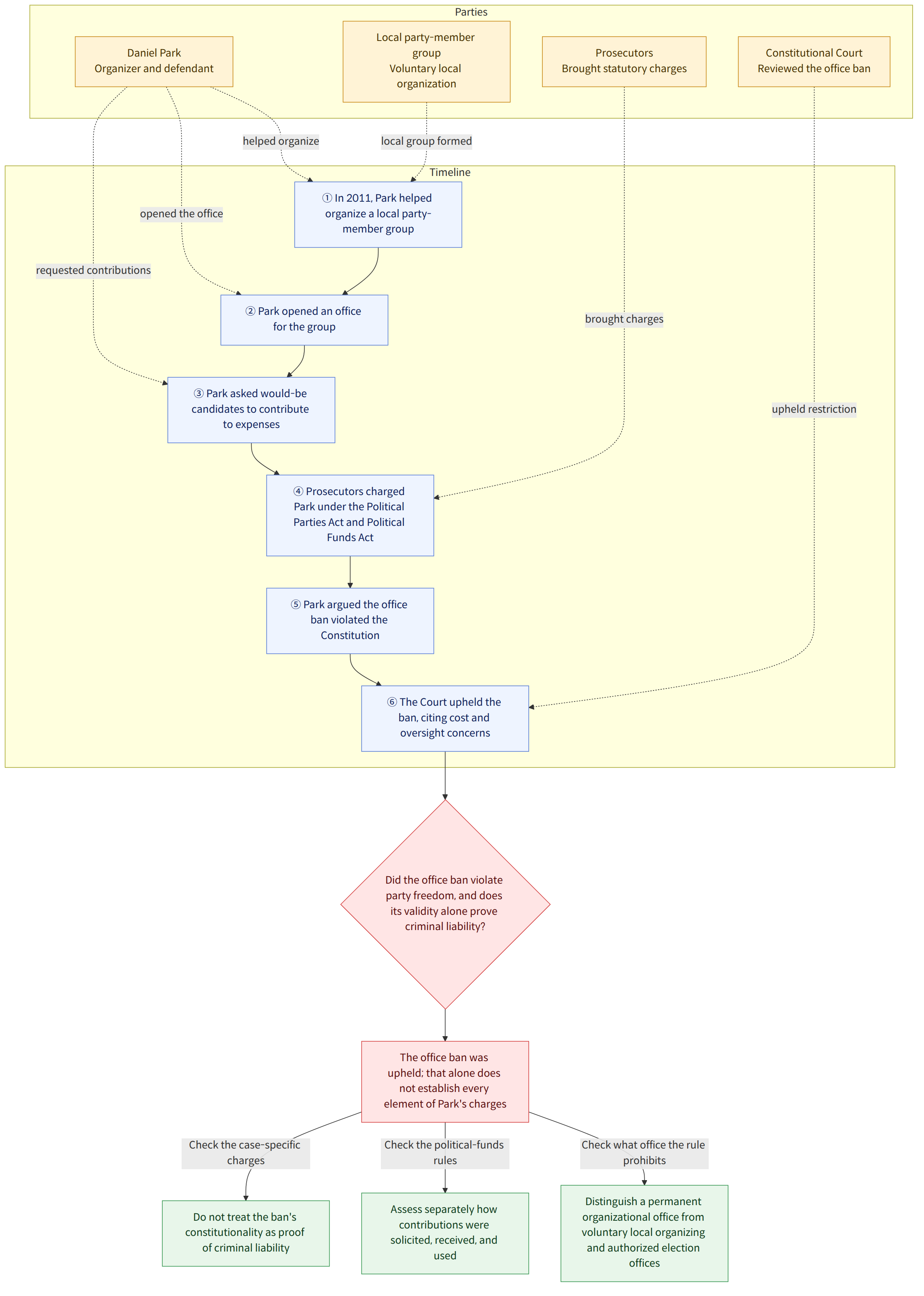
In 2011, Daniel Park had a practical problem. He helped organize a local group of members affiliated with a political party, but the group had no official office. Meetings were awkward to arrange, papers had nowhere to go, and the rent and basic operating costs had to be paid somehow.
Daniel opened a small office and asked several people planning to run in local elections to contribute money toward its expenses. To him, it was a modest neighborhood operation meant to keep party members connected. To prosecutors, the office and the money raised to support it crossed legal lines. Daniel was charged with violations of the Political Parties Act and the Political Funds Act.
He argued that banning an office for a local party organization violated the Constitution. The dispute raised a question that reaches beyond one room and one set of accounts: how far may the state go in limiting the way political parties organize between elections?
2. The Legal Question
May Korea constitutionally allow local party-member groups to exist while prohibiting them from establishing and operating an office for that purpose? And if the ban is valid, does that alone establish criminal liability for someone who opened an office and collected money to cover its costs?
The answer to the first question is yes: the Constitutional Court upheld the restriction. The second question is separate. The constitutionality of the ban does not, by itself, prove every element of the charges against a particular defendant.
3. What Korean Law Says
Korean law distinguishes between a party’s ability to organize locally and the use of a permanent office to run a local party suborganization. A local members’ council or similar group may operate as a voluntary organization, but the provision at issue bars it from setting up an office for that organizational purpose.
The legal rule, in plain language: A local party-member organization may exist, but it may not maintain an office as the base for operating that organization. The restriction is aimed at the office, not at all local political activity.
The rule sits alongside other ways parties can conduct political work. In particular, parties may establish election offices where election law permits them to do so during an election period. Local members may also organize voluntarily and communicate without maintaining a permanent organizational office.
The constitutional question was assessed through a familiar balancing exercise. In broad terms, the Court considered:
- Legitimate purpose: Does the restriction pursue a valid public goal?
- Suitability: Is prohibiting the offices reasonably connected to that goal?
- Necessity and burden: Is there a less restrictive alternative that would work just as effectively, and how heavily does the rule burden political freedom?
- Overall balance: Is the public benefit sufficient in light of the private interest affected?
The Court accepted that the restriction sought to prevent a return of problems associated with the former district-party structure and to encourage a less costly, more efficient party system. It also concluded that allowing the offices without adequate oversight could create risks of excessive spending and opaque local operations.
A crucial distinction: The office ban and the rules governing political money are related in Daniel’s story, but they are not the same legal issue. Whether a contribution was unlawful depends on the political-funds rules and the facts of how the money was solicited, received, and used.
4. How Korean Courts Approach This
When reviewing a law that limits political activity, Korean constitutional review does not ask only whether the restriction makes organizing less convenient. It asks whether the legislature had a legitimate reason, whether the restriction can advance that reason, and whether the burden on individual freedom is excessive compared with the public interest.
In this dispute, the Constitutional Court considered the history of the former district-party system and the possibility that local offices could become costly, difficult-to-supervise centers of political activity. It also noted that local members could continue to form voluntary groups, parties could use authorized election offices during election periods, and modern communications made it possible to organize without a permanent office.
The Court therefore rejected the argument that the office ban violated the freedom of party activity. Its reasoning did not amount to a judgment that every local party group is improper, or that every payment from a prospective candidate is automatically unlawful. It upheld the specific restriction on maintaining an office and left the separate criminal questions to be resolved under the relevant statutes and evidence.
5. Applying the Law to the Case
Daniel’s case can be analyzed in several steps.
- Was the office used to operate a local party suborganization? Daniel did not merely meet members occasionally in a borrowed room. He opened a dedicated office to keep the local group running. If the evidence established that the premises functioned as the group’s organizational office, the conduct fell within the type of activity the ban was designed to prevent.
- Did the Constitution require an exception for the group’s practical needs? Daniel could point to the inconvenience of meeting without a permanent location. But the Court found that inconvenience insufficient to invalidate the law. The organization could still operate voluntarily, meet in other settings, and use communication technology. A permitted election office was also a different category, available only when the applicable election rules allowed it.
- Did the ban serve a sufficiently important public purpose? The Court accepted the aim of preventing a return to expensive and poorly supervised local party structures. It considered that aim legitimate and the restriction on offices reasonably connected to it.
- Was the burden disproportionate? Daniel lost the ability to keep a permanent office for the local organization. The Court viewed that as a real but limited burden, weighed against the public interest in controlling costs and avoiding unsupervised political structures. It concluded that the balance favored the law.
- What about the money from would-be candidates? The office ruling does not settle that issue. Prosecutors would still need to prove the elements of any political-funds offense, including facts about who gave and received the money, the purpose of the payments, and whether the transaction complied with the applicable rules. The same is true of any separate party-law charge: guilt cannot be inferred merely from the fact that the constitutional challenge failed.
6. Conclusion: What Happened, and What Should You Do?
Daniel’s constitutional argument did not succeed. The Constitutional Court upheld the rule prohibiting an office for operating a local party-member organization, reasoning that it served legitimate purposes and did not unconstitutionally extinguish local political participation. His prosecution could therefore proceed under the law. Whether he was ultimately criminally liable, however, would depend on proof of the specific offenses—not simply on the Court’s decision about constitutionality.
For anyone involved in a local political organization:
- Check the organization’s actual function before leasing space. A room used as a continuing operational base may raise different issues from occasional meetings or a legally authorized election office.
- Keep political money transparent and properly documented. Confirm who may contribute, how funds may be received, and what records must be kept before accepting money for rent or other expenses.
- Get advice before acting, not after charges arise. Party organization rules and political-funds restrictions can overlap, and a lawful purpose does not necessarily make an otherwise prohibited arrangement lawful.