Understanding Suspended Sentences and Recidivism
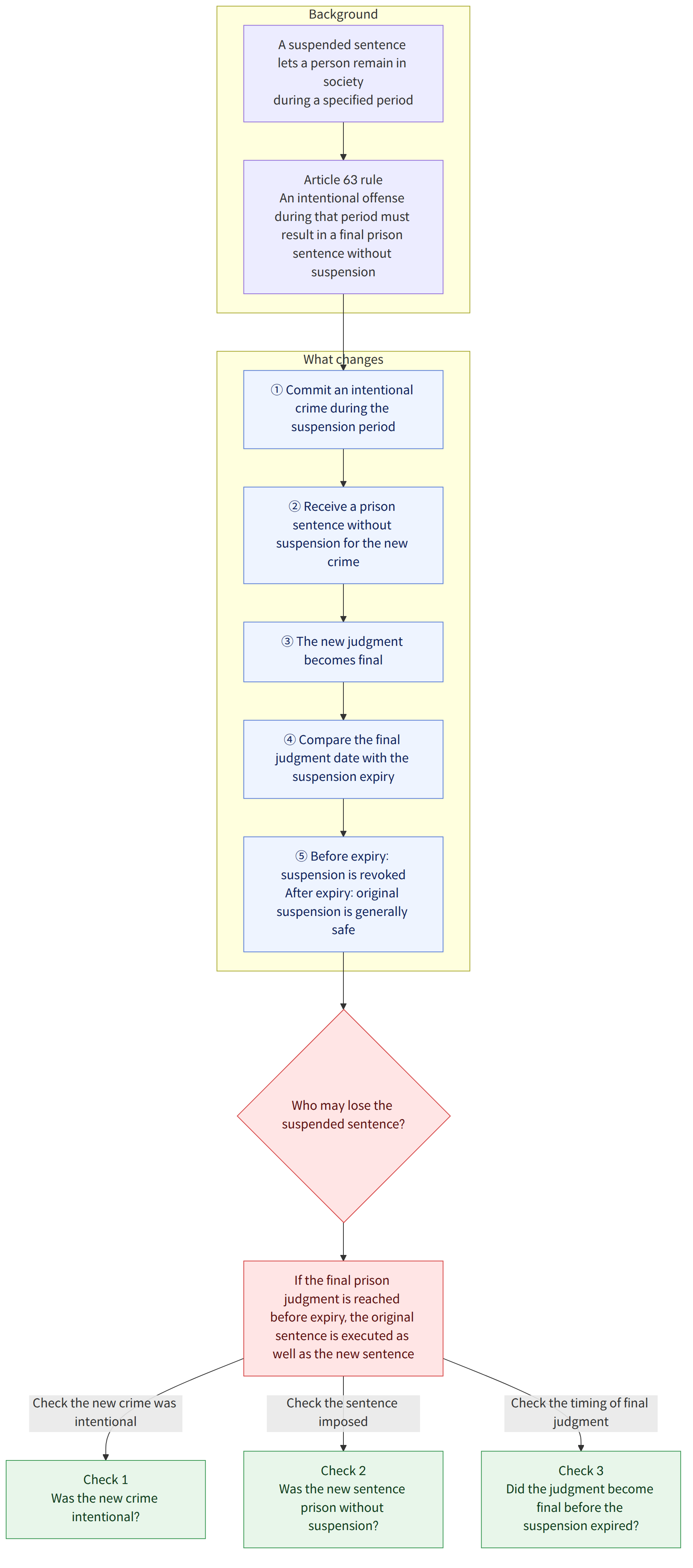
In Korea, a suspended sentence (집행유예) allows a person convicted of a crime to remain in society without going to prison, provided they do not commit another offense during a specified period. However, committing a new crime during this period carries significant risks.
The Core Rule: Article 63 of the Criminal Act
According to Article 63 of the Criminal Act, a suspended sentence loses its validity if the person is sentenced to a prison term (without suspension) for an intentional crime committed during the suspension period, and that judgment becomes final.
Key Legal Requirement: It is not just about committing the crime; the court's final decision must be confirmed before the original suspension period ends for the suspension to be revoked.
What happens to the previous sentence?
If the suspension is revoked, you must serve the original prison term in addition to any new sentence. For example, if you were sentenced to 1.5 years suspended for 3 years, and you commit a new crime that results in a final prison sentence before those 3 years are up:
- You must serve the 1.5 years from the first case.
- You must also serve the new prison term for the second case.
The Importance of Timing
- Case A: If the final verdict for the new crime is reached before your suspension period ends, your suspension is revoked, and you go to prison for both crimes.
- Case B: If the final verdict for the new crime is reached after your suspension period has already expired, the original suspension is generally safe, and you only serve the sentence for the new crime.
Is this Double Punishment?
The Supreme Court of Korea has ruled that revoking a suspended sentence is not a violation of the Constitution. Since the suspension was granted under the condition of good behavior, failing to meet that condition simply triggers the execution of the original punishment.
--- This information is provided for general guidance and does not constitute legal advice. For specific cases, please consult with a legal professional.