1. A Human Story
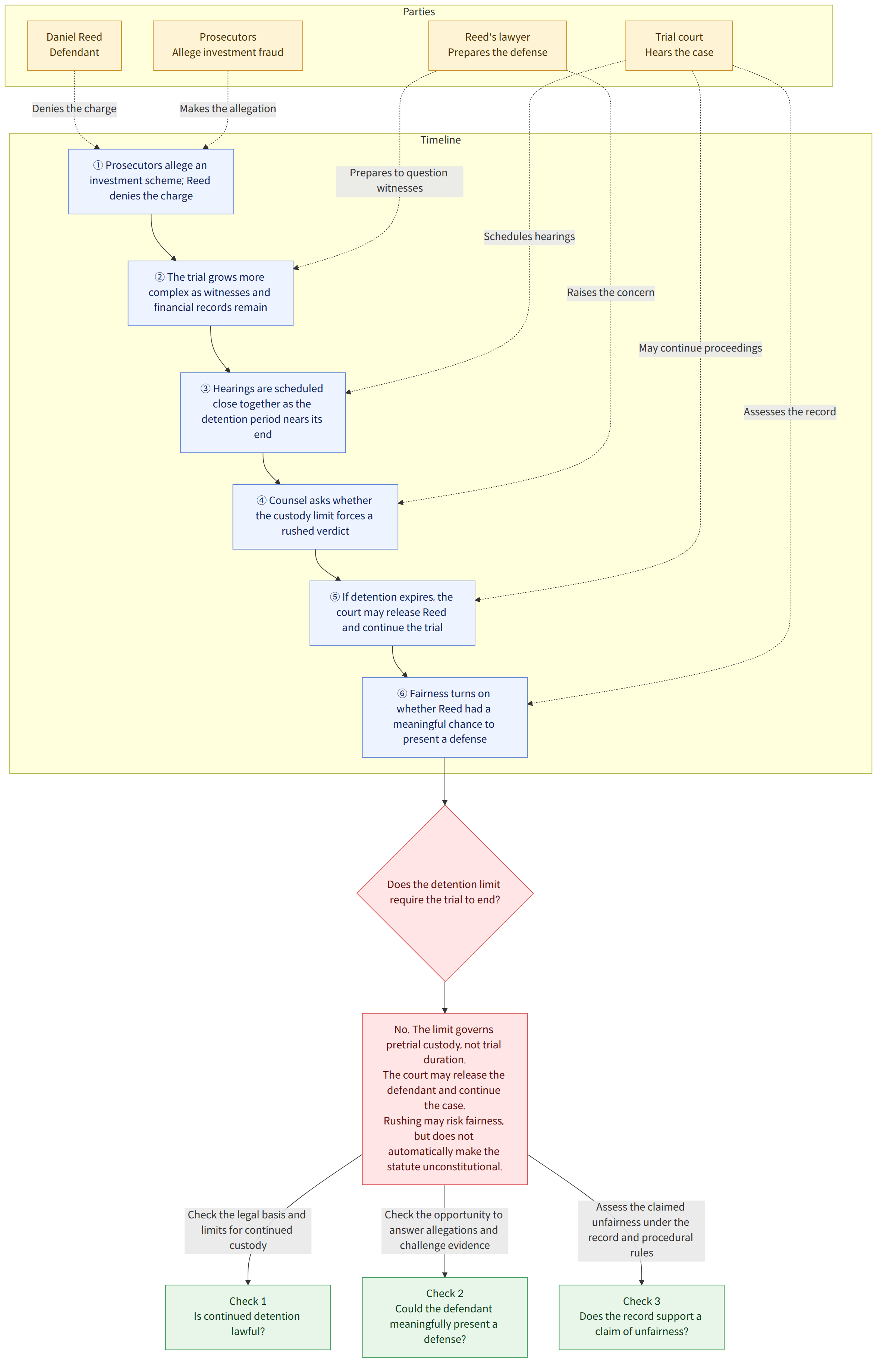
For months, Daniel Reed had watched his fraud trial grow more complicated. Prosecutors alleged that he had helped orchestrate a major investment scheme. Daniel denied the charge, and his lawyer was still preparing to question witnesses and present financial records that, she said, could alter the case. A conviction might mean many years in prison.
Then Daniel noticed a change in the courtroom rhythm. Hearings were being scheduled close together, and the judge repeatedly referred to the time left in the period during which Daniel could remain detained before trial. Daniel began to fear that the court was racing to deliver a verdict—not because the evidence was ready, but because the custody clock was running down. His lawyer asked the question troubling him: did the law itself force the court to choose between keeping him detained and giving him a fair hearing?
2. The Legal Question
Does the statutory limit on pretrial detention in a Korean criminal case also restrict how long the court may take to hear the case—and, if judges rush a serious case to meet that limit, does the law violate the defendant’s right to a fair trial?
3. What Korean Law Says
Korea’s Criminal Procedure Act sets limits on the period a defendant may be held in custody while a criminal case is being tried. Under the earlier version of Article 92, the period was two months, with up to two renewals at each level of trial if continued detention was particularly necessary. A later amendment, effective from January 1, 2008, retained the two-month period and the ordinary renewal limit, while allowing up to three renewals in an appellate proceeding in specified exceptional circumstances requiring additional examination.
The key point is what this period measures. It is the time during which the court may try the defendant while keeping the defendant in custody. It is not a statutory countdown requiring the court to finish the trial or stop considering the case when the detention period expires.
The detention limit protects personal liberty against unjustifiably prolonged pretrial custody. It does not limit the court’s authority to continue hearing the case.
If the court concludes that further hearings are necessary after the lawful detention period has run its course, it can release the defendant and continue the proceedings. The case does not automatically end, and the court does not lose the power to decide it.
In practical terms, the legal framework separates two questions:
- May the defendant continue to be detained before judgment? That depends on the statutory limits and the legal basis for custody.
- May the court continue the trial? Yes. The expiration of a period for detention does not, by itself, prevent the court from continuing to hear evidence and arguments.
The distinction also matters constitutionally. A rule limiting detention serves the defendant’s right to liberty. If a courtroom practice wrongly treats that rule as a deadline for completing the trial, the resulting problem is the way the rule is being applied—not necessarily the rule itself.
4. How Korean Courts Approach This
Korean constitutional jurisprudence has treated detention limits as safeguards against excessive deprivation of liberty, rather than as limits on the duration of criminal proceedings. A court can keep a case on its docket and continue its work even when it can no longer keep the defendant in pretrial custody under that particular detention period.
A court should not treat the need to release a defendant as a reason to curtail the defendant’s opportunity to challenge the prosecution’s case.
The constitutional analysis therefore distinguishes the law from courtroom practice. If judges routinely hurry a case toward judgment because the detention period is about to expire, that practice may place the defendant’s ability to prepare and present a defense at risk. But that does not automatically make the detention-limit statute unconstitutional. The statute’s purpose is to protect liberty, and the court has another option: release the defendant and continue the trial.
This does not mean that every trial conducted quickly is unfair, or that every claim of unfairness succeeds. The question in an individual case is whether the defendant had a meaningful opportunity to understand and answer the allegations, challenge evidence, and present a defense. Any challenge to an allegedly rushed or unfair proceeding must be assessed on the record and under the applicable procedural rules.
5. Applying the Law to the Case
Daniel’s concern is understandable: the seriousness of the charge and the possibility of a long prison sentence make a complete defense especially important. But the detention limit does not require the judge to deliver a verdict before Daniel’s custody period expires.
First, the court must identify what is actually about to expire. Article 92 concerns the period for which Daniel may be held in custody while his case is pending. It does not define the time available to his lawyer to review evidence, question witnesses, or make submissions.
Second, the court must decide whether continued detention remains lawful and necessary. The limit does not mean Daniel must be detained for its full duration; nor does it allow detention to continue automatically beyond the applicable period. If custody can no longer be maintained under the relevant rules, release is the alternative to continued detention—not a reason to deny Daniel a fair chance to defend himself.
Third, the trial can continue after release. Daniel would remain subject to the court’s proceedings, but he would not be held in pretrial custody on the basis of an expired detention period. The judge could schedule further witness examinations, consider the financial records, and hear the parties’ arguments before deciding the case.
Finally, the constitutional issue must be framed carefully. If the court were to exclude necessary evidence or deny Daniel a reasonable opportunity to respond simply to finish before the detention deadline, that could raise a serious case-specific fair-trial concern. But the problem would be the court’s handling of the proceedings, not the existence of a law that limits how long the state may hold him before judgment. The detention statute itself gives the court a way to avoid that conflict: release him if required, then continue the hearing.
6. Conclusion: What Happened, and What Should You Do?
Daniel’s lawyer asks the court to separate the custody question from the trial schedule. The judge rules that the detention limit does not force an immediate verdict. If Daniel can no longer lawfully be held in pretrial custody, he must be released under the applicable rules; the court may nevertheless continue hearing the case. The statutory limit is therefore not unconstitutional merely because a mistaken courtroom practice might encourage rushed trials.
For anyone facing a similar situation:
- Ask your lawyer to track detention deadlines precisely. The applicable period and renewal rules can depend on the stage of the case and the circumstances.
- Put specific defense needs on the record. Identify outstanding evidence, witnesses, or preparation time and explain why they matter to a fair hearing.
- Challenge unfair procedure directly. If the court actually restricts your ability to present or answer evidence, discuss promptly with counsel the appropriate procedural objection or appeal; the detention limit alone does not automatically invalidate the trial.