
A Community Built on Trust, Shattered by Betrayal
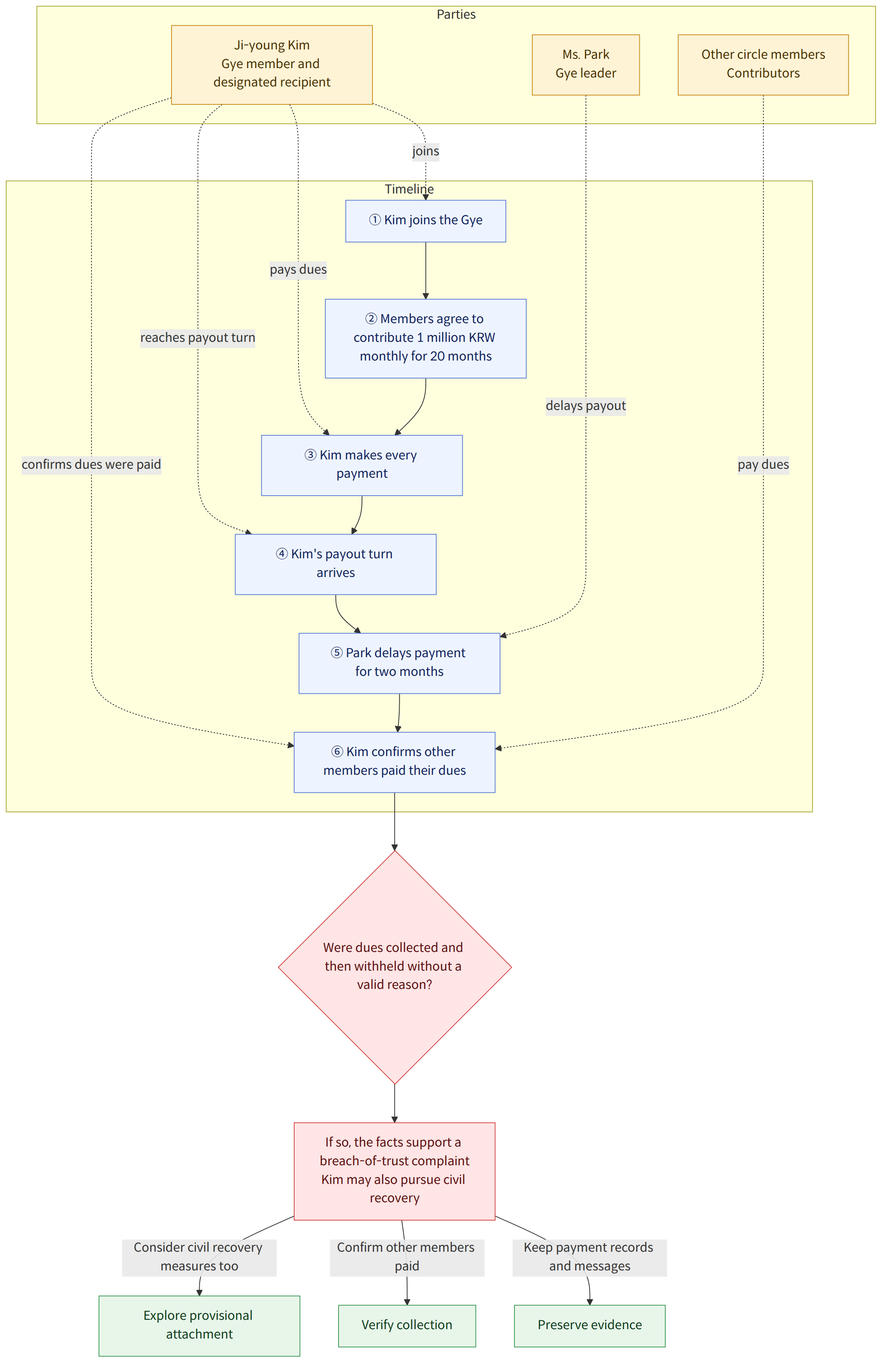
Ji-young Kim, who runs a small neighborhood cafe in Seoul, joined a 'Gye'—a traditional Korean private mutual aid and credit circle—two years ago with fellow local merchants. The agreement was simple: each member contributes 1 million KRW every month for 20 months. Members take turns receiving the total lump sum. Ji-young planned to use her payout to cover her shop's security deposit increase.
Despite the harsh economy, Ji-young never missed a single payment. Finally, her turn arrived. However, the circle's leader, Ms. Park, who Ji-young had always treated like an older sister, suddenly changed her tune. "Things are a bit difficult right now," and "Please just wait a little longer," were the only responses she gave for two months. Through other members, Ji-young discovered that everyone else had already paid their dues. The sense of betrayal and the looming threat of losing her shop lease have left Ji-young in despair.
The Legal Question: Is Non-payment a Crime or Just a Debt?
The core legal issue here is whether Ms. Park’s failure to pay the lump sum goes beyond a simple civil breach of contract and crosses into the territory of Breach of Trust (Baem-im-joe) under the Korean Criminal Act.
What Korean Law Says About a Gye Leader's Duty
In the Korean legal system, a 'Gye' is often viewed as a form of partnership (johap). The leader of such a circle carries a specific legal burden.
The Legal Status of a Gye LeaderA Gye leader has the duty to collect monthly installments from members and pay them to the designated member according to the agreement. This duty is considered both the leader's own business and the management of 'the affairs of others' (the members).
According to the precedents set by the Supreme Court of Korea, the distinction between a criminal act and a civil dispute depends on whether the funds were actually collected:
- When Breach of Trust applies: If the leader has successfully collected the monthly dues from all other members but refuses to pay the designated recipient without a valid reason, this constitutes a crime. The leader has violated their fiduciary duty to handle the affairs of others.
- When Breach of Trust does NOT apply: If the leader has failed to pay because other members did not submit their installments, the leader is not yet deemed to be handling the 'affairs of others' in a way that triggers criminal liability for the payout. In this case, it remains a civil matter of debt collection.
How Korean Courts Approach This
The Korean judiciary views the Gye leader not merely as a borrower of money, but as a fiduciary manager of trust. Because the Gye system relies heavily on communal trust, the law seeks to punish those who abuse this position for personal gain.
Supreme Court rulings emphasize that if a leader collects the funds and uses them for their own personal debt repayment or private expenses instead of giving them to the rightful member, it is a severe violation of social and legal trust. This is treated as a criminal offense to protect the financial stability of such community-based credit systems.
Applying the Law to the Case: What Happens to Ji-young?
Returning to Ji-young Kim’s situation, she has already confirmed that the other members have fully paid their installments to Ms. Park. This means Ms. Park is currently holding 20 million KRW that legally belongs to Ji-young's turn.
Since Ms. Park has already collected the funds, she is legally obligated as a 'fiduciary' to deliver that money. If she continues to withhold it without a legitimate legal excuse (such as a court-ordered seizure), she is committing Breach of Trust. If it is found that she spent the money on herself, the criminal case becomes even stronger.
Conclusion: What Happened, and What Should You Do?
Ultimately, Ji-young Kim has the right to file a criminal complaint against Ms. Park for Breach of Trust. The investigation will focus on tracing where the collected money went. Often, the pressure of a criminal investigation encourages the leader to settle the debt to avoid imprisonment.
If you find yourself in a similar situation, here are a few practical tips:
- Secure Your Evidence: Keep a list of all members, records of your own payments (bank transfers), and save all text messages or recordings of conversations with the leader.
- Verify Collection: Try to confirm with other members if they have indeed paid their dues. Knowing the leader has the money is the key to a criminal charge.
- Pursue Civil and Criminal Routes Simultaneously: While filing a criminal complaint, you should also look into civil measures like 'provisional attachment' (ga-ap-ryu) on the leader’s assets (property or bank accounts) to ensure there is money left to recover later.
While a Gye is built on neighborly trust, the law is your ultimate shield when that trust is broken.