1. A Human Story
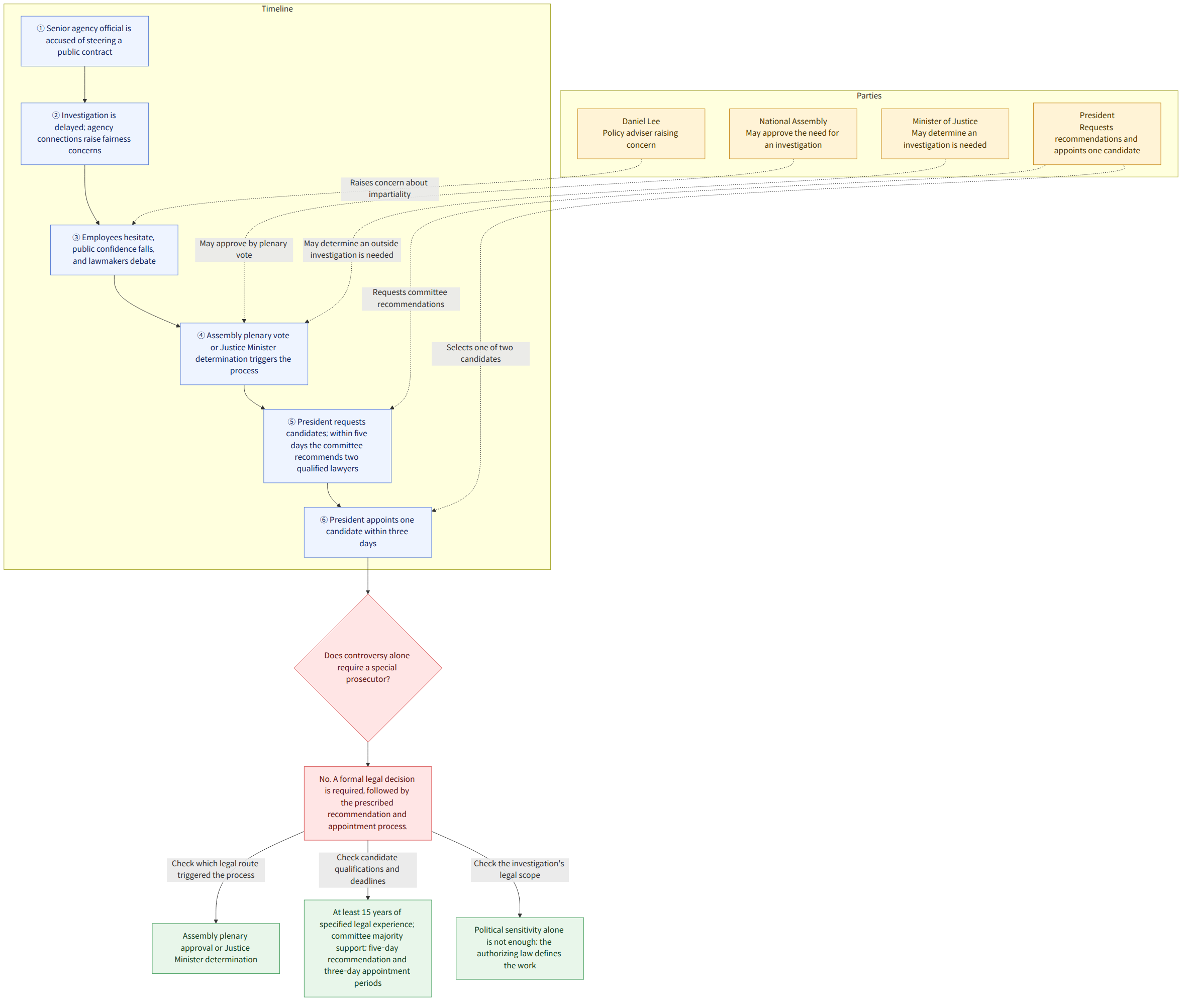
When a senior official at a government agency was accused of steering a public contract to a politically connected company, Daniel Lee, a junior policy adviser, expected investigators to arrive quickly. Instead, weeks passed. The agency’s leadership had close ties to people implicated in the allegation, and rumors spread that the inquiry was being handled by colleagues who might eventually have to investigate their own superiors.
Daniel had not witnessed the alleged misconduct himself. But he had seen how the uncertainty affected the people around him: employees hesitated to speak, reporters asked whether evidence was being overlooked, and the public began to doubt that an ordinary investigation could be impartial. Lawmakers argued over whether an independent investigator should take over. Daniel’s question was simple: What, exactly, is a special prosecutor—and who gets to appoint one?
2. The Legal Question
The central question is how South Korea’s special prosecutor system works when an investigation may not be trusted to proceed fairly. In particular: who can trigger the process, how is a special prosecutor selected, and does public controversy by itself require an appointment?
3. What Korean Law Says
A special prosecutor is an investigator appointed to handle a particular matter when the fairness or independence of an ordinary investigation is reasonably in doubt. The system is not a standing office that automatically takes over every politically sensitive case. It is a special procedure governed by law and tied to a defined investigation.
A special prosecutor may be considered when the investigation itself cannot reasonably be expected to be fair, or when it is difficult to regard the investigation as having been conducted fairly.
Under the framework described in the Act on the Appointment of Special Prosecutors, there are two routes for deciding that a special prosecutor’s investigation is needed:
- The National Assembly may approve the need for a special prosecutor by a vote at a plenary session, based on concerns such as political neutrality or fairness.
- The Minister of Justice may determine that a special prosecutor is needed, including where a conflict of interest or fairness concern makes an ordinary investigation inappropriate.
Once the decision to use the special prosecutor system has been made, the appointment proceeds on a short timetable:
- The President must promptly ask the Special Prosecutor Candidate Recommendation Committee to recommend candidates.
- Within five days of that request, the committee must recommend two candidates to the President. Each must be a lawyer with at least 15 years’ experience as a judge, prosecutor, or attorney, and the recommendations require the support of a majority of the committee’s members.
- Within three days of receiving the recommendations, the President must appoint one of the two candidates as special prosecutor.
The key distinction is between deciding that a special prosecutor is needed and choosing who will serve. The first decision follows a legally recognized route; the appointment then follows the prescribed recommendation and selection process.
4. How Korean Courts Approach This
The special prosecutor system is a legal mechanism for addressing concerns about investigative fairness—not a general remedy for every dispute about the government or public officials. Korean courts would be concerned with the law that authorizes the investigation and the procedures that govern it. A case’s political sensitivity, standing alone, does not establish that a special prosecutor must be appointed.
Courts generally resolve concrete legal disputes brought before them; they do not replace the statutory decision-making process merely because public confidence is low. The relevant question is whether the proper legal route was followed and whether the investigation and appointment stayed within the authority granted by law. The precise scope of a special prosecutor’s work depends on the law authorizing that particular investigation.
Public suspicion may explain why the special prosecutor system exists, but suspicion alone is not the appointment procedure. The required legal decision and selection steps still matter.
5. Applying the Law to the Case
Daniel’s concern is serious: the agency’s connections to people under scrutiny could make the ordinary investigation appear compromised. But that concern does not, by itself, install a special prosecutor. The law requires a formal decision through one of the recognized routes.
First, lawmakers would need to consider whether the allegation and the circumstances justify a special investigation on grounds such as fairness or political neutrality. If the National Assembly decides that they do, it must approve the matter at a plenary session. Alternatively, the Minister of Justice may determine that a special prosecutor is necessary—for example, because a conflict of interest undermines confidence in the ordinary inquiry.
Second, if the system is triggered, the President does not simply select any person. The President must ask the recommendation committee to put forward two candidates. The committee must recommend candidates who meet the experience requirement, and its decision requires a majority of its members. The President then appoints one of those recommended candidates within the three-day period.
Finally, Daniel should distinguish two different concerns: whether the special prosecutor is properly appointed, and whether the investigation actually uncovers misconduct. Appointment provides an independent investigative route; it is not a finding that anyone is guilty. The investigation must still examine evidence, and any later legal consequences depend on what that evidence establishes.
6. Conclusion: What Happened, and What Should You Do?
In Daniel’s fictional case, lawmakers voted at a plenary session that concerns about impartiality warranted a special prosecutor. The President requested two candidates from the recommendation committee; within five days, it recommended two lawyers who each had more than 15 years of qualifying legal experience. The President appointed one of them within the following three days. The new investigator could then examine the matter within the authority granted for that investigation—but the appointment itself did not prove the alleged contract-rigging occurred.
For readers facing a similar situation:
- Separate concern from legal trigger. A controversial case may raise genuine fairness questions, but a special prosecutor requires the formal decision provided by law.
- Track the procedure and timetable. The recommendation of two qualified candidates and the President’s appointment are distinct steps, each with a statutory deadline.
- Preserve evidence and avoid conclusions. Keep relevant records, use appropriate reporting channels, and remember that an independent investigation is a means of finding facts—not a verdict.