
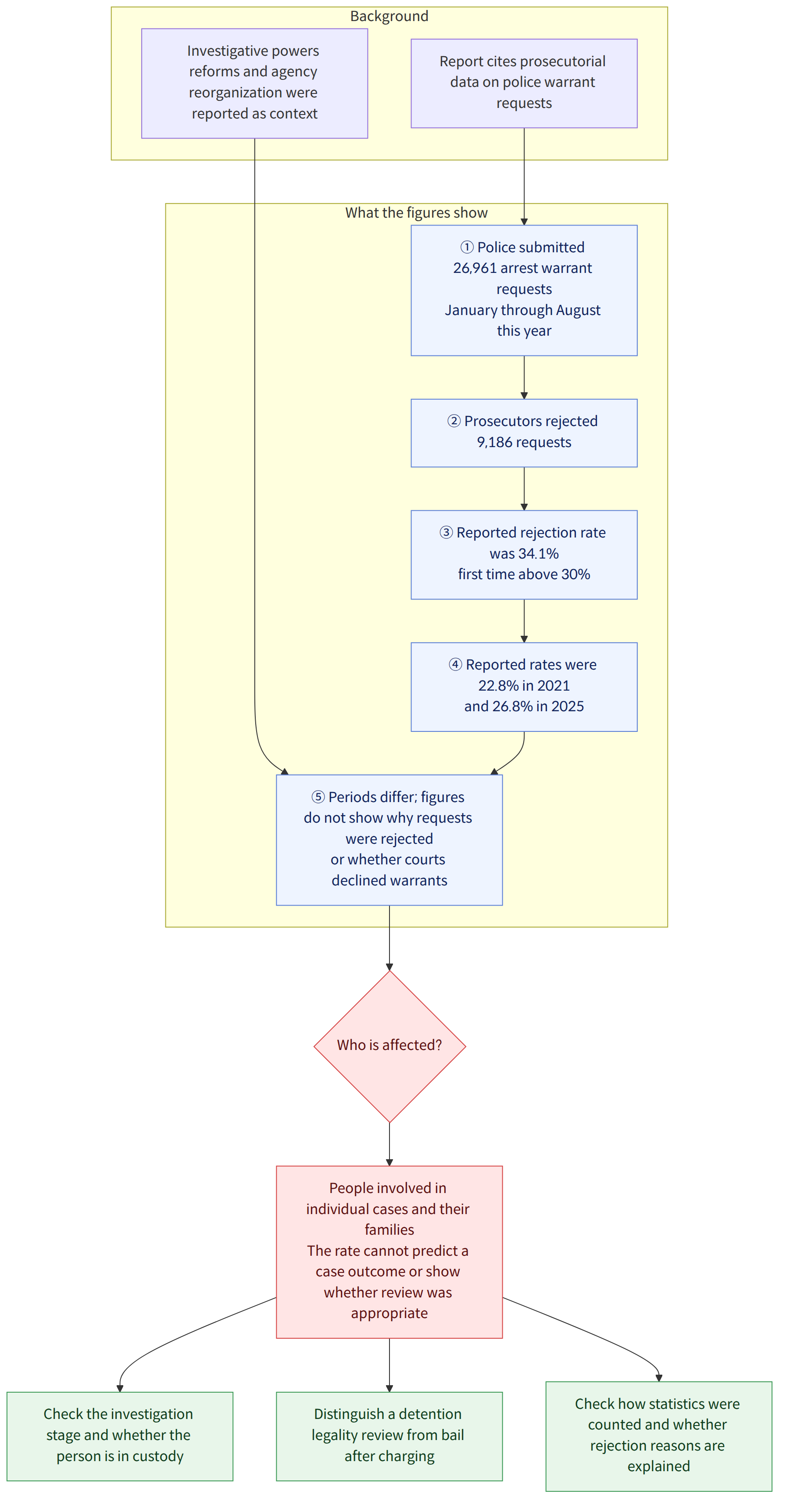
Yonhap News (연합뉴스) reported that prosecutors rejected 9,186 (34.1%) of the 26,961 arrest warrant requests submitted by police to prosecutors between January and August this year. The report cited prosecutorial data and said this was the first time the rejection rate had exceeded 30%. The article was published on October 4, 2026.
Here, rejection means that prosecutors did not accept a request from police. The rate should therefore not be interpreted as the rate at which courts declined to issue arrest warrants.
Background and context
According to the report, the rejection rate for arrest warrant requests rose from 22.8% in 2021 to 26.8% in 2025, reaching 34.1% between January and August this year. A simple comparison suggests that a larger share of police requests were not accepted at the prosecutorial stage. However, the periods being compared are different, so care should be taken not to interpret this year’s figure as an annual rate.
The article also presented the debate over adjustments to investigative powers and a reorganization of the prosecution as part of the background. It said police investigators had complained that prosecutors were reluctant to seek warrants, and reported that reforms reducing prosecutorial investigative powers were under way. It also reported that the prosecutors’ office was abolished last Friday and that two agencies separating investigation from prosecution were launched. This context was presented alongside the statistics, but the figures in the article alone do not establish that the reorganization caused the rejection rate to rise.
What this news means
The 34.1% figure shows that a substantial share of police warrant requests were not accepted during prosecutorial review. Key issues may include the criteria used by investigative authorities when requesting warrants and prosecutors when making decisions, and whether the reasons for rejection are also explained when statistics are published. However, the rejection rate alone cannot determine whether prosecutors reviewed requests appropriately or whether the police requests were sufficiently supported.
For people involved in individual cases and their families, it is important to understand that this statistic cannot predict the outcome of their case. For example, if a family member has been arrested or detained, they should check the current stage of the investigation and whether the person is in custody, and review the legal procedures available, rather than relying on the overall rejection rate. The fact that prosecutors rejected a police request does not, by itself, mean that the person was released or, conversely, that a court issued a warrant.
Related legal procedures and support information
According to an internal legal guide, a suspect arrested or detained during an investigation, as well as people legally entitled to apply, may petition a court for a review of the legality of detention (구속적부심사)—a procedure in which a court examines whether detention is lawful and remains necessary. A spouse, direct relatives and others may also file a petition. The petition should include information about the suspect and the petitioner, the date of detention, and the purpose and grounds of the petition, and may include supporting materials such as proof of family relationship or a settlement agreement. The court questions the suspect and then decides whether to release them; it may also grant release on condition that bail is paid.
The procedure changes after a person is charged. A defendant may apply for bail, and the court considers the specific circumstances before deciding whether to grant it and setting any conditions. A review of the legality of detention and bail differ in who may apply and when, so it is important not to confuse them with statistics on prosecutors’ rejection of warrant requests. Bail may be revoked or the bail money forfeited if the conditions are violated or the defendant fails to appear in court without a valid reason.
What is confirmed and what remains unknown
Confirmed facts
- According to the report, police requested 26,961 arrest warrants between January and August this year, and prosecutors rejected 9,186 of them.
- The reported rejection rate was 34.1%, and the report said this was the first time it had exceeded 30%.
- The article cited prosecutorial data and reported that the rejection rates were 22.8% in 2021 and 26.8% in 2025.
- The article was published on October 4, 2026.
What remains unknown
- The article does not provide sufficient detail on the source data, the criteria used to compile the statistics, or how requests and rejections were classified.
- The main reasons prosecutors rejected requests and differences by case type are not confirmed.
- It is not known how this year’s figure will change by year-end or what the trend would look like in a comparison with the same period in previous years.
What readers should check
- People involved in a case and their families should first check whether the case is at the investigation stage or after charges have been filed, and whether the person is under arrest or in detention. The applicable procedures may differ.
- Families of detained suspects should check who is eligible to petition for a review of the legality of detention and what information is required, and consider what materials they can submit, such as proof of family relationship or a settlement agreement.
- Defendants who have been charged should check whether they can apply for bail and what conditions may apply. If bail is granted, they must attend scheduled hearings and comply with the conditions set by the court.
References
- How Should You Respond to Arrest, Detention, Release, and Bail?
- Other coverage consulted: koreatimes.co.kr