
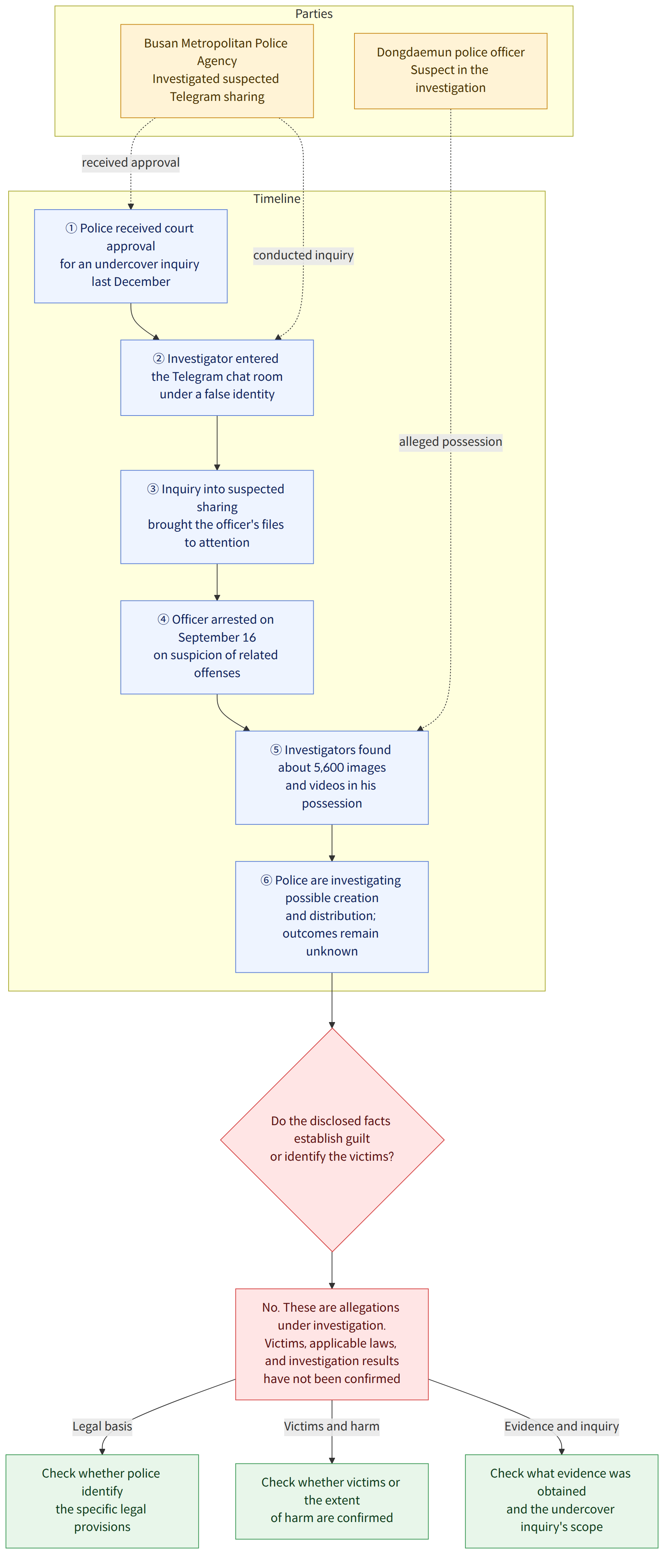
Police said Sunday that an officer with the Seoul Dongdaemun Police Station (서울 동대문경찰서) had been arrested on suspicion of using artificial intelligence to create sexually explicit deepfakes—images or videos manipulated to appear to depict real people—of people he knew and sharing them on Telegram. The officer is suspected of possessing sexually exploitative material and deepfakes, as well as creating and distributing related content. Police said he was arrested on September 16 and that investigators found about 5,600 images and videos in his possession.
Background and context
The material reportedly included about 2,600 deepfakes, 1,600 items of sexually exploitative material involving children and adolescents, and 1,300 illegally recorded images or videos. Police are also investigating the possibility that the officer personally created and distributed some of the material. This means that, based on what has been made public, the investigation concerns possession of the material as well as the possibility that he created and distributed some of it; it is not a confirmed conclusion that he personally created or shared all of the material.
The case came to light while the Busan Metropolitan Police Agency (부산경찰청) was investigating a Telegram chat room suspected of sharing sexually explicit deepfakes. Police said they received court approval last December to conduct an undercover investigation of the chat room. According to the report, an investigator entered the chat room under a false identity and tracked activity, but the information released does not say what the investigator was tracking.
What this news means
One notable aspect of the case is that the investigation began with an inquiry into a Telegram chat room suspected of sharing the material, and that the officer’s possession of files and alleged creation and distribution of content came to light during that inquiry. The fact that an investigation into suspected sharing through a chat room became linked to an individual’s digital files illustrates how tracking signs of content being exchanged on a platform can be important in investigations of digital sex crimes. However, the specific focus of the undercover investigation and how evidence was obtained have not been disclosed.
For victims, an important concern may be whether their faces or likenesses were used in sexually altered content, but the report did not identify any victims or state the extent of the actual harm. The number of files alone cannot be used to estimate the number of victims or the scale of distribution. For example, even if someone were to find a sexually explicit manipulated image in which they could recognize themselves, the report on this case alone would not establish that the content was connected to this investigation.
Police have disclosed allegations and circumstances under investigation. The arrest or discovery of files does not establish that a crime has been committed, and the identities or number of victims cannot be confirmed from the information currently available.
Relevant legal framework and support information
In-house legal guidance materials explain that whether a crime has been committed is not automatically determined by a content label or a few characteristics; it can depend on the elements of each offense and the specific facts. They also note that obscenity, the scope of disclosure and distribution through an information and communications network are issues that must be examined separately. These principles do not make it possible to draw a conclusion about the specific charges or potential penalties in this case.
The report does not identify the specific legal provisions applied to the officer. Therefore, the information currently available does not establish which laws underpin which allegations or what conclusions might be reached in an actual trial. The legal guidance materials also caution that conclusions in individual cases depend on the laws in force at the time and the circumstances of each case, so current laws and evidence must be reviewed in an actual case.
What is known and what remains unknown
Confirmed facts
- Police said an officer with the Seoul Dongdaemun Police Station was arrested on suspicion of creating and distributing sexually explicit deepfakes and other material involving people he knew, as well as possessing them.
- Police gave September 16 as the date of the arrest.
- Investigators said they found about 5,600 images and videos in the officer’s possession.
- The material found included about 2,600 deepfakes, 1,600 items of sexually exploitative material involving children and adolescents, and 1,300 illegally recorded images or videos.
- The case came to light during the Busan Metropolitan Police Agency’s investigation of a Telegram chat room. Police said they received court approval last December to conduct an undercover investigation.
What remains unknown
- The officer’s identity, the victims’ identities and the extent of the harm cannot be confirmed from the information made public.
- Police are still investigating which of the illegal items, if any, the officer actually created or distributed.
- The specific legal provisions applied to the officer and the outcomes of the investigation or any trial have not been disclosed.
- Police have not explained what the investigator was tracking during the undercover operation or how the officer’s files came to light.
What readers should check
- When reading follow-up reports, distinguish between an arrest and allegations on the one hand, and facts established by the investigation or a court on the other. Check whether the applicable laws and any additional charges have been disclosed.
- For claims about victims or the volume of material, check whether the information was confirmed by police or is an estimate or an online claim. It is best to avoid speculating about victims’ identities or resharing suspected content.
- If you need to assess a similar digital-content issue legally, do not draw a conclusion from general guidance alone; review the specific evidence and the laws currently in force.