
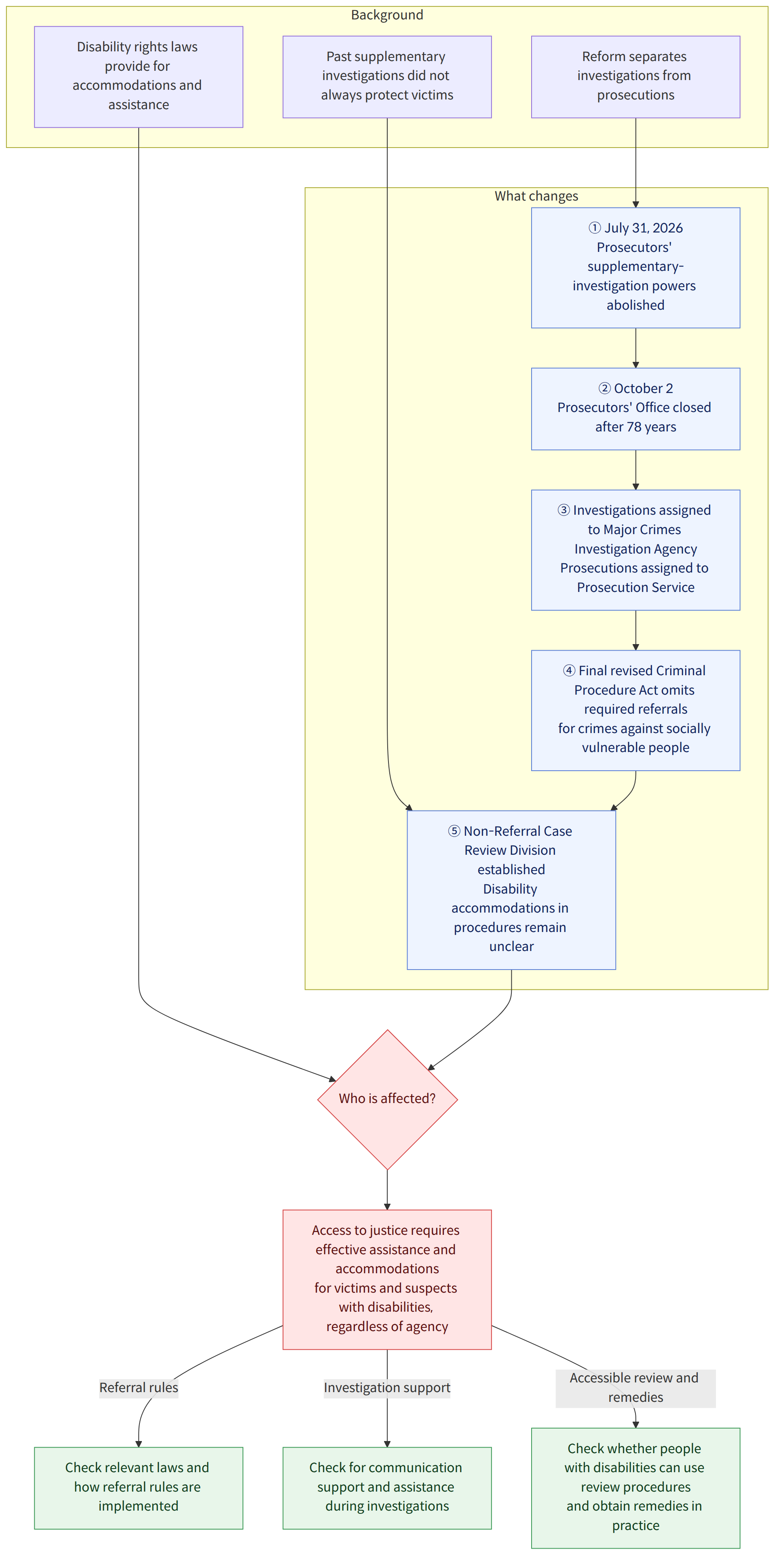
With prosecutors’ supplementary-investigation powers abolished and the Prosecutors’ Office (검찰청) closed, investigations are now handled by the Major Crimes Investigation Agency (중대범죄수사청), while prosecutions are handled by the Prosecution Service (공소청). However, a provision requiring the referral of cases involving crimes against socially vulnerable people—including child abuse, domestic violence, sexual crimes, stalking, abuse of people with disabilities, and elder abuse—was left out of the final version of the revised Criminal Procedure Act. Jo Tae-heung, a senior researcher at the Disability Policy Monitoring Center of the Korea Disabled People’s Human Rights Forum (한국장애인인권포럼 장애인정책모니터링센터), says it is important to ensure that people with disabilities’ access to justice is protected within the system amid these changes.
Background and context
According to the article, the National Assembly fully abolished prosecutors’ supplementary-investigation powers on July 31, 2026. The Prosecutors’ Office then closed on October 2, after 78 years, with investigations and prosecutions assigned to the Major Crimes Investigation Agency and the Prosecution Service, respectively. The broad framework for reform—separating investigations from prosecutions—has been established, but what assistance victims and suspects receive during investigations remains a separate issue that needs examination.
Jo Tae-heung points out that the provision requiring the referral of cases involving crimes against socially vulnerable people was omitted from the final version, leaving only a promise to address the issue through individual laws. A referral requirement means that police must pass cases they have investigated on to prosecutors. With the provision omitted, it remains necessary to examine the relevant laws and how they are implemented in practice to determine how these crimes will be reviewed and proceed to the next stage.
The opinion article explains that Article 13 of the Convention on the Rights of Persons with Disabilities (유엔 장애인권리협약) establishes access to justice as a distinct right and obliges states to provide procedural accommodations. It also cites Article 26 of the Act on the Prohibition of Discrimination against Persons with Disabilities and Remedies for Infringement of Their Rights (장애인차별금지법) and the Act on the Rights and Welfare Support of Persons with Developmental Disabilities (발달장애인법), which provide for accommodations and assistance with giving statements during investigations and trials. Jo Tae-heung’s concern is whether these rights are built into the system so that they remain effective in actual investigative procedures after the changes.
Supplementary-investigation powers in the past did not always protect victims. Jo Tae-heung wrote that, in the salt-farm slavery case, prosecutors rejected a warrant for the arrest requested by police and dragged out supplementary investigations for more than a year, while the victim remained exposed to even greater exploitation. His argument is that whether vulnerable people are protected cannot be judged solely by whether the powers are retained or abolished; procedures to address harm are needed, no matter which agency is responsible.
What this news means
Jo Tae-heung’s analysis is that, following the abolition of supplementary-investigation powers, police investigations have become a crucial stage in determining the course of a case. He is particularly concerned that people with disabilities who may have difficulty expressing their intentions accurately at the start of an investigation could see their right to a defense curtailed if they do not receive assistance in giving statements or communication support. This raises the issue of access and assistance in investigative procedures for both victims with disabilities and suspects with disabilities.
To prevent inadequate investigations and the concealment of cases, the government established a Non-Referral Case Review Division (불송치심사부) within the Prosecution Service to review cases that are not referred. However, Jo Tae-heung points out that it is not clear whether assistance that takes account of disabilities, communication support, and remedies have been built into the standard procedures. Creating a review body and ensuring that people with disabilities can actually use its procedures may be separate tasks.
For example, if a person with a disability reports being the victim of a crime but cannot adequately communicate their experience or wishes during an investigation, whether assistance and communication support are provided during the initial documentation of the case and subsequent review could affect how the case is handled. This is a hypothetical situation and does not assert what the outcome of any actual case would be. The central question is whether the system provides support that enables people to understand and participate in the process, as well as remedies they can use to challenge an inadequate investigation.
The issue Jo Tae-heung raises is not just whether supplementary-investigation powers should be retained or abolished. His argument is that whether people with disabilities’ access to justice is guaranteed as part of the basic procedures of investigations and trials is a measure of how complete the reform is.
Relevant systems and support information
The opinion article describes Article 13 of the Convention on the Rights of Persons with Disabilities, Article 26 of the Act on the Prohibition of Discrimination against Persons with Disabilities and Remedies for Infringement of Their Rights, and the Act on the Rights and Welfare Support of Persons with Developmental Disabilities as the basis for procedural accommodations and assistance with giving statements during investigations and trials. Jo Tae-heung proposes that the law—not enforcement decrees or internal guidelines—should explicitly provide for the protection of the right to a defense in ways that take account of disabilities, assistance with giving statements, and remedies when rights protections fail. He also argues that a legal basis should be established for the staffing, budget, and processing deadlines of dedicated organizations, along with accountability for implementation, and that consultations should be held with people with disabilities.
An in-house legal guide explains that, in criminal trials, how evidence was collected and prepared, and whether there was an opportunity to challenge testimony and its contents in court, affect its admissibility (whether it is eligible to be used as evidence at trial). Evidence collected unlawfully, and secondary evidence obtained on its basis, generally cannot be used as evidence of guilt, though whether an exception applies may be determined by the specific circumstances. The guide also notes that a suspect-interrogation record prepared by police can be used as evidence only if the defendant or their lawyer admits its contents in court.
Victims also have separate rights and procedures available to them in criminal proceedings. According to internal materials, victims of certain crimes may apply for a compensation order before the close of arguments in a first- or second-instance trial and, if they meet the requirements, may request that a trusted person be present during witness questioning or that proceedings be closed to the public. People who suffer an injury or serious bodily harm specified by law as a result of a crime against their life or body may apply for crime victim compensation, subject to the requirements. However, these systems cannot be considered a substitute for assistance to people with disabilities at the start of an investigation or for support through the Non-Referral Case Review Division.
Confirmed facts and what remains unknown
Confirmed facts
- According to the article, prosecutors’ supplementary-investigation powers were fully abolished on July 31, 2026, with the Major Crimes Investigation Agency responsible for investigations and the Prosecution Service for prosecutions.
- The provision requiring the referral of cases involving crimes against socially vulnerable people was omitted from the final version of the revised Criminal Procedure Act.
- The government established a Non-Referral Case Review Division within the Prosecution Service to review cases that are not referred.
- Jo Tae-heung proposed that the law explicitly provide for the right to a defense, assistance with giving statements, and remedies that account for disabilities, and that it establish a legal basis for the staffing, budget, and processing deadlines of dedicated organizations.
What remains unknown
- The available information does not establish whether an individual bill to require the referral of cases involving crimes against socially vulnerable people has actually been introduced or passed.
- It is also unclear what specific review procedures the Non-Referral Case Review Division will use or how it will provide assistance and communication support for people with disabilities.
- It remains unknown how consultations with people with disabilities will be conducted or whether the proposed dedicated organization’s staffing, budget, and processing deadlines will be reflected in law.
What readers should check
- Victims or suspects with disabilities may need to check whether procedures are actually in place for requesting communication support and assistance with giving statements during investigations and trials. The opinion article cites the relevant legal provisions on rights but does not discuss the specific application process.
- If a case record or statement record is in question, readers can check how the record was prepared and whether there is an opportunity to challenge its contents in court. Admissibility may depend on the procedures used to obtain evidence and whether it was examined in court; being admitted as evidence and being sufficient on its own to establish guilt are separate matters.
- Victims whose cases are going through a criminal trial can check the deadline for applying for a compensation order and the procedures for protecting victims who testify, depending on the case and applicable requirements. A compensation order must be applied for before the close of arguments in a first- or second-instance trial, while requests for a trusted person to be present or for proceedings to be closed to the public are subject to the relevant requirements.