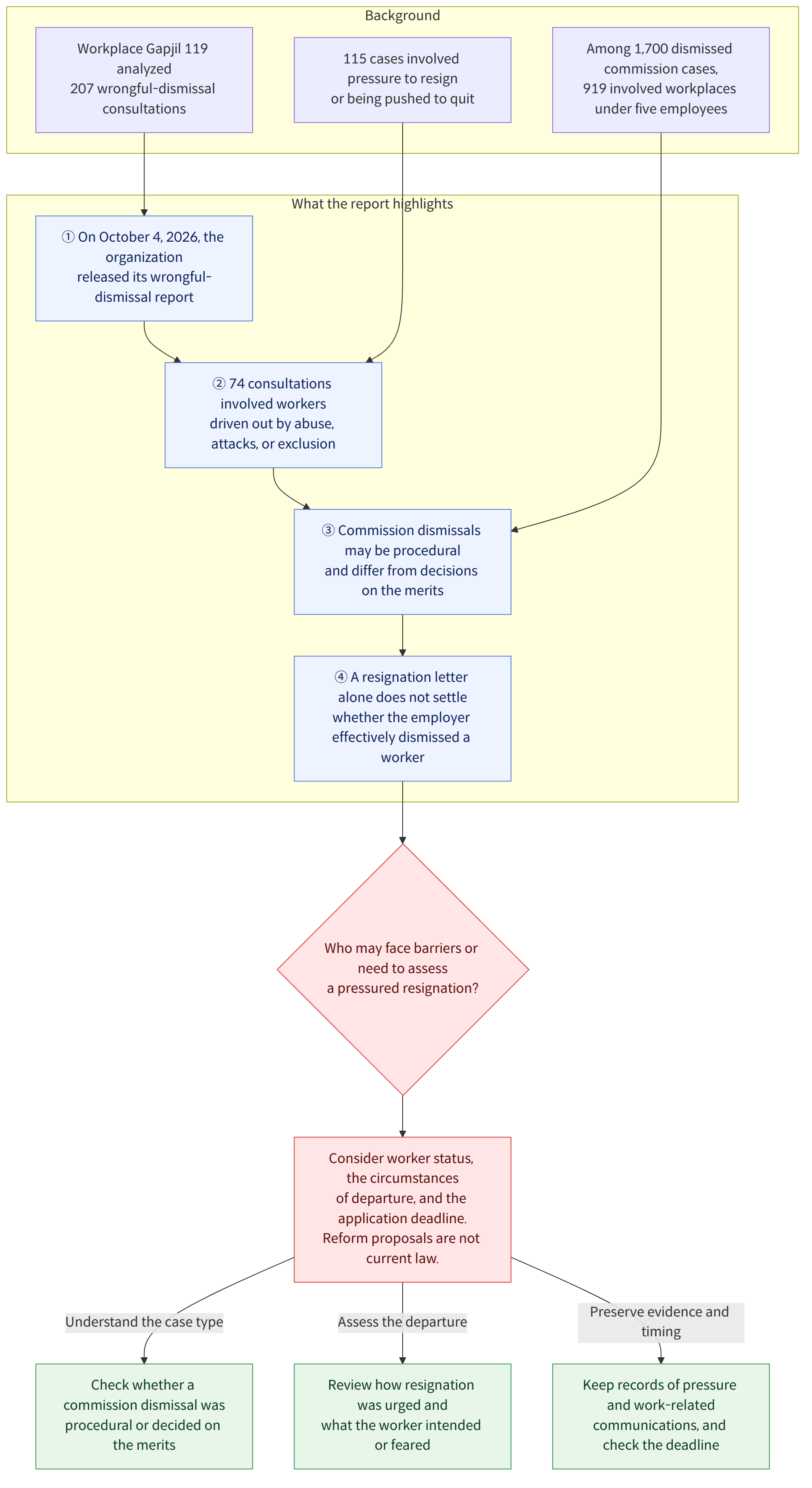
On October 4, 2026, Workplace Gapjil 119 (직장갑질119) released a report titled “10 Commandments on Wrongful Dismissal,” based on its analysis of 207 consultations about wrongful dismissal. Of these, 115 cases, or 55.6%, involved pressure to resign or being pushed to quit, while 74 involved workers being driven to leave their jobs by verbal abuse, personal attacks, exclusion from work, or similar treatment. Separately, more than half of the wrongful-dismissal cases filed with labor commissions that were dismissed were related to workplace size.
Background and context
The report highlights that dismissal does not always take the form of an explicit notice of termination. Pressuring workers to quit or making it difficult for them to endure their workplace in order to induce them to resign also accounted for a large share of the consultations. Park Eun-ha, a labor attorney with Workplace Gapjil 119, described pressure to resign and being pushed to quit as indirect forms of dismissal and said the actual reasons behind a worker’s departure should be considered together.
Labor commission data points to another barrier. According to data obtained by Workplace Gapjil 119 through the office of Rep. Jeong Hye-gyeong of the Progressive Party (진보당), 82,617 wrongful-dismissal cases were filed and 68,309 cases were processed between January 1, 2023, and July 1, 2026. According to the article, 9.5% of processed cases were recognized as wrongful dismissals, and 919 (54.1%) of the 1,700 dismissed cases were dismissed because the workplaces had fewer than five employees.
A dismissal means a case is not accepted for reasons such as failing to meet procedural requirements before the merits of the case are considered. Dismissal statistics should therefore be distinguished from cases in which a worker’s claim was rejected after the merits of a wrongful-dismissal dispute were examined. According to the article, which cited data from the National Data Agency (국가데이터처), workplaces with fewer than five employees accounted for 86.4% of all businesses nationwide in 2023. This figure alone, however, cannot establish what protections an individual worker can actually receive.
What this news means
The mere fact that a resignation letter exists is not enough to conclude that the worker left voluntarily. A guide based on consultation cases from the Korea Legal Aid Corporation (대한법률구조공단) explains that even if a worker submitted a resignation letter and was processed as having resigned voluntarily, the departure may be considered a dismissal if the worker had no intention of resigning and the employer effectively ended the employment relationship unilaterally. This means the specific circumstances—including how the worker was urged to resign and what disadvantages they expected at the time—must be considered together.
However, it is important to distinguish Workplace Gapjil 119’s proposals from the legal standards currently in force. Workplace Gapjil 119 called for expanding the definition of a worker and the scope of the Labor Standards Act (근로기준법), and for placing the burden of proving that a dismissal was not wrongful on the employer. These are the organization’s demands for systemic reform; the article does not say whether an amendment to the law that would allow workers at workplaces with fewer than five employees to challenge wrongful dismissal will actually be pursued.
For example, even if someone who was pressured to quit has already submitted a resignation letter, records of the pressure and of work instructions or conversations before and after the departure may help establish whether the resignation was voluntary. This alone cannot establish that a dismissal occurred, but it is one reason to document the entire process leading to departure rather than keeping only the resignation letter.
Related systems and support information
The guide based on consultation cases from the Korea Legal Aid Corporation explains that dismissal must have just cause, and that receiving advance notice of dismissal or dismissal notice pay does not substitute for a valid reason for dismissal. It also advises workers not to assume they cannot challenge a dismissal simply because they submitted a resignation letter or received severance pay or dismissal notice pay, and to consider the circumstances at the time and any objections they raised. The outcome of a specific case may vary depending on its circumstances.
If you are considering filing a remedy application with a labor commission, it is important not to miss the deadline. The guide based on consultation cases says that an application must be filed within three months of the date of dismissal, while cautioning that the applicable procedures and deadlines should be checked in each actual case. It is safer to promptly seek advice after organizing the date of dismissal, the date the resignation letter was submitted, and when any relevant notice was received.
The fact that a contract describes the arrangement as outsourcing or contracting, or that 3.3% was deducted from a worker’s pay, does not by itself establish that the person is not an employee. According to the guide, employee status—whether someone qualifies as a worker protected by law—is determined by considering the actual relationship as a whole, including the employer’s direction and supervision of the work, restrictions on working hours and location, and the continuity of the pay and work, rather than the title of the contract. This connects to Workplace Gapjil 119’s call to protect “fake freelancers,” but an individual worker’s status must be determined based on the specific facts.
What is confirmed and what is still unknown
Confirmed facts
- Workplace Gapjil 119 released a report on October 4, 2026, analyzing 207 consultations about wrongful dismissal.
- Pressure to resign or being pushed to quit accounted for 115 cases (55.6%); 74 of these involved bullying or personal insults.
- From January 1, 2023, to July 1, 2026, 82,617 cases were filed with labor commissions and 68,309 were processed.
- Of the 1,700 dismissed cases, 919 (54.1%) were dismissed because the workplaces had fewer than five employees.
- Workplace Gapjil 119 called for expanding the definition of a worker and the scope of the Labor Standards Act, and for placing the burden of proving that a dismissal was not wrongful on the employer.
What is still unknown
- The article does not say whether an amendment to the law that would allow workers at workplaces with fewer than five employees to challenge wrongful dismissal will actually be pursued.
- It is not known whether the consultation cases and labor commission cases differed by industry, region, or type of worker.
- The article does not say what procedures the workers who experienced pressure to resign in the consultation cases actually pursued or what outcomes they received.
What readers should check
- If you are urged or pressured to resign, do not immediately write a resignation letter. Keep a dated record of the process leading to your departure, including notices, conversations, and exclusion from work. Workplace Gapjil 119 also recommended exercising caution before writing a resignation letter, gathering relevant evidence, and seeking advice.
- Even if you have already submitted a resignation letter, check whether records remain of the circumstances in which you submitted it, the pressure at the time, any request that you leave, and any objections you raised. Do not assume that you cannot challenge the dismissal just because you received dismissal notice pay or severance pay.
- If you are considering filing a remedy application with a labor commission, organize the date of dismissal and relevant documents, and consult a labor counselor to confirm the three-month deadline stated in the case-based guide and the procedures that actually apply. Also keep records of work instructions and supervision, regardless of the wording in your contract.