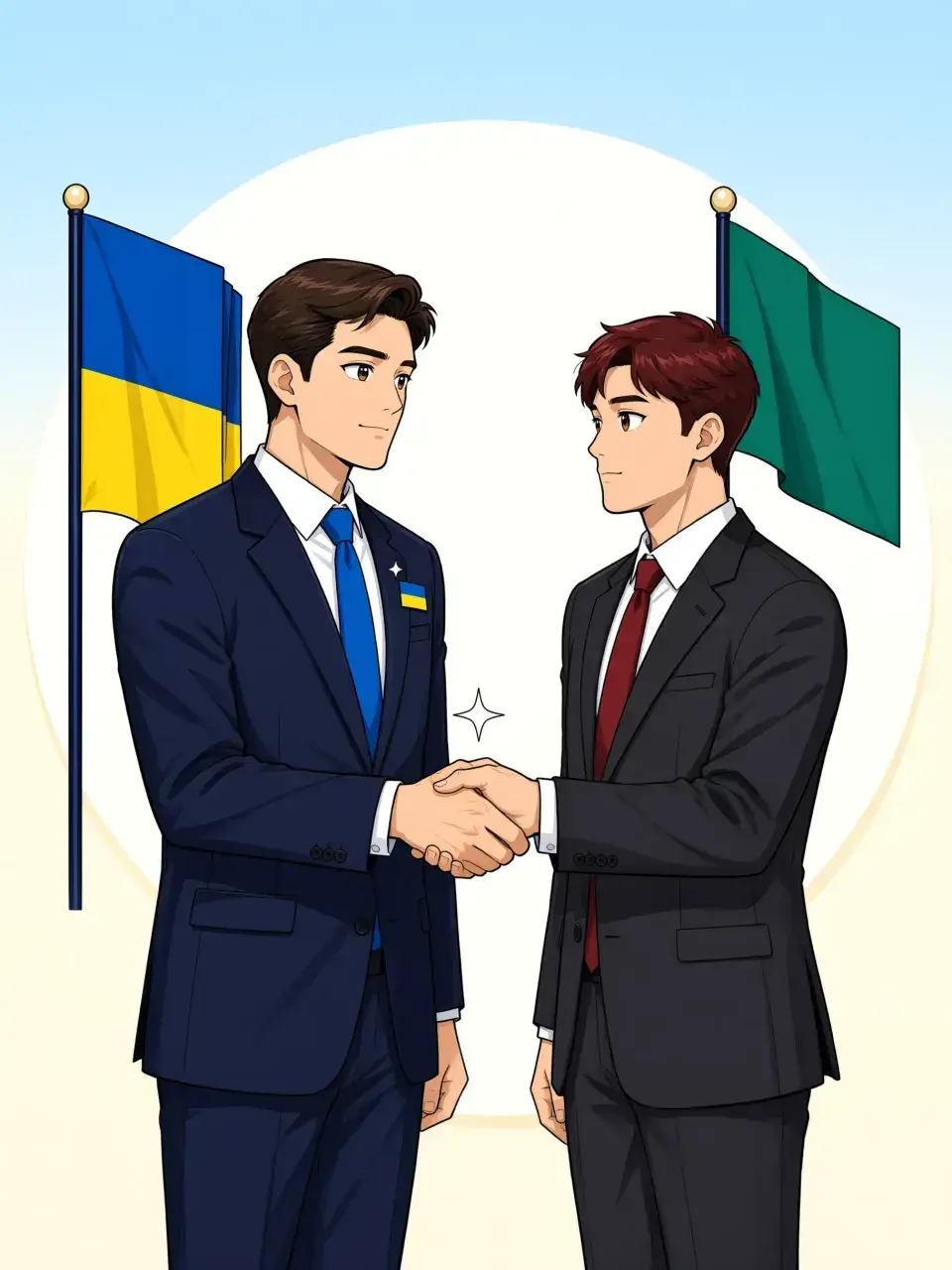
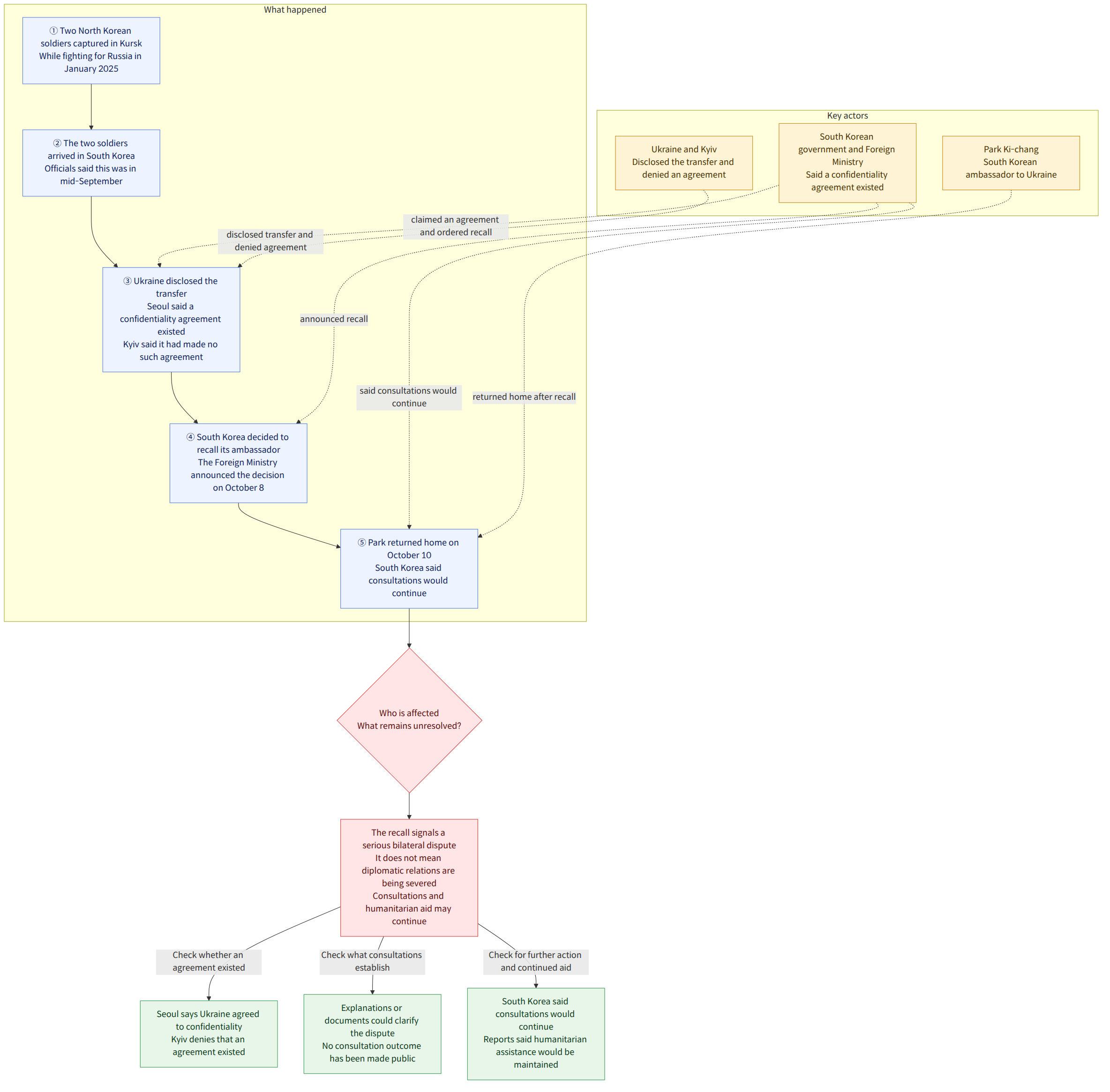
Park Ki-chang, South Korea’s ambassador to Ukraine, returned home on October 10, two days after the Ministry of Foreign Affairs (외교부) decided to recall him. The ministry announced the recall in response to Ukraine’s public disclosure of the transfer of North Korean prisoners of war to South Korea and Kyiv’s subsequent position that it had never agreed with Seoul to keep the matter confidential. The two North Korean soldiers were captured in the Kursk region in January 2025 while fighting for Russia and, according to officials, arrived in South Korea in mid-September.
Background and context
The central issue is not only that the transfer of the two North Korean prisoners of war was made public, but also whether the two sides had agreed not to disclose it. The South Korean government said it had reached a confidential agreement at Ukraine’s request to protect the soldiers and their families who remain in North Korea. It also argued that Ukrainian President Volodymyr Zelenskyy violated the agreement by disclosing the transfer during his address to the United Nations General Assembly in New York last month.
Kyiv, by contrast, says it never made such a confidential agreement with South Korea. The publicly available information therefore does not make it possible to establish whether an agreement existed or whether it was breached. With the two sides offering conflicting accounts, the diplomatic dispute has extended beyond the circumstances of the prisoners’ transfer to a disagreement over whether an agreement was made and what it contained.
South Korea decided to recall its ambassador on October 8, and Park returned home two days later. The recall was described as a stronger diplomatic measure than a protest or expression of regret. According to reports, it was the first time in 18 years that South Korea had brought an ambassador home as a protest; in 2008, it recalled its ambassador to Japan to protest claims over sovereignty of Dokdo.
Tensions between the two countries had already been building. South Korean President Lee Jae-myung was reported to have warned on October 2 that South Korea would take further measures unless Ukraine issued a public apology. The foreign minister told a parliamentary audit by the National Assembly Foreign Affairs and Unification Committee (국회 외교통일위원회) that he had received a message from Ukraine’s foreign minister concerning an apology, but that it fell short of expectations. He also indicated that the government would respond firmly.
What this means
The move shows that the South Korean government is treating the confidentiality issue not as a minor disagreement but as a diplomatic matter affecting bilateral relations. The decision to bring an ambassador home may signal growing mistrust between the two countries, but there is no basis to conclude that it means an immediate severing of diplomatic relations. Other reports have, however, predicted that the dispute could significantly worsen bilateral ties and affect South Korea’s relations with European countries that support Ukraine.
South Korea’s Ministry of Foreign Affairs said it would continue consultations with Ukraine and, according to reports, maintain humanitarian assistance to the country. This shows that dialogue and aid may continue separately from the ambassador’s recall. However, with the two sides’ claims about the agreement still unresolved, it remains unclear how consultations will proceed or whether South Korea will take further action.
For example, if documents or explanations establishing whether an agreement existed are made public during consultations with Ukraine, the focus of the dispute could shift from whether an agreement existed to questions of responsibility for the disclosure and preventing a recurrence. This is a hypothetical scenario; it does not mean that the content or outcome of actual consultations has been made public.
What is confirmed and what remains unknown
Confirmed facts
- The two North Korean soldiers were captured in the Kursk region in January 2025 and, according to officials, arrived in South Korea in mid-September.
- The South Korean government said it had reached a confidential agreement with Ukraine before the transfer was made public, while Kyiv said no such agreement existed.
- The Ministry of Foreign Affairs announced the recall of Ambassador Park Ki-chang, and he returned home on October 10, two days after the decision.
- Reports said it was the first time in 18 years that South Korea had brought an ambassador home as a protest, and cited the 2008 return of its ambassador to Japan.
- The South Korean government said it would continue consultations with Ukraine and maintain humanitarian assistance.
What remains unknown
- Whether South Korea and Ukraine actually made a confidential agreement and, if so, what its terms were and how broadly it restricted disclosure.
- What additional measures the South Korean government may take after Ambassador Park’s return.
- Whether consultations between the two sides can resolve the dispute over the agreement and how significantly the dispute will affect diplomatic relations.
What readers should watch for
- Whether the South Korean government provides further explanations about the outcome of consultations with Ukraine or the alleged confidentiality agreement.
- Whether the existing position that humanitarian assistance will continue after the ambassador’s recall is reflected in actual policy.
- Reports have suggested that the dispute could also affect relations with Europe, making it worth watching how the South Korean government explains the matter in its relations with European countries.
References
- Other coverage consulted: hani.co.kr
- Other coverage consulted: chosun.com