A Strategic Convergence of Labor Power
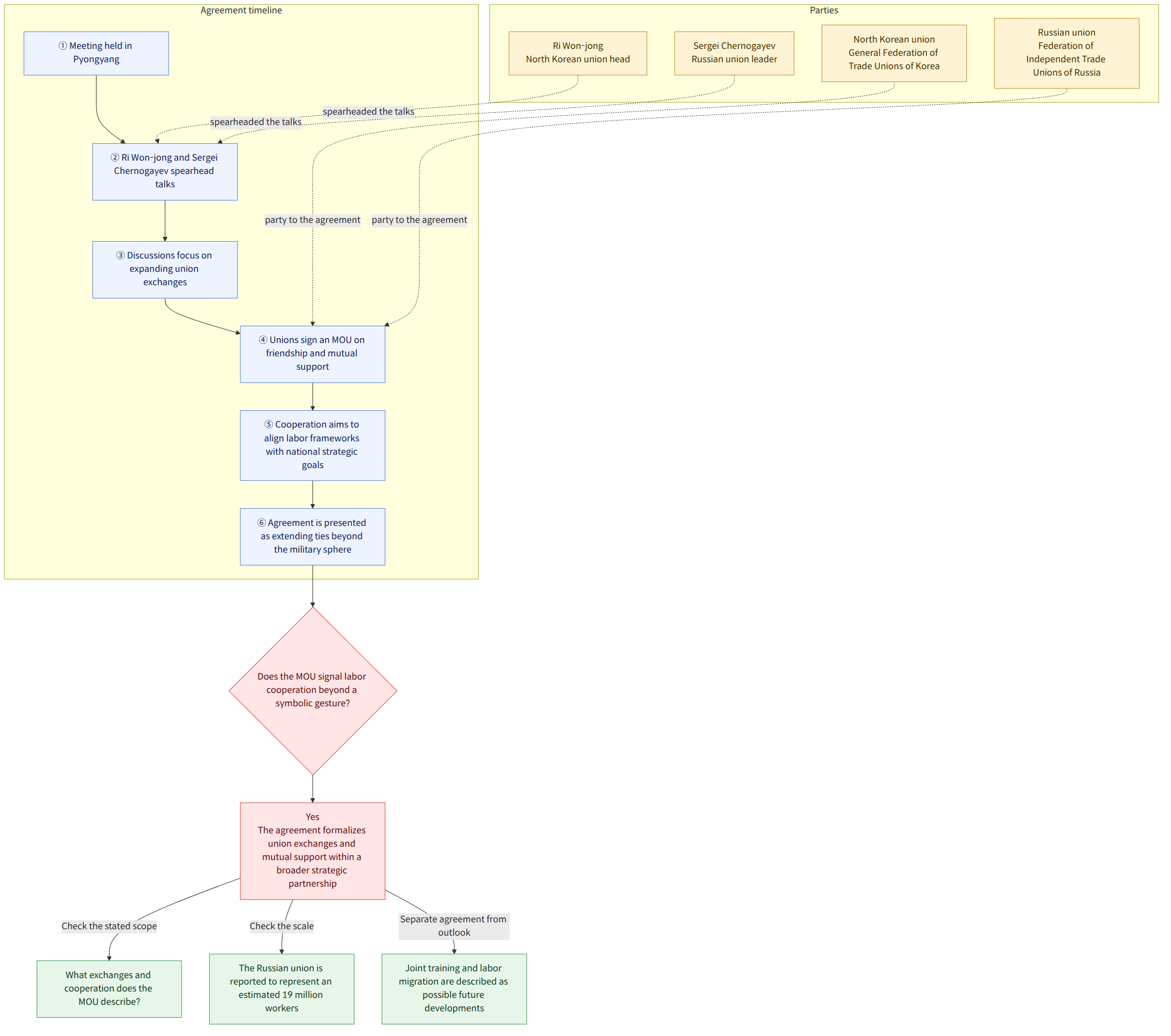
In a move that signals a deepening ideological and structural alignment, the largest umbrella labor unions of North Korea and Russia have officially entered into a cooperation agreement. The meeting, held in Pyongyang, culminated in the signing of a Memorandum of Understanding (MOU) (a formal document describing a bilateral agreement between two parties) focused on friendship and mutual support.
Ri Won-jong, the head of the General Federation of Trade Unions of Korea, and Sergei Chernogayev, the leader of the Federation of Independent Trade Unions of Russia, spearheaded the talks. This agreement is not merely a symbolic gesture but a calculated step to synchronize the labor frameworks of two nations that have recently accelerated their strategic partnership.
Expanding the Scope of Bilateral Ties
According to official reports, the discussions focused on expanding and strengthening exchanges between the two countries' trade unions. This initiative is described as being in line with the North Korea-Russia friendship, which has reportedly entered a "new stage" of intimacy.
The cooperation aims to create a unified front of labor solidarity, ensuring that the workforce of both nations is aligned with the strategic goals of their respective governments.
To understand this in real-world terms, this is similar to how two companies might sign a partnership agreement to share training manuals and employee exchange programs to ensure their operations are perfectly synchronized. In this case, the "companies" are the state-led labor apparatuses of two sovereign nations.
The Scale of Russian Labor Influence
One of the most significant aspects of this agreement is the sheer scale of the Russian delegation. The Federation of Independent Trade Unions of Russia represents an estimated 19 million workers, making it one of the most powerful labor organizations in the world.
Key Implications of the Russian Presence:
- Massive Scale: The involvement of 19 million workers provides North Korea with a blueprint for large-scale labor management and organization.
- Diplomatic Signaling: The physical presence of a high-level Russian delegation in Pyongyang serves as a visible sign of Moscow's commitment to the North Korean regime.
- Knowledge Transfer: The exchange likely involves sharing methods of labor mobilization and industrial productivity techniques.
The Geopolitical Context: Beyond Labor
This labor agreement does not exist in a vacuum. It is a direct extension of the broader military and political alliance that has intensified recently. The two nations have aligned closely across various sectors, creating a symbiotic relationship based on mutual survival and strategic leverage.
The Cycle of Mutual Support:
- Military Personnel: North Korea has deployed troops to support Russia's ongoing military operations in Ukraine.
- Technical Exchange: In return, Russia has provided vital military technology (advanced weaponry and engineering blueprints) and essential resources to Pyongyang.
- Economic Buffering: By strengthening labor ties, both nations seek to create a social safety net and economic stability that can withstand international sanctions.
Future Outlook and Potential Risks
Looking forward, this labor alliance could evolve into a more formal economic bloc. If the two countries begin integrating their labor standards or creating joint industrial projects, it could lead to a more resilient economic axis that is less dependent on Western financial systems.
However, this move is likely to draw sharp criticism and further sanctions from the international community. The alignment of labor unions—which in these countries often function as arms of the state—suggests a move toward a closed-loop economy (an economic system that relies entirely on internal or allied trade, ignoring external market pressures).
Potential Future Developments:
- Joint Vocational Training: The establishment of shared training centers for industrial workers.
- Labor Migration: Potential agreements for North Korean laborers to work in Russian industrial sectors under state-monitored contracts.
- Ideological Synchronization: The use of labor unions to propagate shared political narratives among the working class of both nations.