A refusal two days before the audit
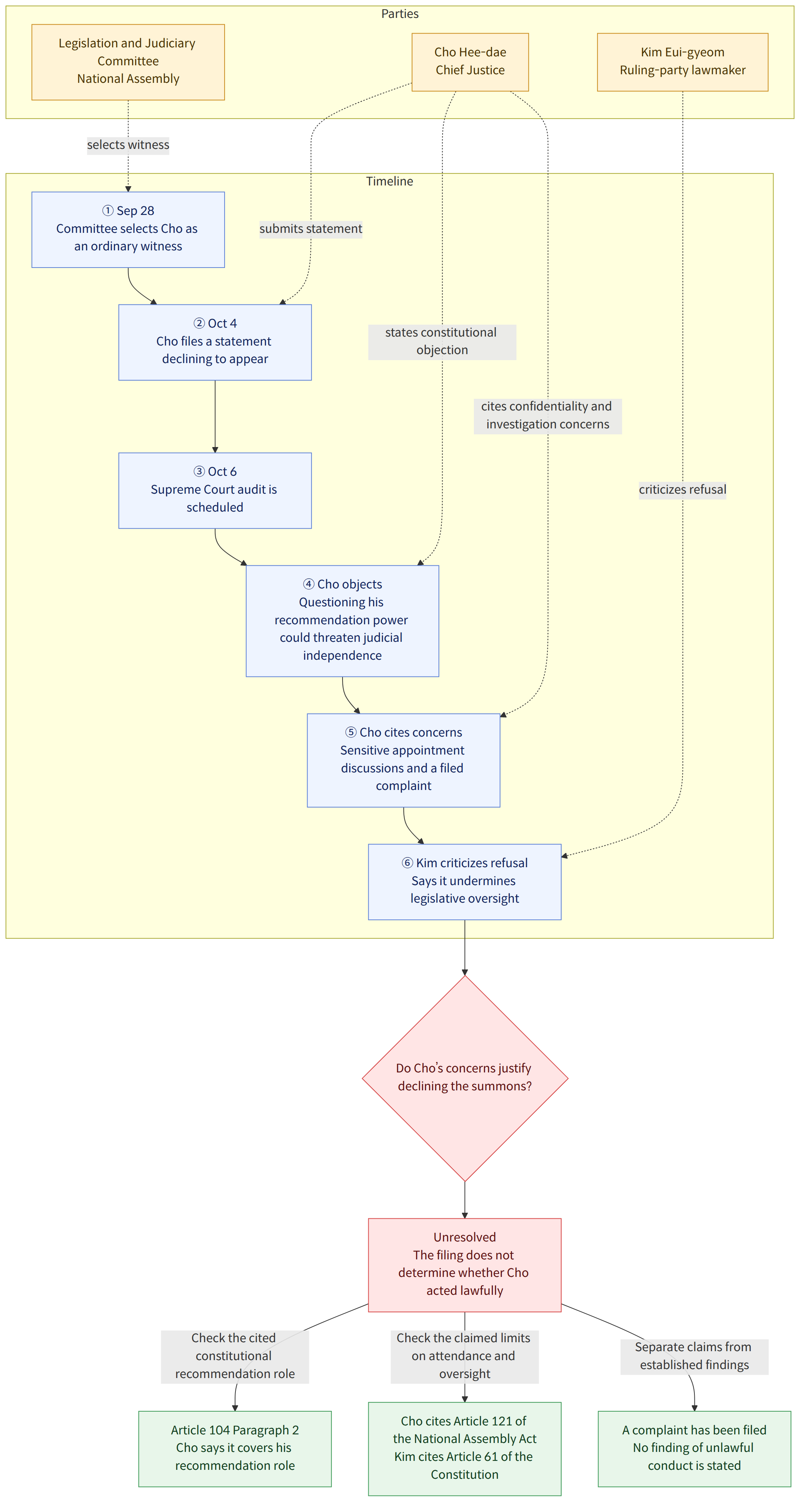
South Korea’s Chief Justice Cho Hee-dae has filed a statement explaining why he will not appear as a witness at a National Assembly audit of the Supreme Court scheduled for October 6. The filing came on October 4, just two days before the hearing.
The audit is being conducted by the National Assembly’s Legislation and Judiciary Committee, which has summoned Cho as an ordinary witness. The committee’s review is part of the legislature’s oversight of public institutions; it is not, by itself, a criminal trial or a finding that anyone has broken the law.
Cho argues that requiring him to testify about his constitutional powers would conflict with judicial independence and the separation of powers.
Cho’s constitutional objection
In his statement, Cho said that his authority to recommend candidates for the Supreme Court is an independent constitutional power of the chief justice. He argued that questioning him in the National Assembly about how he exercised that authority would run against the purpose of separation of powers (the division of government authority among the legislature, executive and courts).
Cho also cited Article 104, Paragraph 2 of South Korea’s Constitution, which addresses the chief justice’s role in recommending Supreme Court justices. He said the audit would go beyond the proper limits of parliamentary oversight and pointed to Article 121 of the National Assembly Act, which he says does not impose a duty on the chief justice to attend and answer questions in this capacity.
His position reflects a broader institutional concern: if lawmakers question a top judge about a specific decision involving judicial appointments, the exchange could be seen as political pressure on the courts. Cho says that protecting judicial independence (the ability of courts to make decisions without improper influence from other branches of government) is central to his refusal.
Confidentiality and a possible investigation
Cho also argued that it would not be appropriate to disclose sensitive details about an appointment process that is still under way. He specifically referred to information about candidates’ personal circumstances and discussions with the president, whose constitutional powers are also involved in the appointment process.
He added that a complaint has already been filed concerning the exercise of his recommendation authority and that a future investigation cannot be ruled out. Cho’s argument is that discussing the matter in public before any possible investigative process could expose sensitive information or affect what happens next.
- Cho’s stated reasons: constitutional limits, judicial independence and the sensitive nature of appointment discussions.
- The unresolved issue: whether those concerns justify declining a summons to a parliamentary audit.
- What the filing does not establish: it does not determine whether Cho’s actions were lawful or unlawful.
A lawmaker says Cho is reversing an earlier position
Kim Eui-gyeom, a Democratic Party lawmaker and the committee’s ruling-party secretary, criticized the decision. Kim said Cho had previously indicated that he would explain the controversy over refusing a request to recommend Supreme Court candidates again through the parliamentary audit.
Kim argued that submitting a nonattendance statement after being formally summoned contradicts that earlier position. He also said the National Assembly’s audit authority is guaranteed by Article 61 of the Constitution and described the refusal as a rejection of the legislature’s constitutional role.
Kim warned that if the possibility of an investigation were enough to avoid an audit, other public officials facing complaints could use the same reasoning to decline parliamentary questioning.
The disagreement is therefore not only about whether Cho should answer questions on one appointment dispute. It also raises a wider question about how to balance legislative scrutiny of public officials with protections intended to keep courts independent from political pressure.
The dispute behind the summons
The committee selected Cho as an ordinary witness on September 28, with Democratic Party lawmakers leading the move. The party says Cho’s refusal to recommend Supreme Court justice candidates again after a request from the presidential office may have infringed the public’s right to a trial and violated constitutional or legal duties.
The ruling party has also raised questions about Cho’s actions during the December 3 martial law crisis, including reports that he convened a meeting of senior officials. These are allegations and concerns raised by the party; the material provided does not establish them as proven violations.
At the heart of the appointment dispute is the chief justice’s recommendation role. In practical terms, the disagreement concerns who may decide whether candidates are put forward again and what reasons, if any, should be disclosed when that decision is challenged.
Why this matters beyond one hearing
Supreme Court appointments can shape how the country’s highest court handles major legal disputes for years. At the same time, parliamentary audits allow elected lawmakers to ask public officials how they have used their authority and to explain decisions to the public.
The two principles can collide. For example, lawmakers may argue that a public appointment decision needs explanation, while a judge may say that answering questions about the decision could expose confidential discussions or make the courts appear subject to political direction.
What happens next
The immediate question is whether the committee will proceed with its October 6 audit without Cho or take further steps in response to his absence. The submitted statement sets out his reasons, but it does not resolve the dispute over whether he is required to attend or whether the committee’s questions would cross constitutional boundaries.
The outcome could influence how future audits handle senior judicial officials and sensitive appointment matters. Any broader consequences will depend on how lawmakers, the courts and other relevant institutions interpret the competing constitutional responsibilities.
- Cho’s position: appearing to answer questions about his recommendation authority would threaten judicial independence and exceed the limits of the audit.
- Kim’s position: refusing to attend weakens the National Assembly’s constitutional oversight and conflicts with Cho’s earlier remarks.
- The central tension: accountability for public decisions must be weighed against the independence of the judiciary.
The constitutional balance at stake
The dispute puts two principles in direct conversation: the legislature’s authority to examine government conduct and the judiciary’s need to remain independent. Neither side’s argument, on its own, settles where the legal boundary lies in this particular case.
For the public, the practical stakes are whether the reasons behind a consequential judicial appointment decision will be explained in an open forum—and whether that explanation can be sought without undermining the courts’ ability to act independently.