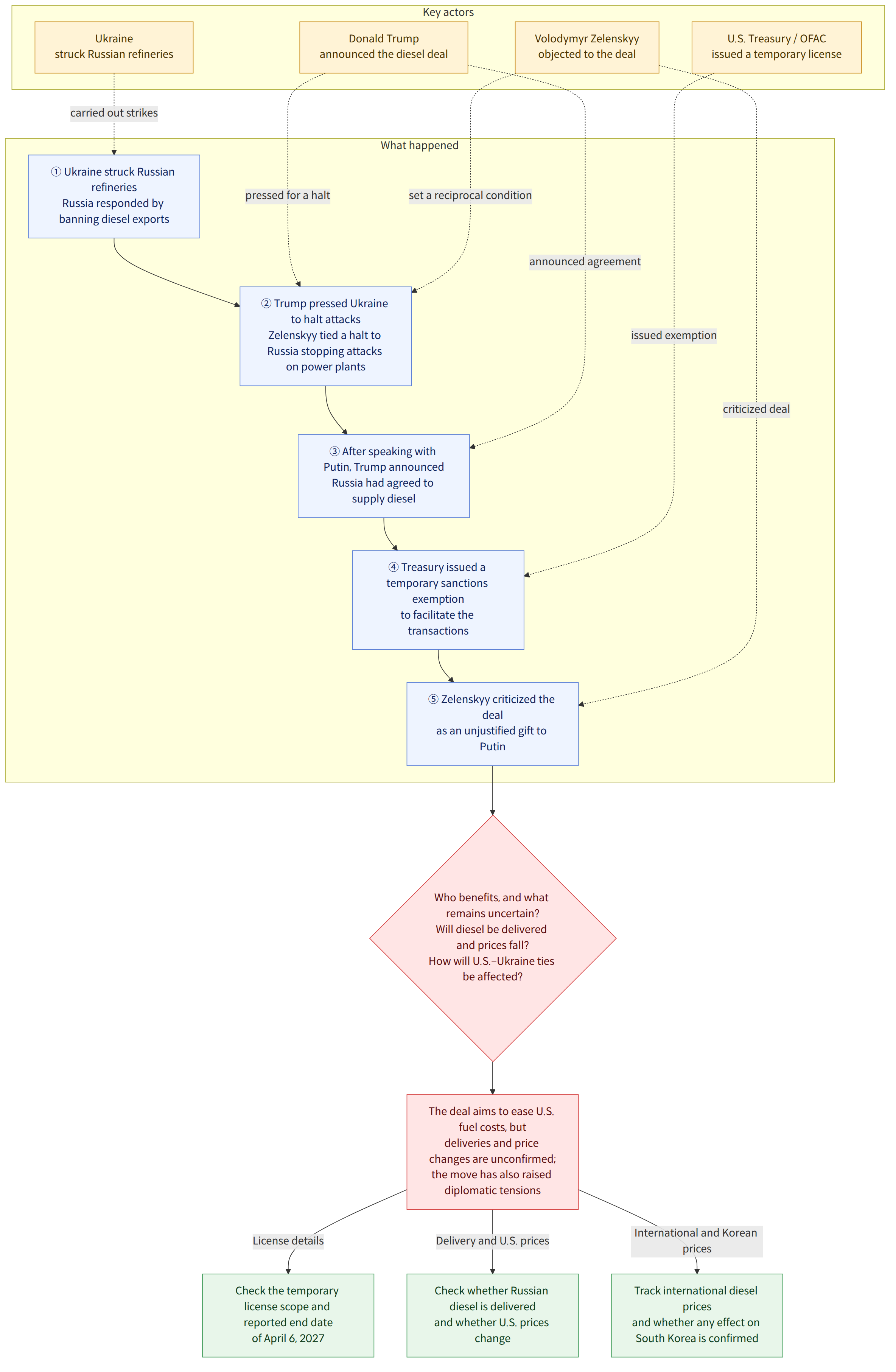
After speaking with Russian President Vladimir Putin, U.S. President Donald Trump announced that Russia had agreed to supply diesel to the United States and global markets. The U.S. Treasury Department issued a temporary sanctions exemption allowing the sale and import of Russian diesel, among other transactions, to facilitate the deal. Ukrainian President Volodymyr Zelenskyy objected, saying the deal amounted to an unjustified gift to President Putin.
The announcement brings together an effort to lower fuel prices in the United States and the policy of imposing sanctions on Russia. At the same time, differences between the United States and Ukraine over Ukrainian attacks on Russian refineries have become public, drawing attention to the potential impact of the energy supply measure on relations between the two countries and their policies related to the war.
Background and context
According to Axios, President Trump asked Ukraine six times to stop attacking Russian refineries, but his requests were not accepted. A U.S. government official said President Zelenskyy was misreading the situation and argued that continuing the attacks would damage the friendly relationship he had built with President Trump over the past six months. President Trump was also reported to have publicly called for the attacks to stop last month.
Ukraine has heavily targeted Russian refineries in recent months, and Russia responded by banning diesel exports. According to the article, this added pressure to an international diesel market that was already unstable. Data from Korea National Oil Corporation's Opinet (한국석유공사 오피넷) show that the international diesel price rose from $78.34 per barrel in the first week of January 2026 to $170.14 in the first week of October. The average price of diesel in the United States also rose by about 70% after the outbreak of the Iran war, reaching $6.28 per gallon as of October 9, according to reports.
President Zelenskyy was reported to have told the U.S. side that Ukraine could stop attacking Russian refineries if Russia stopped attacking Ukrainian power plants. A U.S. government official, by contrast, said President Trump called for the attacks to stop because he believed Ukraine’s strikes were contributing to rising fuel prices in the United States. Taken together, the two sides’ accounts show that calls to halt the attacks are tied not only to the conduct of the war but also to U.S. fuel prices.
What this news means
For U.S. consumers, the key question is whether Russian diesel will actually be supplied and whether that will lead to lower prices. President Trump claimed that expanded supply would quickly bring down diesel prices worldwide, but neither the actual delivery of the announced volumes nor any price changes have been confirmed. The announcement of a supply agreement alone therefore does not mean that the burden of fuel costs in the United States has eased.
For Ukraine, the U.S. sanctions exemption could pose a diplomatic challenge because it enables the sale of Russian energy. President Zelenskyy objected, saying the deal was neither fair nor honest and gave President Putin an unjustified gift. The U.S. side, meanwhile, argued that Ukraine’s attacks were affecting fuel prices in the United States. This points to the possibility of a clash between U.S. interests in stabilizing diesel prices and Ukraine’s war aims.
The trend in international diesel prices is also a metric for readers in South Korea to watch. However, the reports provided do not make it possible to determine how the Russian diesel deal will affect actual diesel prices in South Korea. For example, even if international supply increases, it would be difficult to conclude that the announcement alone will stabilize prices if the transactions and deliveries do not take place.
Related rules and support information
A key point is that the U.S. Treasury Department issued a temporary sanctions exemption for the deal. Another report said the Treasury’s Office of Foreign Assets Control issued a temporary general license, allowing transactions involving the sale, delivery and unloading of Russian diesel, as well as its import into the United States, through April 6, 2027. However, the specific conditions for applying the exemption are difficult to confirm based on the information provided.
Sanctions are measures that restrict certain countries or transactions. The exemption was reported as a temporary easing of sanctions limited to transactions involving Russian diesel. It should therefore not be interpreted more broadly as a lifting of sanctions on Russian energy in general or as a permanent change in policy.
Points reported differently by the outlets
Both reports gave the initial supply volumes announced by President Trump. The first report mentioned more than 300,000 tonnes immediately, 500,000 tonnes in November and 1 million tonnes shortly afterward. Another report also included President Trump’s announcement that Russia would supply an additional 3 million tonnes in the near term, calculating the total at 4.8 million tonnes.
The reports also differ in the level of detail they provide about the deadline for the sanctions exemption. One described it only as a temporary measure, while another said the period during which transactions are allowed runs through April 6, 2027. However, neither report provides confirmation of the actual supply schedule or whether the deliveries will be carried out.
What is confirmed and what remains unknown
Confirmed facts
- According to Axios, President Trump asked Ukraine six times to stop attacking Russian refineries, but his requests were not accepted.
- The international diesel price rose from $78.34 per barrel in the first week of January 2026 to $170.14 in the first week of October.
- President Trump announced a phased plan to supply Russian diesel, and the U.S. Treasury Department issued a temporary sanctions exemption for the transactions.
- President Zelenskyy criticized the deal.
What remains unknown
- It has not been confirmed when or how the announced volumes of diesel will be supplied, or whether the plan will be carried out as announced.
- It is not known how much the deal will change international diesel prices or fuel prices in the United States.
- The specific conditions for applying the sanctions exemption are difficult to determine from the reports provided.
- It is not yet known what consequences the differences between the United States and Ukraine over halting attacks on Russian refineries will have for their relationship going forward.
What readers should watch for
- It is worth watching whether the announced diesel supply leads to actual deliveries and transactions, and whether follow-up announcements confirm additional volumes and schedules.
- Readers should check whether the U.S. Treasury Department publicly clarifies the scope of transactions permitted under the sanctions exemption and the conditions for applying it.
- Actual fuel prices in each country should be checked alongside changes in international diesel prices. It is difficult to determine the direction of domestic prices based only on rising international prices or an announced supply agreement.
References
- Other coverage consulted: hani.co.kr
- Other coverage consulted: koreatimes.co.kr