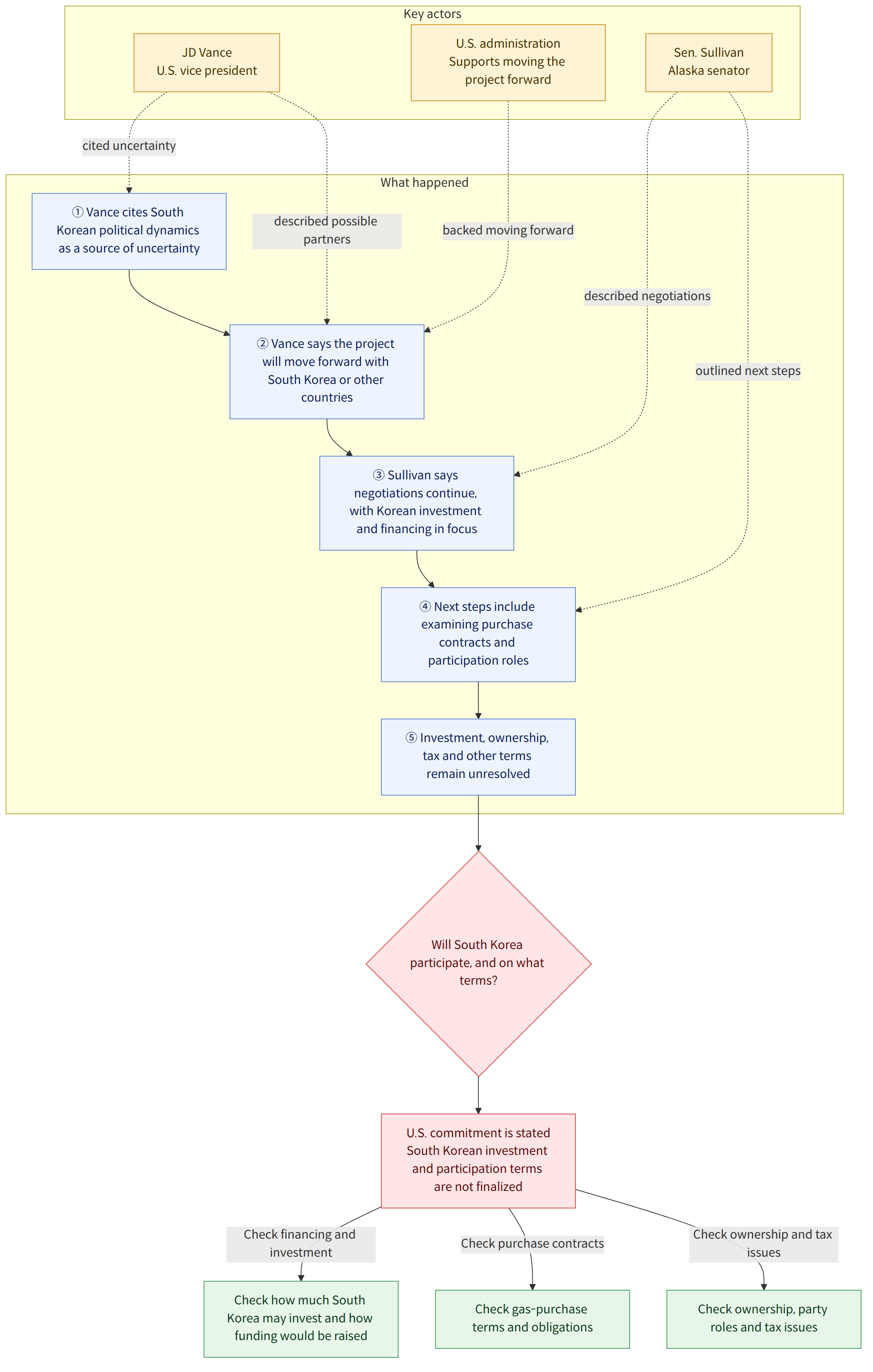
U.S. Vice President JD Vance cited South Korea’s political situation as a source of uncertainty for the Alaska liquefied natural gas (LNG, a fuel made by cooling natural gas into a liquid) project. He also said the project would be completed in cooperation with South Korea’s current or next government, or with Japan and other countries if necessary. While he emphasized the commitment to move the project forward, he did not spell out how much South Korea would invest or the terms on which it would participate.
Background and context
In an interview with an Alaska regional broadcaster on October 6 (local time), Vice President Vance cited South Korea’s “political dynamics” as one source of uncertainty for the project. He did not explain what specific circumstances he had in mind. The report also did not confirm how South Korean politics might actually affect the project or whether the South Korean government’s willingness to participate had changed.
Vice President Vance claimed there was strong demand for natural gas produced in Alaska. He also said Alaska gas was cheaper, higher quality, and more reliable than gas from some small authoritarian regimes. These were Vance’s claims; the information in the report alone does not allow for an independent comparison of price, quality, or supply reliability.
He said what made the current situation different from the past was that the administration wanted to move the project forward and there was a president who kept his promises. Sen. Sullivan, who was interviewed alongside him, also said negotiations and discussions about the project’s structure were continuing, while emphasizing that this time there was funding and the president and Cabinet supported the project. However, these remarks describe a commitment to move forward and support for the project; they do not mean that South Korea’s investment or the terms of the project have been finalized.
What this news means
One notable point in these remarks is that the U.S. side said it wanted South Korea to participate while also saying it would move the project forward even if South Korea’s government changed. This could be read as a message that the U.S. is not limiting its potential partner to South Korea’s current government, but there is no basis to interpret it as evidence that South Korea has already made an investment decision or signed a contract. Whether the project comes to fruition depends not only on political will but also on conditions such as financing, purchase contracts, and the roles of the participating parties.
In particular, since Sen. Sullivan said the administration’s current focus was South Korea’s investment and financing, the amount South Korea would take on and how it would raise the funds could be central to the next round of discussions. He also said the next steps would be to examine purchase contracts and the participation structure involving South Korea, the U.S. federal government, and the state of Alaska. However, it is not known when a proposal will be finalized or what responsibilities and authority each party will have.
For example, if South Korean companies or the government consider participating in the project, the U.S. statement that it will “move the project forward” alone is not enough to determine the scale of participation or how profits and costs would be shared. Investment and financing, gas-purchase terms, ownership, and tax issues need to be examined to gauge the actual obligations and significance of participation.
Questions remain in Alaska, too, about the project’s ownership structure and tax issues. State legislators have criticized President Trump’s announcement for not providing details about the project’s structure. It is therefore more accurate to view this reporting as showing that the U.S. administration has expressed its commitment to moving forward and that South Korea’s investment is being addressed first in negotiations, rather than as evidence that the project’s terms have been finalized.
Differences in how the reports presented the story
There are no clear differences in the key information reported. One report added that after mentioning “political dynamics,” Vice President Vance did not explain specifically what he meant. Another report also described South Korea’s political situation as a variable, but did not provide background or specific examples.
What is confirmed and what remains unknown
Confirmed facts
- In an interview on October 6 (local time), Vice President Vance cited South Korea’s political situation as a source of uncertainty for the Alaska LNG project.
- He said the project would be completed in cooperation with South Korea’s current or next government, or with Japan and others if necessary.
- Sen. Sullivan said the administration’s current focus was South Korea’s investment and financing, and that the next step would be to examine purchase contracts and the participation structure.
- Questions about the Alaska project’s ownership structure and taxes remain unresolved, and reports said state legislators had criticized the lack of details about the project’s structure.
- Ahead of the November midterm elections, the Alaska Senate race is close, and some polls have shown Mary Peltola leading incumbent Sen. Sullivan.
What remains unknown
- How will the scale of South Korea’s investment and its financing be determined?
- When will the purchase contracts and the participation structure for South Korea, the U.S. federal government, and the state of Alaska be finalized?
- How will the project’s ownership structure and tax issues be resolved?
- What specifically did Vice President Vance mean by South Korea’s “political dynamics”?
What readers should watch for
- Follow-up announcements should be checked for details on the scale of South Korea’s investment and how it will be financed.
- When purchase contracts and the roles of South Korea, the U.S. federal government, and the state of Alaska are determined, it will also be important to examine who bears the costs and risks.
- Watch for explanations of ownership and tax issues. It is important to distinguish statements of commitment from finalized project terms.
References
- Other coverage consulted: koreatimes.co.kr
- Other coverage consulted: en.yna.co.kr