A nomination dispute puts the judiciary under pressure
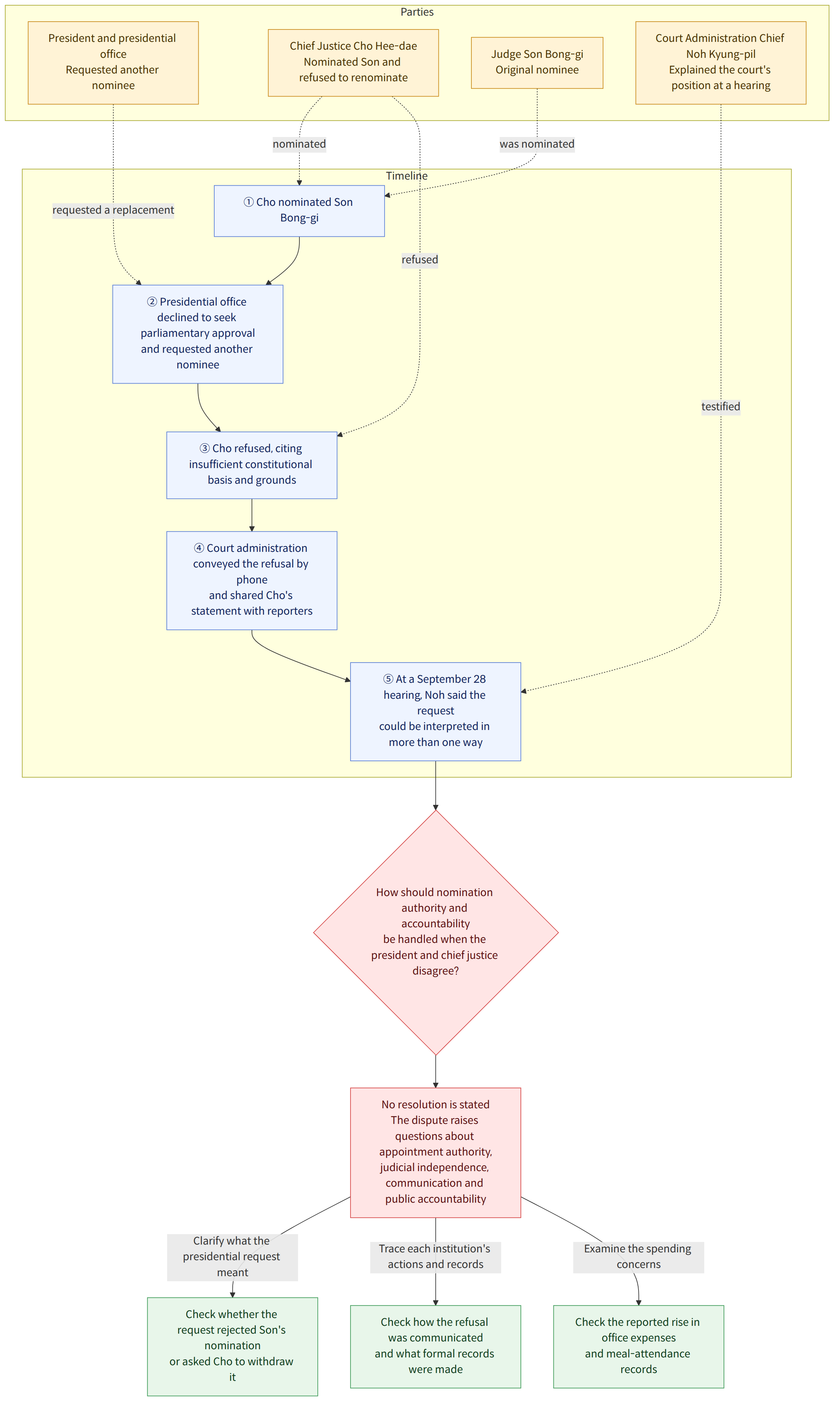
Chief Justice Cho Hee-dae’s refusal to put forward a new candidate for the Supreme Court has triggered a political and constitutional dispute. The disagreement centers on a request from the presidential office to nominate someone else after it decided not to seek parliamentary approval for Cho’s original candidate, Judge Son Bong-gi.
The controversy has raised a broader question: where does the chief justice’s authority to recommend Supreme Court candidates end, and what role should the president and the legislature play? The answer matters beyond this one appointment, because Supreme Court justices help shape how the law is interpreted for years to come.
A nationwide poll conducted from September 28 to 30 among 1,000 adults found that 55% supported asking the chief justice to consult again with the president and recommend another candidate. By comparison, 34% said the president should appoint the candidate originally proposed by the chief justice. The figures suggest that more respondents favored another round of consultation, although public opinion alone does not settle the constitutional question.
The dispute is no longer only about one candidate. It has become a test of how senior judicial appointments are handled when the president and the chief justice disagree.
Four points of criticism over the refusal
1. The presidential request was treated as unclear
The court administration’s position was that the presidential office’s written request did not clearly say whether the original nomination had been rejected or whether the chief justice was being asked to withdraw it voluntarily. In a September 28 parliamentary hearing, National Court Administration chief Noh Kyung-pil told lawmakers that the letter could be interpreted in more than one way.
Critics argued that the request was straightforward: the president would not ask parliament to approve Son’s appointment and wanted the chief justice to recommend someone else. They said that, in ordinary terms, this amounted to rejecting the first candidate, even if the letter did not use that exact word.
The legal distinction matters because appointment procedures often depend on who formally takes each step and how that step is recorded. But critics said that relying on a narrow reading of the wording, rather than addressing the apparent intent, made the court’s response seem needlessly combative.
2. Critics say the ambiguity could have been clarified directly
If the chief justice believed the letter was open to interpretation, lawmakers and commentators argued, the simplest course would have been to ask the presidential office to confirm what it meant. Instead, Cho issued a statement saying that the request lacked a constitutional basis and sufficient grounds, without first making clear whether he understood the president to have rejected the candidate.
That response fueled the impression that the disagreement was being framed as a constitutional confrontation rather than resolved through routine communication. Democratic Party lawmakers described the exchange as confusing and said it appeared to disregard the presidential office’s stated position.
The chief justice’s supporters could argue that a written constitutional objection is more appropriate than informal negotiation when the limits of each institution’s authority are at stake. Still, critics said the public deserved a clear explanation of what had been requested, what Cho believed the law required and what he planned to do next.
3. The method of communication drew criticism
Cho’s statement emphasized that presidential actions under the law should be conducted in writing. Yet, during the parliamentary hearing, Noh confirmed that the court administration had conveyed its refusal to the presidential office by telephone.
The contrast prompted lawmakers to ask whether the chief justice was demanding formal documentation from the president while relying on a phone call to communicate his own position. The criticism was not simply about etiquette: written records can help clarify what each institution said and when, especially during a high-stakes constitutional dispute.
The statement was also shared with a group chat used by reporters covering the Supreme Court, rather than being presented at a formal public briefing. Noh said he had understood that the court’s spokesperson would handle the announcement. Critics said that a dispute with consequences for the courts and the public warranted a more direct and transparent explanation.
4. Even the court administration chief could not explain the next step
At the hearing, lawmakers asked Noh what Cho’s position was and how the chief justice intended to resolve the standoff. Noh said he could not state the chief justice’s position precisely. That answer intensified concerns that the decision-making process was concentrated around Cho and that the plan for resolving the dispute had not been clearly communicated within the court administration.
The chief justice’s office has a central role in judicial appointments, but the office also carries a responsibility to explain consequential decisions. Critics say that when a public institution’s senior official remains silent, uncertainty can spread quickly and weaken confidence in the institution.
The dispute has therefore become a test of both legal authority and administrative accountability: whether the courts can explain their reasoning, clarify their next steps and keep a political disagreement from becoming a prolonged institutional crisis.
Office expenses rise sharply, while meal records face scrutiny
A second controversy concerns the chief justice’s official business expenses, known in South Korea as office-operation expenses (public funds used for work-related meetings, meals and other official duties). Figures submitted to parliament show that the amount recorded for the chief justice’s office was several hundred thousand won a year in 2021, 2022 and 2023, before rising to 136.52 million won in 2024.
The recorded total then fell to 68.797 million won in 2025, while spending for the first half of 2026 reached 57.472 million won. Compared with the 2023 figure of 4.59 million won, the 2024 total was nearly 30 times higher. The court administration has not publicly explained the reason for the increase, according to the material described in the report.
The figures alone do not establish that any spending was improper. A change in budgets, duties or accounting practices could affect annual totals. But the scale of the rise has prompted calls for the court to explain what changed, what kinds of expenses were covered and how public funds were checked.
Public spending records are meant to let taxpayers see how money was used. When the amounts change dramatically, a clear explanation is essential—even if the spending itself is ultimately found to be legitimate.
Questions about reported meal attendance
Separate reporting alleged that some expense records listed more people at meals than were actually present. One example involved a restaurant where the records reportedly listed a gathering of 38 people, while the restaurant’s largest private room was said to seat 19. Other reported entries described meals at around 28,000 won per person at restaurants where critics questioned whether that amount was plausible.
A media investigation said it had identified at least 13 instances in the first half of 2026 in which the attendance figures in expense records were inaccurate. At the parliamentary hearing, Noh acknowledged that the number of people listed for some meals did not match the actual attendance and apologized.
The discrepancy is significant because the number of attendees can affect the reported cost per person. But the available account does not establish who entered the figures, why they were wrong or whether the chief justice personally knew about them. Those questions require a documented review rather than assumptions based only on the reported discrepancies.
A lawyer quoted in the original report said repeated inaccuracies could raise questions under laws governing public records and official documents. That was a legal concern, not a finding of criminal wrongdoing. Any determination of responsibility would depend on evidence about how the records were prepared, reviewed and submitted.
Other spending questions
The article also cited an audit finding that the court administration bought wine worth 108.92 million won from 2022 through 2025 without keeping adequate supporting documentation. Of that amount, purchases made late at night or on weekends and public holidays were reported to total 99.5 million won. Spending at bars was reported at roughly 16.25 million won.
Those figures do not, by themselves, show whether each purchase was for an official purpose or whether rules were broken. They do, however, raise practical questions that a transparent audit should answer: who approved the purchases, what events they supported and whether receipts and attendance records were complete.
The expense dispute has also revived criticism of a previous ruling involving a bus driver dismissed after allegedly taking a small amount of money from fares. The original commentary contrasted that case with the much larger public expense figures now under scrutiny. The comparison expresses a criticism about fairness and consistency; it does not, on its own, determine whether the spending records violated the law.
The meaning of judicial independence
At the heart of the dispute is the meaning of judicial independence (the ability of judges to decide cases according to the constitution, the law and their conscience, without improper pressure). Cho and his supporters have emphasized the independence of the judiciary from political institutions. Critics counter that independence should not mean freedom from public scrutiny or the right of a senior judge to act without explaining major decisions.
South Korea’s Constitution says in Article 103 that judges must rule independently, in accordance with the Constitution and laws, and according to their conscience. That provision focuses directly on the independence of judges when deciding cases. The commentary argues that protecting the judiciary as an institution is not the same as protecting a chief justice from questions about appointments, spending or internal personnel decisions.
The distinction can be understood through an everyday example: a referee should be free to apply the rules without pressure from either team, but that does not mean the referee’s decisions or conduct can never be reviewed. Similarly, judicial independence protects fair decision-making; transparency helps the public determine whether that protection is being respected.
The article also argues that appointments to the Supreme Court require public legitimacy as well as institutional expertise. A chief justice’s nomination power is important, but critics say it should not be treated as an absolute power that excludes consultation with elected branches of government.
A judge’s reappointment review raises a separate concern
The article points to the case of Heo Yong-gu, a senior judge at the Seoul Central District Court, who was reportedly undergoing a review for reappointment. In November 2024, while presiding over a trial connected to allegations involving Seongnam FC, Heo ordered a prosecutor to leave the courtroom.
Heo had concluded that the prosecutor’s temporary assignment to take part in the hearing was unlawful. The prosecutor’s original workplace had changed, but the prosecutor continued to appear in the case through a series of one-day assignments. Prosecutors objected, other prosecutors left the courtroom in protest and a motion seeking Heo’s removal from the case was filed. The Supreme Court ultimately rejected that motion.
Judges in South Korea undergo reappointment reviews every 10 years. The process is intended to assess whether a judge can continue in office, including in cases of serious performance problems, incapacity or conduct incompatible with judicial service. The article says that actual non-reappointments are rare and raises concern that some judges who publicly criticized the judiciary have faced adverse outcomes.
Heo reportedly wrote on the judiciary’s internal network that the courts should consider whether they defend judicial independence publicly while undermining judges’ dignity and independence inside the institution. After news of his review became public, the court administration reportedly told him by phone that the stated reason had changed from concerns about conduct to poor performance, explaining that the first description had been an employee error.
That reported change has prompted questions about how the review was handled. It does not establish that Heo is being punished for his courtroom decision, and the account does not provide the full record behind the review. But because a reappointment decision can end a judge’s career, the criteria and reasoning should be clear enough to rule out retaliation or arbitrary treatment.
Judicial independence must protect judges from pressure both outside and inside the courts. A review process that affects a judge’s career needs clear criteria, consistent records and a credible explanation.
What happens next—and why public trust matters
The nomination dispute and the spending questions are separate issues, but together they have intensified scrutiny of the Supreme Court’s leadership. The court can help restore confidence by clarifying its interpretation of the president’s request, explaining whether it will nominate another candidate and publishing a clear account of how office expenses are approved and recorded.
An independent review of inaccurate expense entries could establish whether they resulted from mistakes, weak controls or intentional misreporting. Likewise, an explanation of the judge’s reappointment review could help show whether the process followed established standards. In each case, an evidence-based response would be more persuasive than either blanket denial or speculation.
The central challenge is to protect the judiciary from political interference without placing it beyond accountability. If the courts appear to take sides in political disputes, refuse to explain consequential decisions or apply different standards to public money and individual citizens, public trust may suffer—even when the institution invokes independence.
The commentary’s warning is that judicial independence is strengthened not only by distance from politicians, but also by fair rulings, transparent procedures and respect for the independence of individual judges. Whether Cho’s decisions meet that standard remains contested. The immediate test is whether the Supreme Court can explain its actions clearly enough for the public to judge them.