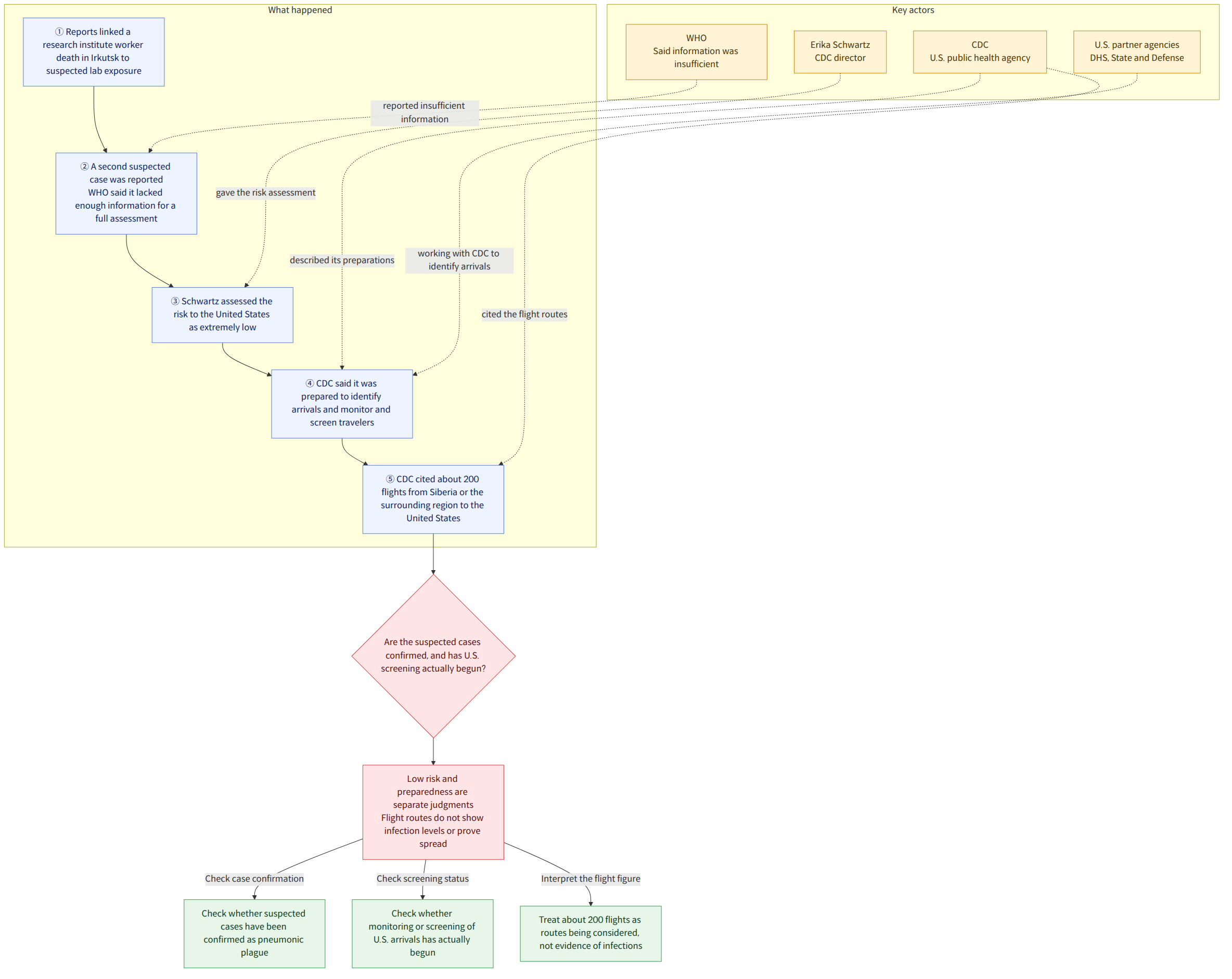
Erika Schwartz, director of the U.S. Centers for Disease Control and Prevention (CDC; 미국 질병통제예방센터), said Wednesday that the risk to the United States from suspected cases of pneumonic plague in Siberia is extremely low. The CDC also said it is prepared to monitor and screen travelers, and that there are about 200 flights from Siberia or the surrounding region to the United States. The CDC said it is working with the Department of Homeland Security (국토안보부), the Department of State (국무부), the Department of Defense (국방부) and other government agencies to determine whether anyone is entering the United States from the area.
The CDC’s low-risk assessment and its preparations to identify and screen arrivals should be viewed together. The fact that preparations are underway does not, by itself, confirm that there have been infections in the United States or that screening has actually been carried out.
Background and context
Reports said the concerns emerged after a 28-year-old woman who worked at a plague research institute in Russia’s Siberian region of Irkutsk died. Initial reports said she was hospitalized with severe pneumonia and later died, and raised the possibility that she had contracted pneumonic plague in a laboratory exposure incident. The reports provided here do not present this as a confirmed fact.
A suspected case involving another employee at the research institute was also reported. The World Health Organization (WHO; 세계보건기구) said it had not yet received enough information from Russia to understand the overall situation and could not conduct a full risk assessment. The WHO director-general said timely, complete and transparent information-sharing was needed to verify conflicting reports and make an accurate assessment.
Russia was reported to have warned people to be wary of misinformation, while the Mongolian government said it was implementing health surveillance and monitoring measures along its border with Russia amid growing international concern. The situation shows countries responding in different ways while the veracity and scope of the suspected cases remain unclear.
What this news means
The key point in the CDC’s remarks is that risk assessment and precautionary measures are separate judgments. The CDC director assessed the risk to the United States as extremely low, while also saying the agency was prepared to work with other agencies to determine whether anyone was arriving from the area and to monitor and screen travelers. This shows that a low-risk assessment does not mean information-gathering or preparedness has stopped.
The reference to about 200 flights describes the scale of the travel routes the CDC is considering as it seeks to identify arrivals. However, that figure does not indicate the scale of infection in Siberia or the possibility of spread in the United States. The reports do not say whether actual monitoring or screening of travelers arriving in the United States has already begun.
This is only an illustrative hypothetical, however; the information provided does not establish that any actual measures have been taken with respect to specific travelers.
Points reported differently across outlets
Reports differ in how many suspected cases they describe and how they characterize them. One report covered both the research institute employee’s death and reports of a second suspected case, while another focused on the laboratory employee who died and reported that the WHO could not assess the overall risk. Neither report, based on the information provided, confirms a case of pneumonic plague.
The name of the U.S. government agency also differs across accounts. The source text reporting the CDC’s remarks says “Department of War,” while the fact list identifies the agency as the Department of Defense. Accordingly, this article refers to it as the Department of Defense, while noting that the source texts use different names.
What is confirmed and what remains unknown
Confirmed facts
- CDC Director Erika Schwartz assessed the risk to the United States from suspected cases of pneumonic plague in Siberia as extremely low.
- Schwartz said the CDC was prepared to monitor and screen travelers.
- Schwartz said there are about 200 flights from the area to the United States and that the agency is working with several government agencies to identify arrivals.
- The WHO said it could not conduct a full risk assessment because it had not received sufficient information from Russia.
What remains unknown
- Whether the suspected cases in Siberia have been confirmed as pneumonic plague.
- The identity of the deceased worker and the exact circumstances of her death.
- Whether actual monitoring or screening of travelers arriving in the United States has begun.
What readers should check
- It is important to distinguish reports of suspected cases from announcements confirming cases. The reports provided here do not answer whether the cases have been confirmed.
- Anyone concerned about U.S. entry or travel can check subsequent announcements from the CDC and relevant government agencies to see whether screening has actually begun and what its scope is.
- Since the WHO has said it cannot assess the overall risk, readers should watch for whether further information is released and whether Russia provides additional details.
References
- Other coverage consulted: koreatimes.co.kr
- Other coverage consulted: koreatimes.co.kr