
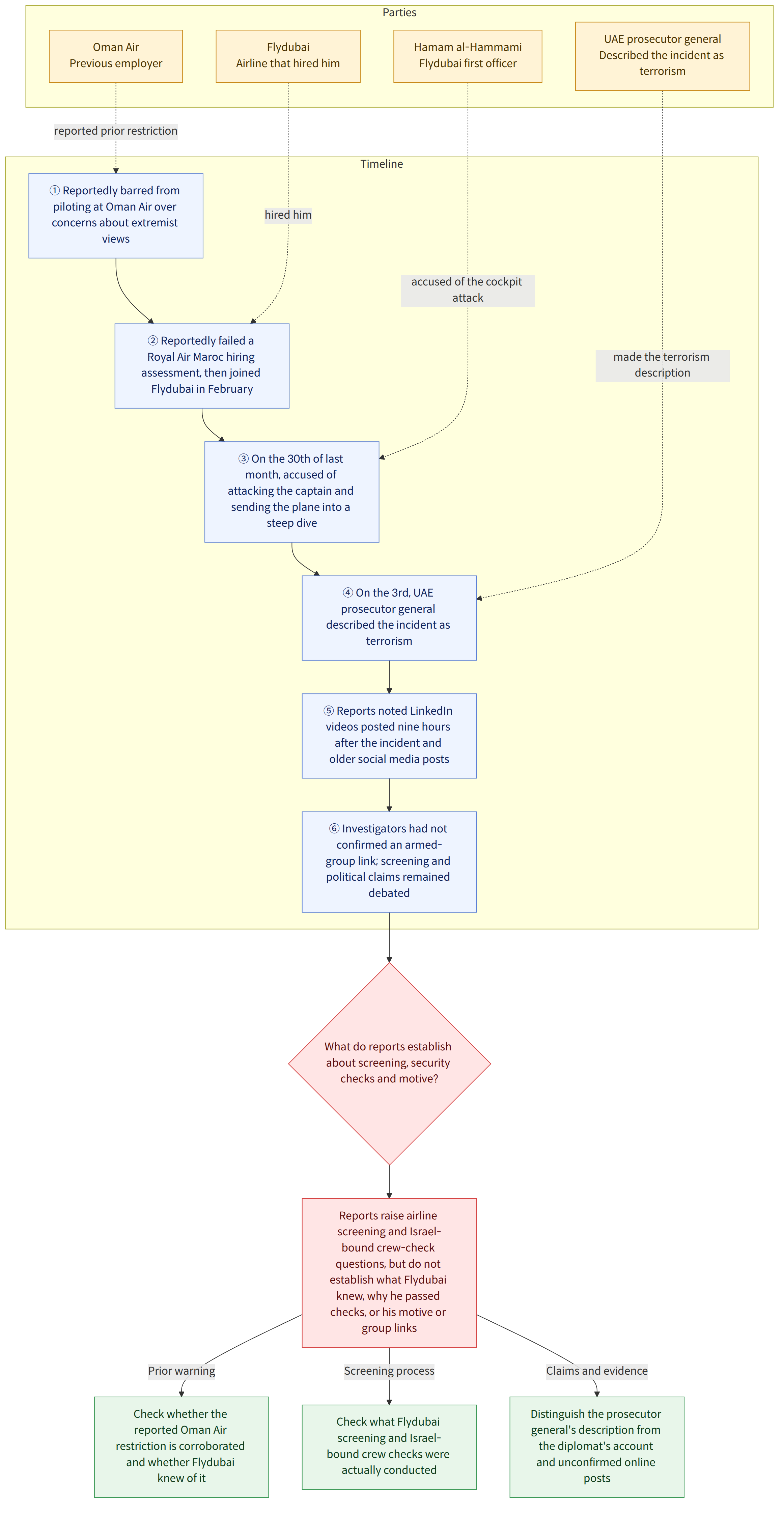
On the 30th of last month, Flydubai first officer Hamam al-Hammami tried to crash a passenger plane flying from Dubai to Tel Aviv by sending it into a steep dive, and passengers restrained him, the report said. On the 3rd, the United Arab Emirates prosecutor general said al-Hammami had attacked the captain with an emergency axe in the cockpit and tried to take control of the aircraft. He described the incident as an act of terrorism.
After the incident, attention turned to al-Hammami’s past aviation career and social media posts. However, based on the circumstances reported so far, neither his specific motive nor any relationship with an armed group can be said to have been established.
Background and context
CNN and Saudi state media reported on the 3rd that the first officer was identified as Hamam al-Hammami, 29, an Omani national. He was born in the United Arab Emirates to an Omani father and a Syrian mother and spent his early childhood there before obtaining Omani nationality.
The Associated Press, citing two sources including diplomats from Gulf countries, reported that al-Hammami had previously worked at Oman Air and was barred from piloting aircraft because of concerns about extremist views. He was subsequently transferred to an administrative role in ground operations and resigned last year. However, the views that prompted those concerns are unknown.
Reports said al-Hammami joined Flydubai in February this year after failing a three-month hiring assessment at Royal Air Maroc last year, and carried out the alleged attack after eight months on the job. This work history raises questions about what was checked during the hiring process, but the reports alone do not establish what screening Flydubai actually conducted. The report also said that a diplomat from a Gulf country told AP that Flydubai appeared to focus on criminal records and not look closely at applicants’ backgrounds, including signs of radicalization.
Online posts were also cited in the investigation and reporting. According to CNN, videos of Ayman al-Zawahiri and Humam Khalil al-Balawi appeared on al-Hammami’s LinkedIn profile on the 30th of last month, nine hours after the incident. According to the article, al-Balawi carried out a suicide bombing in Afghanistan in 2009, killing nine people, including operatives from the U.S. Central Intelligence Agency. It has not been confirmed whether the videos had been scheduled for posting before the incident.
The report also said that posts denigrating women in the name of Islamic law and other justifications were found on an old Twitter account from 2021–2022. The posts were reported alongside his previous removal from piloting duties, but whether any individual post proves his motive or an organizational link is a separate question.
What this means
The incident raises questions beyond the past of one pilot: it asks what warning signs airlines check for during hiring and how they assess that information. However, the fact that al-Hammami had previously been barred from piloting does not establish whether Flydubai knew about that record, or whether that fact alone could have prevented this incident. The diplomat’s assessment cited in the reports is an account from a source, not the same as official confirmation of the airline’s screening process.
Some have also said the incident exposed gaps in Israel’s aviation security agreements. Israel has agreements with foreign airlines to prevent pilots who are nationals of countries with which it has no diplomatic relations from flying routes to Israel, but the agreements did not screen out al-Hammami, an Omani national. This may mean that it is necessary to examine whether the nationality-based restriction was applied in the process of checking operating crew. However, the reports do not establish the agreements’ detailed application or why he was not screened out in this case.
The Gulf diplomat’s account that investigators have not confirmed links to an armed group should be distinguished from an official final conclusion. The diplomat told AP that no links had been found in the ongoing investigation, suggesting al-Hammami may have acted alone. By contrast, the UAE prosecutor general described the incident as an act of terrorism. These are accounts concerning different aspects of the case and should not be read as establishing the incident’s classification or motive.
The political fallout is also growing. Israel is scheduled to hold a general election on the 27th, and far-right ministers are calling the incident an attack by an Islamist terrorist organization as they seek support. However, the reported status of the investigation also includes a diplomat’s account that no links to an armed group have been confirmed. It is important to distinguish political characterizations from confirmed investigative facts until the investigation’s findings are final.
For example, readers who want to conclude that a particular organization directed the incident cannot do so based only on the reported timing of the videos’ posting. It has not even been established whether the videos were scheduled in advance.
Related regulations and support information
The materials provided contain no information about visas, support programs or application deadlines that readers could use in connection with this matter. An internal legal resource explains that criminal liability can depend on the specific circumstances, including the nature and purpose of the conduct. However, this resource offers general legal guidance; it does not provide a legal assessment directly applicable to the ongoing investigation in the United Arab Emirates or explain whether the allegations against al-Hammami are substantiated.
Therefore, the existence of the LinkedIn videos or past posts alone should not be taken to establish legal liability or motive. It is important to note that the circumstances of the posts and the results of the investigation must be confirmed. (Source L1)
What is known and what remains unknown
What is known
- The report said that on the 30th of last month, a first officer sent a Flydubai passenger plane flying from Dubai to Tel Aviv into a steep dive and was restrained by passengers.
- The UAE prosecutor general said that al-Hammami attacked the captain with an emergency axe and tried to take control of the aircraft.
- Sources cited by AP said that al-Hammami had previously been barred from piloting at Oman Air, transferred to a ground-based role and then resigned last year.
- According to CNN, videos were posted on al-Hammami’s LinkedIn profile nine hours after the incident, but it has not been confirmed whether they had been scheduled in advance.
- Israel has agreements restricting pilots who are nationals of countries with which it has no diplomatic relations from flying routes to Israel, but the agreements did not screen out al-Hammami, an Omani national.
What remains unknown
- What was al-Hammami’s specific motive for sending the aircraft into a steep dive?
- Were the LinkedIn videos scheduled to be posted before the incident?
- Will the investigation confirm a link between al-Hammami and an armed group?
- What background checks did Flydubai conduct when hiring him, and did it know about his previous ban on piloting at Oman Air?
- Why did Israel’s airline agreement not take effect during this flight?
What readers should check
- In follow-up reports, distinguish the basis and timing of statements by prosecutors from those made by anonymous sources, including diplomats.
- Check the posting time of the LinkedIn videos and whether they were scheduled in advance, as well as what authorities say about the motive and any links to an armed group.
- If further explanations emerge about airline screening or Israel’s agreements, check whether the procedures and responsibility have been officially confirmed.