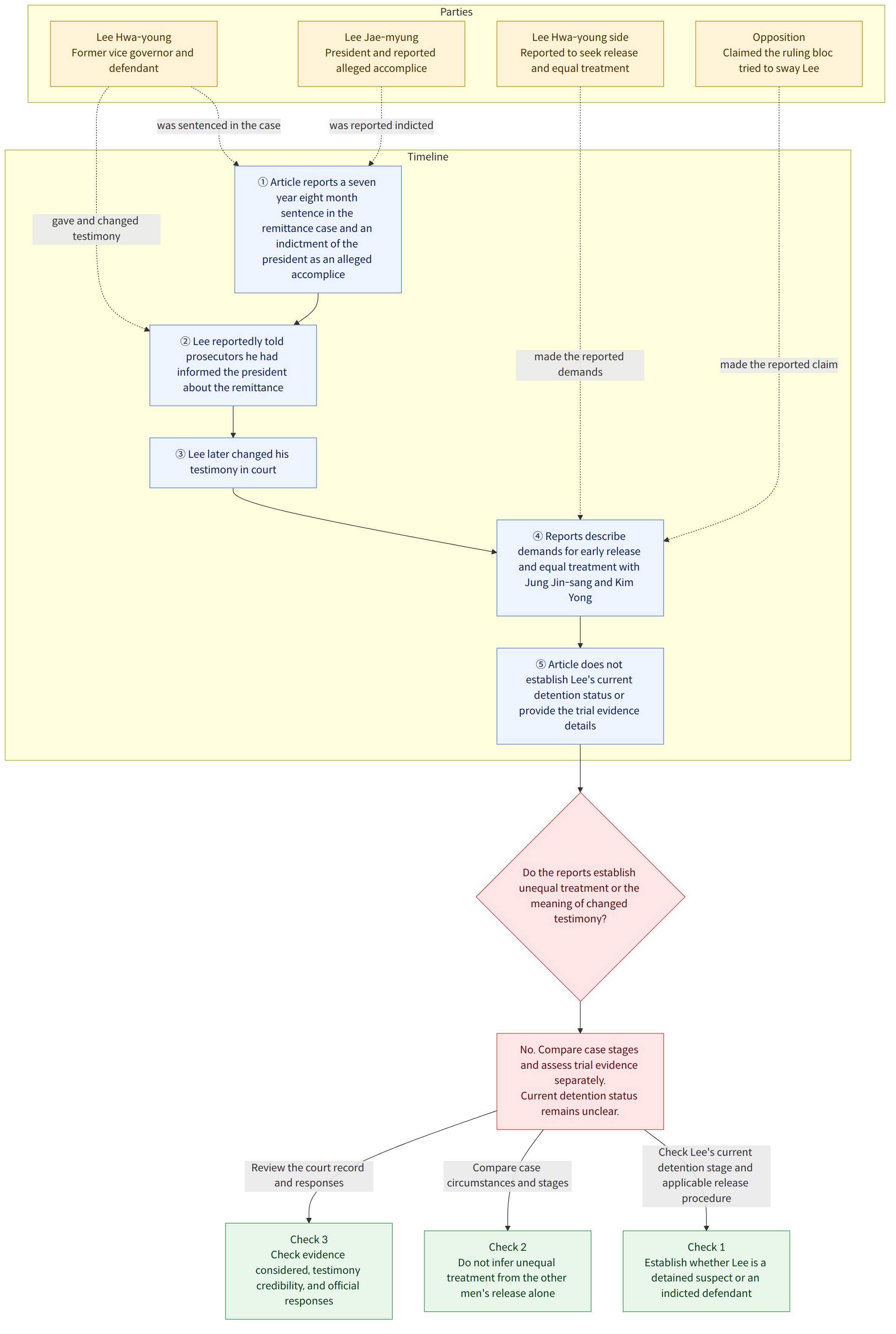
Reports say former Gyeonggi Province vice governor Lee Hwa-young’s side is pressuring President Lee Jae-myung by raising the issues of release and equal treatment. The reports described the lawyer as expressing dissatisfaction with the ruling bloc while Lee Hwa-young takes a conciliatory tone toward the president. They also summarized the message as a demand for an early release, no differential treatment compared with Jung Jin-sang and Kim Yong, and a warning that they would respond otherwise.
This matter involves both political sparring and questions about testimony and criminal procedure in the case involving remittances to North Korea. However, the article alone does not establish Lee Hwa-young’s current detention status or whether he has been released, nor does it provide the official positions of the president and the ruling bloc.
Background and context
According to the reports, Jung Jin-sang and Kim Yong were arrested in connection with the Daejang-dong corruption case, then released on bail and subsequently became active in politics in public. The reports said Lee Hwa-young’s side compares him with the two men and objects to what it sees as differential treatment. However, the article does not say that their cases and stages of trial are the same, so their release alone is not enough to conclude that they have been treated unequally under the law.
Regarding the case involving remittances to North Korea, the article said that while serving as Gyeonggi Province vice governor, Lee Hwa-young acted as a channel for arranging President Lee’s visit to North Korea and was sentenced to seven years and eight months in prison on charges of involving Kim Seong-tae, the former chair of Ssangbangwool, and arranging a large remittance to North Korea. President Lee was also reported to have been indicted as an alleged accomplice in conspiring to make illegal remittances to North Korea. These are the article’s descriptions of the charges, indictment and sentence; this information alone does not allow a new determination of any party’s guilt.
The article said Lee Hwa-young testified during a prosecution investigation that he had reported the remittance to President Lee, then changed his testimony in court. It also reported that the opposition claims the ruling bloc tried to sway him through various means. The alleged attempt to sway him is presented as the opposition’s claim; the article includes no materials to substantiate it and no response or explanation from the ruling bloc.
What this news means
Politically, the questions of release and equal treatment could fuel debate over how the ruling bloc responds. Conversely, if political figures appear to be involved in Lee Hwa-young’s demands, there is a risk that criminal proceedings could be seen as an object of political bargaining. The article alone does not establish what is actually happening, so its descriptions of “push-and-pull” or a “dilemma” should be read as the article’s interpretation, not as established fact.
From the perspective of the trial, the key point is that the fact that testimony changed does not, by itself, determine its evidentiary value. Whether a written record of testimony can be used as evidence in court and whether the testimony is credible must be considered separately. Assessing the significance of the changed testimony therefore requires information about what evidence was submitted and considered in court, but the article does not provide those details.
For example, a defendant who has been indicted and is on trial can apply for bail (보석) if they want to be released. But the court determines whether to grant it and under what conditions by considering the specific circumstances, and the article alone does not establish what procedure currently applies to Lee Hwa-young.
Relevant procedures and support information
According to an internal legal guide, the procedure for seeking release depends on the stage of detention. A suspect detained during an investigation can request a review of the legality of detention (구속적부심사), a procedure in which a court determines whether the detention is lawful and remains necessary. A defendant who has been indicted can apply for bail. The two procedures apply to different people and at different stages, so the means of seeking release should not be assumed without first establishing the current stage of the case.
Even if bail is granted, it does not mean unconditional release. The court may set conditions, such as a promise to appear or restrictions on residence. If the defendant fails to appear in court without a valid reason or violates the conditions, bail may be revoked and all or part of the security deposit may be forfeited. Whether the general procedures described in the guide apply to this case must be established by checking the current case record and the court’s decision.
The question of testimony should also be considered separately. The guide explains that, in the case of a written record of a suspect’s interrogation prepared by a prosecutor, issues in court may include whether the record’s form and contents accurately reflect the testimony and whether the testimony was given under circumstances that make it particularly credible. Whether evidence is admissible and whether its contents are credible are separate questions, so the fact alone that testimony given during a prosecution investigation differs from testimony in court does not settle its admissibility or establish guilt.
The article does not state Lee Hwa-young’s current stage of detention or whether the court has decided on his release. Until it is established whether a review of the legality of detention or bail is available, or whether a decision has already been made, there is no basis to conclude that he “will be released soon.”
What is known and what remains unknown
What is known
- Reports say Lee Hwa-young’s side is demanding his release and equal treatment with Jung Jin-sang and Kim Yong.
- According to the reports, Jung Jin-sang and Kim Yong were released on bail and have since been active in politics in public.
- The article said Lee Hwa-young was sentenced to seven years and eight months in prison on charges related to remittances to North Korea, and that President Lee was also indicted as an alleged accomplice in the related case.
- The article reported that Lee Hwa-young changed in court testimony he had given during a prosecution investigation.
- The opposition’s claim that he was swayed is presented in the article as the opposition’s claim.
What remains unknown
- The article does not state Lee Hwa-young’s current detention status or whether he has been released.
- The specific remarks or demands reportedly conveyed to the president recently have not been established.
- The article does not say what position the president or the ruling bloc has taken on these demands or the allegations that he was swayed.
- The article does not explain how the changed testimony actually affected the assessment of evidence at trial.
- The subtitle alone does not establish whose specific plan the proposal to withdraw the indictment refers to, or whether it is actually being pursued.
What readers should check
- When assessing whether Lee Hwa-young will be released, readers should distinguish political language in reports from actual court decisions and the current stage of the proceedings.
- The testimony dispute should be examined not only in terms of what was said during the prosecution investigation, but also separately in terms of whether it was admitted as evidence in court and how its credibility was assessed.
- The allegations that he was swayed and the proposal to withdraw the indictment should each be distinguished as claims versus confirmed proceedings, and readers should check whether the official positions of the parties involved and the ruling bloc have been reported.